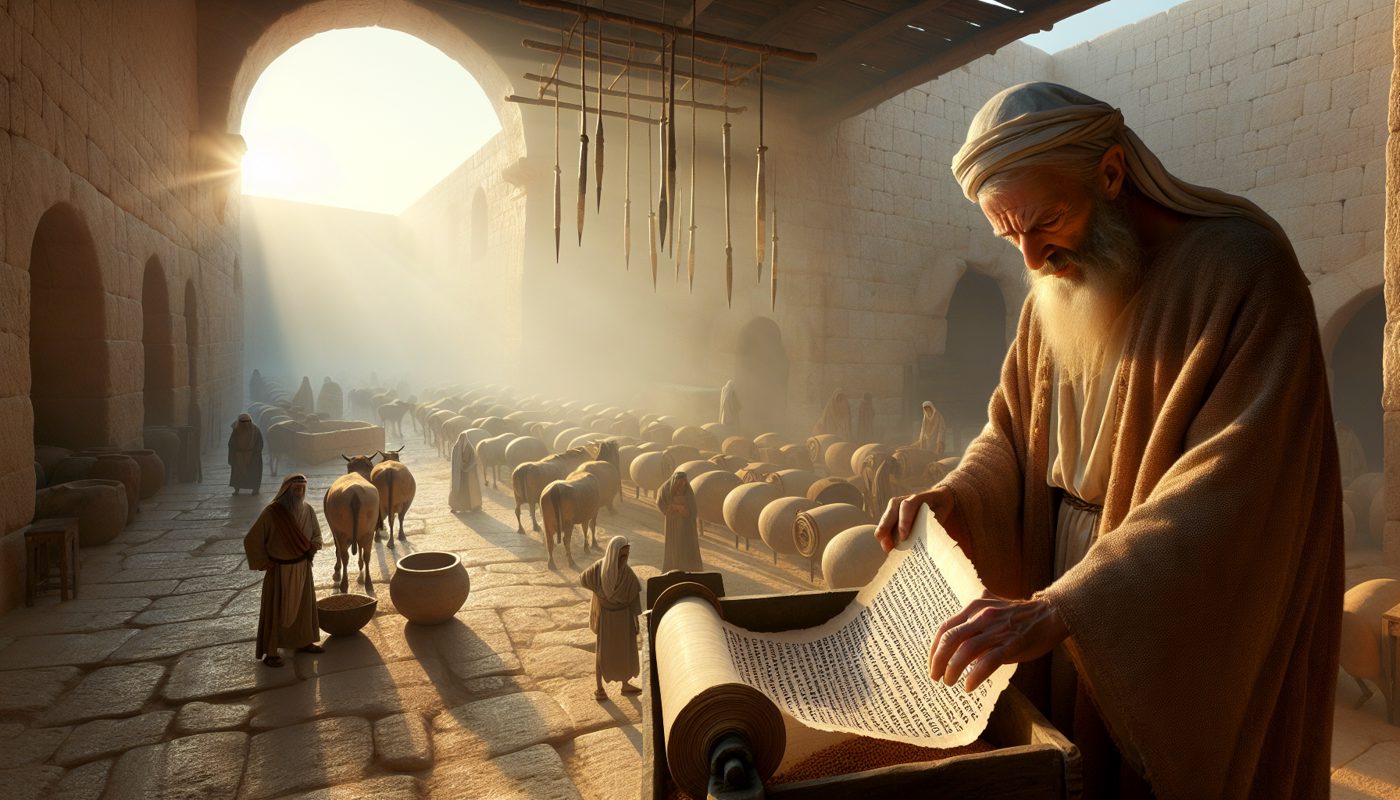
The chapter opens with a statement of fact so plain it almost conceals its weight: King Solomon was king over all Israel. The phrase is not decorative. It is the foundation on which the entire administrative list that follows is built. The kingdom is whole, and the king’s authority is unquestioned.
What follows is not a story in the usual sense. It is a ledger of names and titles, a bureaucratic skeleton of a realm at peace. Azariah son of Zadok is priest. Elihoreph and Ahijah, sons of Shisha, are scribes. Jehoshaphat son of Ahilud is recorder. Benaiah son of Jehoiada commands the army. The list continues with precision: officers over the household, over the forced labor, over the twelve districts that supply the king’s table one month each year.
The twelve officers are named one by one, each with his assigned territory. Ben-hur in the hill country of Ephraim. Ben-deker in Makaz, Shaalbim, Beth-shemesh, and Elon-beth-hanan. Ben-hesed in Arubboth, Socoh, and the land of Hepher. The geography is specific, the boundaries real. Two of these officers married daughters of Solomon: Ben-abinadab in the height of Dor, and Ahimaaz in Naphtali. The system is personal as well as political.
These men were not governors in the modern sense. Their charge was provision: grain, livestock, oil, and fodder for the king’s household and his vast stable of horses. Each officer served one month out of the year. The text is careful to note that they let nothing be lacking. The machinery worked.
And what did that provision look like? The daily tally is staggering: thirty measures of fine flour, sixty measures of meal, ten fat oxen, twenty pasture-fed oxen, a hundred sheep, and game besides—harts, gazelles, roebucks, and fatted fowl. This was not a king eating alone. The table served the entire household and all who came to it.
The scale of the kingdom’s resources is matched by the scale of its peace. Judah and Israel were many as the sand by the sea, eating, drinking, and making merry. Every man sat under his own vine and his own fig tree, from Dan to Beersheba, all the days of Solomon. The phrase is not poetry. It is the summary of a political reality: security so complete that the ordinary life of the farmer and the vintner became the emblem of the age.
Solomon’s dominion stretched from the Euphrates River to the border of Egypt. Kings brought tribute and served him all his life. He had peace on all sides. The forty thousand stalls of horses and twelve thousand horsemen were not for conquest but for display and deterrence. The kingdom was not expanding; it was resting.
Then the chapter turns. The list of officers and the inventory of abundance give way to a different kind of account. God gave Solomon wisdom and understanding exceeding much, and largeness of heart, as the sand on the seashore. His wisdom surpassed the famed sages of the east and of Egypt. He was wiser than Ethan the Ezrahite, Heman, Calcol, and Darda—names that carried weight in the ancient world but are now only echoes in this text.
Solomon spoke three thousand proverbs and a thousand and five songs. He spoke of trees, from the cedar of Lebanon to the hyssop that grows out of the wall. He spoke of beasts, birds, creeping things, and fish. His knowledge was not abstract. It was catalogued, named, and ordered—like the twelve officers and their districts, like the daily provision and the monthly rotations.
And people came. From all peoples, from all kings of the earth who had heard of his wisdom, they came to hear him. The chapter does not say what they heard. It does not record a single proverb or a single song. What it records is the fact of the coming, the reach of the fame, and the silence of the king’s actual words. The ledger of peace is complete, and the wisdom that made it possible is left unnamed, unquoted, and known only by its effects.
Comments
Comments 0
Read the discussion and add your voice.
Members only
Sign in to join the conversation
We keep comments tied to real accounts so the discussion stays clean and trustworthy.
No comments yet. Be the first to add one.