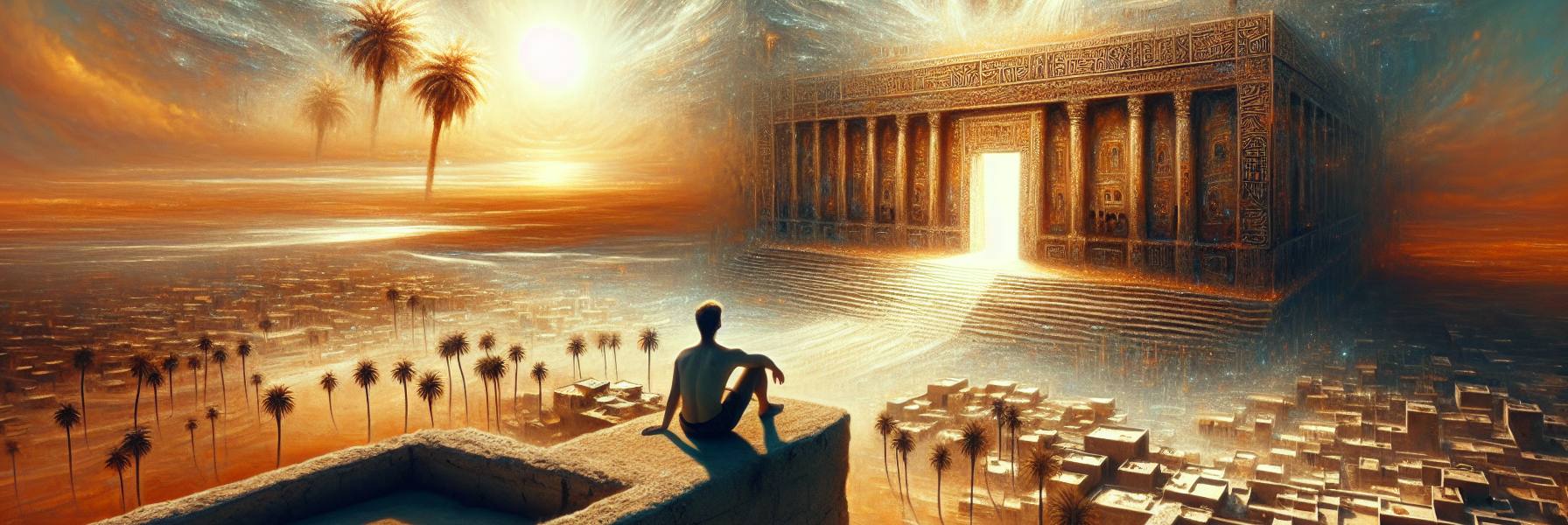

The heat in the air wasn’t just weather; it was a presence. It rose from the desert floor south of the city in shimmering, deceitful waves, making the distant palms dance like drunkards. I sat on the flat roof of my house, my back against the rough plaster of the parapet, but I wasn’t seeing my own dusty courtyard below. My eyes were turned inward, toward a country of the mind I had never walked, yet knew with a dread certainty.
A word had been placed upon me, heavy as a millstone around the neck of a drowned man. “The burden of the desert of the sea.” A contradiction. A desert that was a sea. My spirit understood before my mind did: Babylon. That vast, watered plain, a desert of human pride, a sea of nations swallowed by it.
The vision didn’t come as a clean picture. It was fragments, sensations, crashing in like a storm from the north. I felt the whirlwinds sweeping through the southland—Elam, Media—rising up, mustering. A searing pain gripped my guts, a labor pain with no child to show for it. I bent double on the rooftop, the baked clay tiles digging into my knees. I was twisted by what I heard, terrified by what I saw.
The twilight I loved, that gentle pause between day and night, became a horror. They had set a table, the lords of Babylon. I saw the spread—rich meats, shining goblets, garlands on their heads. Laughter thick with wine and power. “Arise, princes!” one slurred, “oil the shields!” A feast in the very shadow of the siege. The blindness of them, polishing bronze while the earth shook.
And then, the command to me, clear as a shout in a tomb: “Go, set a watchman. Let him declare what he sees.”
So I went, in the vision. I became the watchman. I stood on a bare, windy tower on a wall that seemed to stretch forever across the flat earth. My eyes ached with peering. The duty was endless. Day after long day, I stood while the sun scorched me, and through the chilling nights where the desert stars judged in cold silence.
Then—movement. A swirl in the distant dust. My heart hammered against my ribs. A man riding, then another. Horsemen in pairs. I strained, my hand a visor over my brow. They came on, urgent, driving their beasts. And then he cried out, the lead rider, his voice carried on the wind like the smell of smoke:
“Fallen! Babylon is fallen! And all the carved images of her gods lie shattered on the ground!”
The words hit me like a physical blow. The news was final. Absolute. The great hammer of the earth was broken. The sound of it—the crumbling of impossible walls, the guttering out of a thousand lamps—echoed in the hollow of my soul.
I sank down from my watchpost, my own body back on my Jerusalem roof, but the vision held me still. A second command, raw and immediate: “O my threshed and winnowed one, what I have heard from the Lord of hosts, the God of Israel, I have declared to you.”
But the vision wasn’t done. It turned, like a fever-dream shifting. Now the voice spoke of Edom, our kin to the southeast. “A watchman, what of the night? Watchman, what of the night?” they called, a desperate, repetitive plea from Seir. How long the terror? How long until morning?
And the watchman’s answer was bleak, a draught of cold water to a man burning with fever: “Morning comes, but also night.” A reprieve, then more darkness. A cycle without end. “If you will inquire, inquire; come back again.”
The last fragment was the starkest, a single line of divine attention turned like a burning glass toward a barren place. “The burden upon Arabia.” A caravansary in the thickets of the desert, a temporary safety for the Dedanite traders. But no safety remained. I saw them, bringing water to the thirsty, their bread shared with the fugitives. They were caring for those fleeing the sword, the drawn sword, the bent bow, the press of battle.
And the Lord’s word was simply this: “Within a year, according to the years of a hired worker, all the glory of Kedar will come to an end. The archers, the mighty men of Kedar, will be diminished.” No grand battle scene. Just a date, a contract’s length, and an end. The resilience of the desert tribes, their fierce pride, would simply… expire. Like a lamp without oil.
The vision left me. The Jerusalem sun was lower now, casting long, forgiving shadows. The heat had eased. But the millstone weight remained. I was empty, scoured out. I had seen the unraveling of worlds, the sure and terrible truth that pride is a wall of mud before the flood, that feasts are held on the edge of the abyss. The message was given. The burden was lifted from the Lord’s hand and now rested squarely, wearily, on my own shoulders. There were no neat conclusions. Only the image of shattered idols in the dust, and the echo of a watchman’s cry carried on a wind that smelled of smoke and ending.