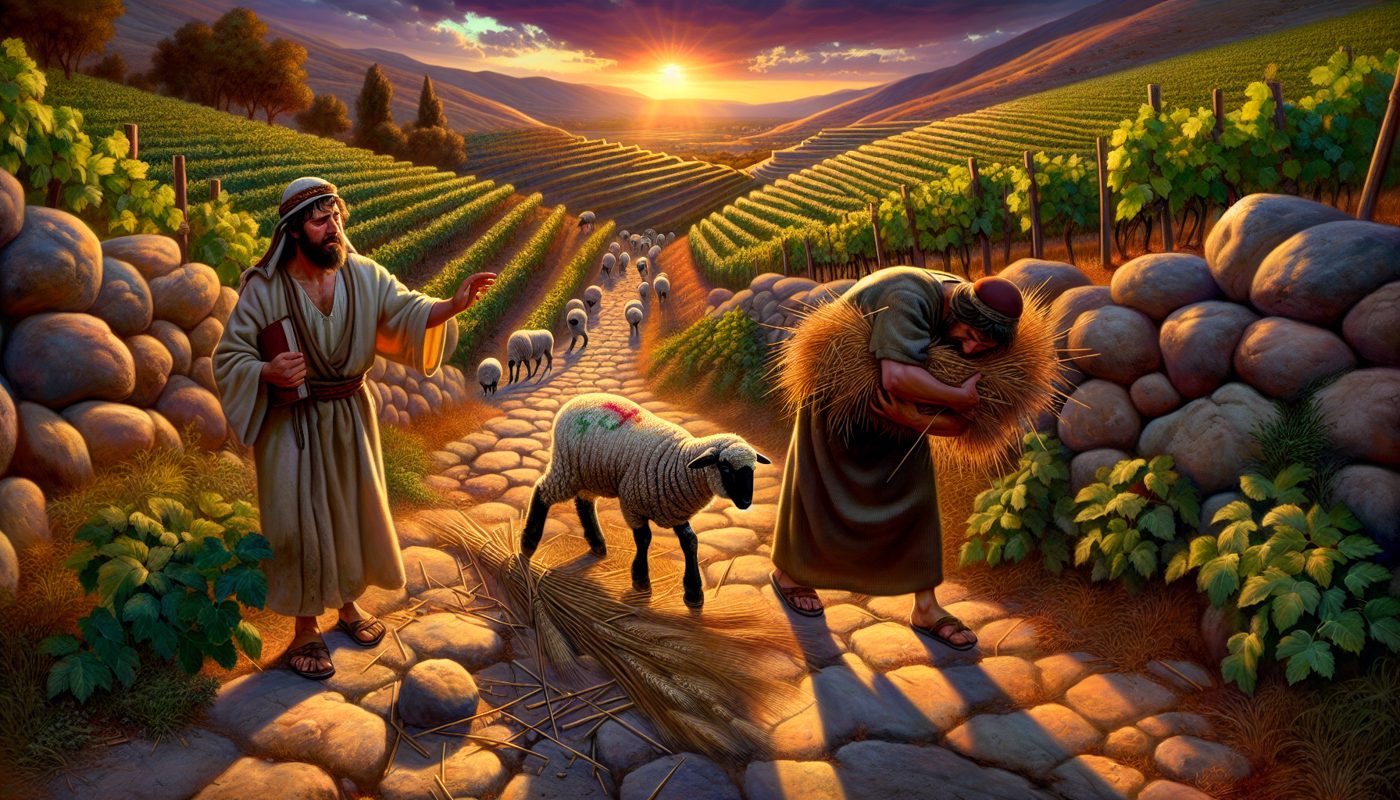
Deuteronomy 22 opens with a command that seems simple enough: if you see your brother's ox or sheep straying, you must not ignore it. You are to bring it back. If the owner is far off or unknown, you keep the animal at your own house until he comes looking for it. The same rule applies to a lost donkey, a lost garment, any lost thing. The law does not permit a man to pretend he saw nothing. The obligation is active, and it falls on anyone who finds what belongs to another.
This principle extends to a fallen animal. If you see your brother's donkey or ox collapsed on the road, you are not to walk past. You must help lift it up. The law treats neglect as a form of concealment. To hide yourself from the need is to treat your brother's loss as none of your concern, and the law will not allow that.
Then the chapter shifts sharply. A woman must not wear what pertains to a man, and a man must not put on a woman's garment. The reason given is blunt: whoever does these things is an abomination to the Lord. No further explanation is offered. The distinction between the sexes is treated as something the Lord has established, and the law protects that boundary without apology.
From there the law moves to a bird's nest. If you find a nest with young or eggs and the mother sitting on them, you may take the young, but you must let the mother go. The promise attached is that it may go well with you and you may prolong your days. The command is not about conservation in a modern sense. It is about restraint in the face of what is vulnerable and generative.
When you build a new house, you must make a battlement for the roof. The reason is practical: so that no one falls from it and you bring bloodguilt on your house. The law treats the builder as responsible for the safety of anyone who might walk on that roof. Negligence is not excused by ownership.
A series of prohibitions follows. You must not sow your vineyard with two kinds of seed, or the whole yield will be forfeited. You must not plow with an ox and a donkey together. You must not wear cloth woven from wool and linen mixed. And you must make fringes on the four corners of the garment you wear. These commands resist mixture and demand distinction. The fringes serve as a visible marker of identity, but the text does not elaborate on their meaning beyond the command itself.
The second half of the chapter turns to sexual offenses, and the tone becomes severe. If a man marries a woman, lies with her, and then accuses her of not being a virgin, the law requires evidence. The parents of the woman must bring the tokens of her virginity to the elders at the city gate. If the garment is produced and the accusation is proven false, the man is chastised, fined a hundred shekels of silver paid to the father, and he may never divorce her. He has slandered a virgin of Israel, and the law binds him to her for life.
But if the accusation is true—if the woman was not a virgin—then she is brought to the door of her father's house, and the men of the city stone her to death. The reason given is that she has committed folly in Israel by playing the harlot in her father's house. The law does not soften this. It calls for the evil to be purged from Israel.
Adultery is treated with equal severity. If a man lies with a married woman, both are put to death. If a man lies with a virgin betrothed to another man in the city, both are stoned at the gate, because the woman did not cry out for help where help could be heard. But if the same act happens in the field, only the man dies. The woman is presumed to have cried out with no one to save her, and she is not held guilty.
If a man lies with a virgin who is not betrothed, he must pay fifty shekels of silver to her father, and she becomes his wife. He may never divorce her. The law does not treat this as a casual arrangement. The man has humbled her, and the marriage is permanent.
The chapter ends with a single verse: a man shall not take his father's wife, nor uncover his father's skirt. The prohibition is terse and final. The law does not argue or explain. It simply draws a line that must not be crossed.
What holds this chapter together is not a single theme of compassion, though compassion appears in the opening commands. The chapter is a collection of boundaries—between what is yours and what is your brother's, between male and female, between the mother bird and her young, between the roof and the ground, between seeds and fabrics, between the innocent and the guilty, between the married and the unmarried, between a man and his father's wife. The law treats these boundaries as serious because the Lord treats them as serious. The penalty for crossing them is not always death, but the pattern is consistent: the Lord's people are to live with distinction, not with mixture, and they are to answer for what they ignore or defile.
Comments
Comments 0
Read the discussion and add your voice.
Members only
Sign in to join the conversation
We keep comments tied to real accounts so the discussion stays clean and trustworthy.
No comments yet. Be the first to add one.