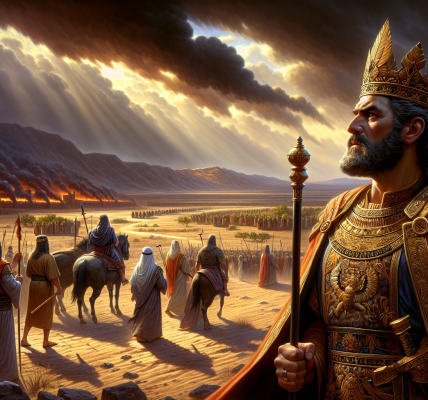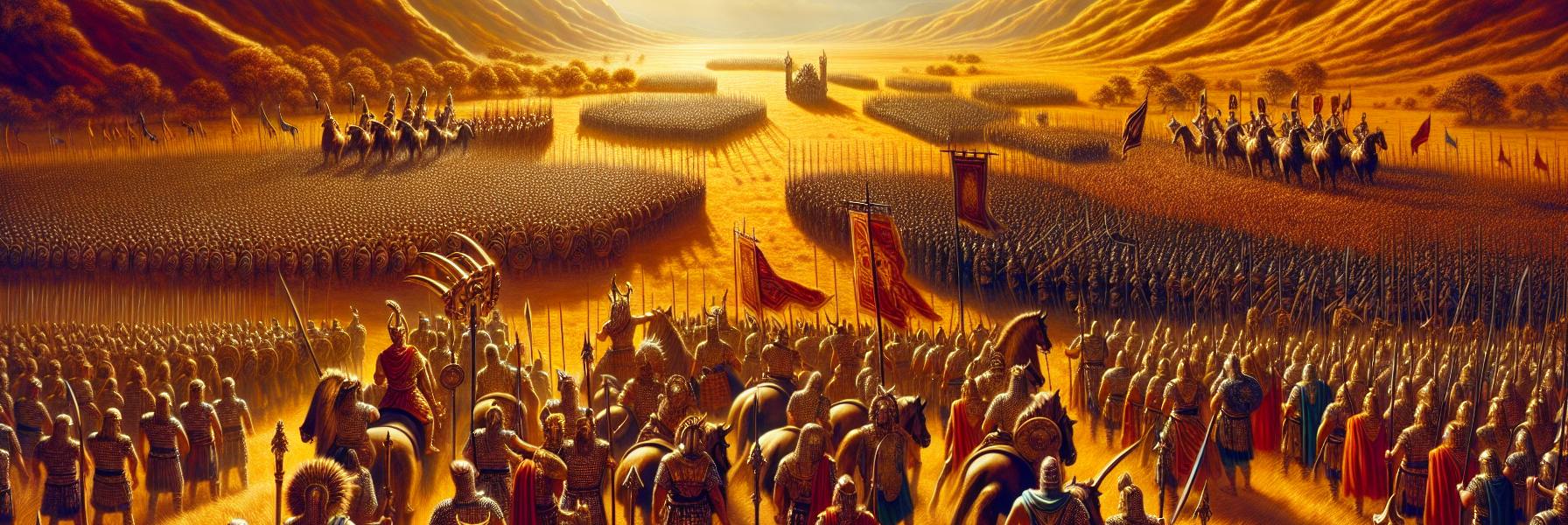

The heat in the fields of Zemaraim was a thick, woolen blanket. It pressed down on the two armies, making the polished bronze of shield and breastplate too hot to touch comfortably, and causing the air above the parched ground to shimmer. On one slope stood Jeroboam, King of Israel, with eight hundred thousand chosen men—a sea of spears and tribal banners fluttering in the listless air. His force was vast, seasoned, and confident. They had broken away from the house of David, and their king had made his own gods: calves of gold in Bethel and Dan. The priests who served them were not Levites, but anyone Jeroboam chose, consecrated for a bull and a handful of grain.
Across the valley, on the slopes of the hill country of Ephraim, stood Abijah, King of Judah. His force was smaller—half the size, and some said, half the heart. He was a young king, this grandson of Solomon, and the weight of his crown felt heavier today than the helmet he wore. He could see the doubt in the eyes of his commanders. They were outnumbered, outflanked, and far from the walls of Jerusalem.
But Abijah felt a fire in his chest that had little to do with the sun. It was a spark passed down, a memory of a covenant. He climbed onto a large, flat stone, his voice not yet a king’s roar, but clear and cutting through the heavy silence.
“Hear me, Jeroboam and all Israel!” he called out, the words carrying across the still valley. “Do you not know that the Lord, the God of Israel, gave the kingship over Israel forever to David and his sons by a covenant of salt? Yet Jeroboam, the son of Nebat, a servant of Solomon, rose up and rebelled against his lord.”
He spoke not just to the enemy, but to his own trembling men. He recounted history they all knew—the split, the rebellion, the golden calves. His voice grew stronger, painting a picture not of politics, but of apostasy.
“And now you think to withstand the kingdom of the Lord in the hand of the sons of David,” Abijah continued, his hand sweeping toward his own ranks. “Because you are a great multitude and have with you the golden calves that Jeroboam made you for gods. Have you not driven out the priests of the Lord, the sons of Aaron and the Levites, and made priests for yourselves like the peoples of other lands?”
He paused, letting the accusation hang. A few of the Israelite soldiers shifted uncomfortably. The truth, even shouted from an enemy hillside, has a weight of its own.
“But as for us,” Abijah declared, and now his voice carried a fierce pride, “the Lord is our God, and we have not forsaken him. We have priests ministering to the Lord who are sons of Aaron, and Levites for their service. They offer to the Lord every morning and every evening burnt offerings and fragrant incense. We keep the charge of the Lord our God, but you have forsaken him.”
He looked at his own men, meeting their eyes. “Behold, God is with us at our head, and his priests with their battle trumpets to sound the call to arms against you. O sons of Israel, do not fight against the Lord, the God of your fathers, for you cannot succeed.”
Silence followed. It was not the silence of awe, but of stunned contempt. From the Israelite lines came a single, derisive laugh, then a chorus of shouts and the chilling scrape of swords being drawn. Jeroboam had heard enough. While Abijah was still speaking, he had sent a detachment of his best troops to slip through the wooded ravines and come around behind Judah’s army. The speech was just a distraction.
The ambush was sprung. Suddenly, shouts of alarm rose from Judah’s rear. They were surrounded, the Israelite force surging forward from the front even as the hidden column attacked from behind. For a moment, sheer panic seized Abijah’s army. The neat lines wavered like wheat in a storm. All the pious words seemed about to be buried under the hammer of military reality.
Then the priests, the sons of Aaron, did as Abijah had said they would. They had not come to fight with sword and spear. They lifted the silver trumpets to their lips and blew a long, piercing blast—not a call to retreat, but the *teruah*, the war-cry of the Lord. The sound cut through the din of clashing metal and screaming men.
And something broke.
It was not a visible thing, not a lightning strike from a clear sky. It was a turning of the tide, a sudden souring of courage in the heart of Israel. The men of Judah, hemmed in and fighting for their very lives, found a second wind. They roared, not in desperation, but in a kind of furious faith, and pressed back against the forces to their front. The Israelite advance, so confident a moment before, stalled. Then it fractured.
Jeroboam, from his vantage point, saw his mighty army begin to falter. The men of Judah fought like men possessed, and his own soldiers seemed to shrink from them, their arms growing heavy, their coordination dissolving into a confused melee. The tide turned with a swiftness that was terrifying. The ambushing force at the rear was now itself cut off and overwhelmed.
It became a rout. The army of Israel broke and ran, a torrent of fleeing men flooding back toward their own towns, throwing down their shields and spears to run faster. The men of Judah pursued, the energy of deliverance fueling them. The slaughter was great. Five hundred thousand of Israel’s chosen men fell that day, a number so vast it was less a military loss and more a divine judgement written in blood upon the hills.
Abijah, breathing hard, the adrenaline still screaming in his veins, watched the pursuit fade into the dust-choked distance. He had not been a brilliant tactician; his plan had failed. He had simply stood and declared a truth, and then witnessed that truth defend itself. They took the cities of Bethel, Jeshanah, and Ephron from Jeroboam, towns with their fields and vineyards. For a time, the border was secure. Jeroboam, broken in strength and spirit, did not recover his power in the days of Abijah. Eventually, the Lord struck him down, and he died.
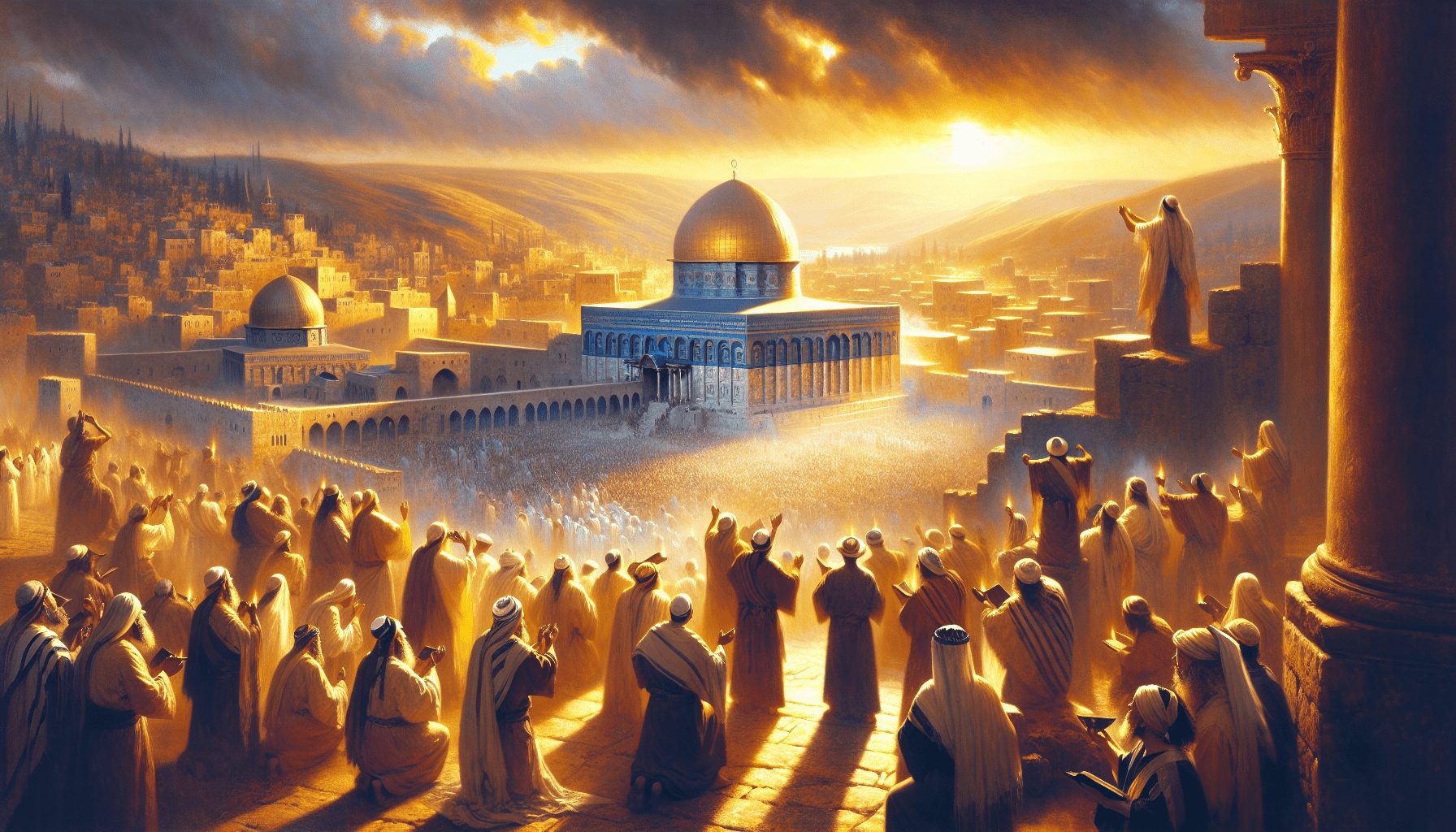
In Jerusalem, the victory was celebrated. But Abijah, in the quiet of his chamber, did not feel like a mighty conqueror. He felt like a man who had stood on a rock, spoken of the covenant, and then been caught in the terrifying, merciful current of a promise kept. The power was not his. It never had been. He had simply, for one desperate moment, remembered whose side he was supposed to be on. The memory of the trumpet blast, and the way the enemy’s courage had melted like wax before a flame, would haunt him with a grateful awe for the rest of his days.