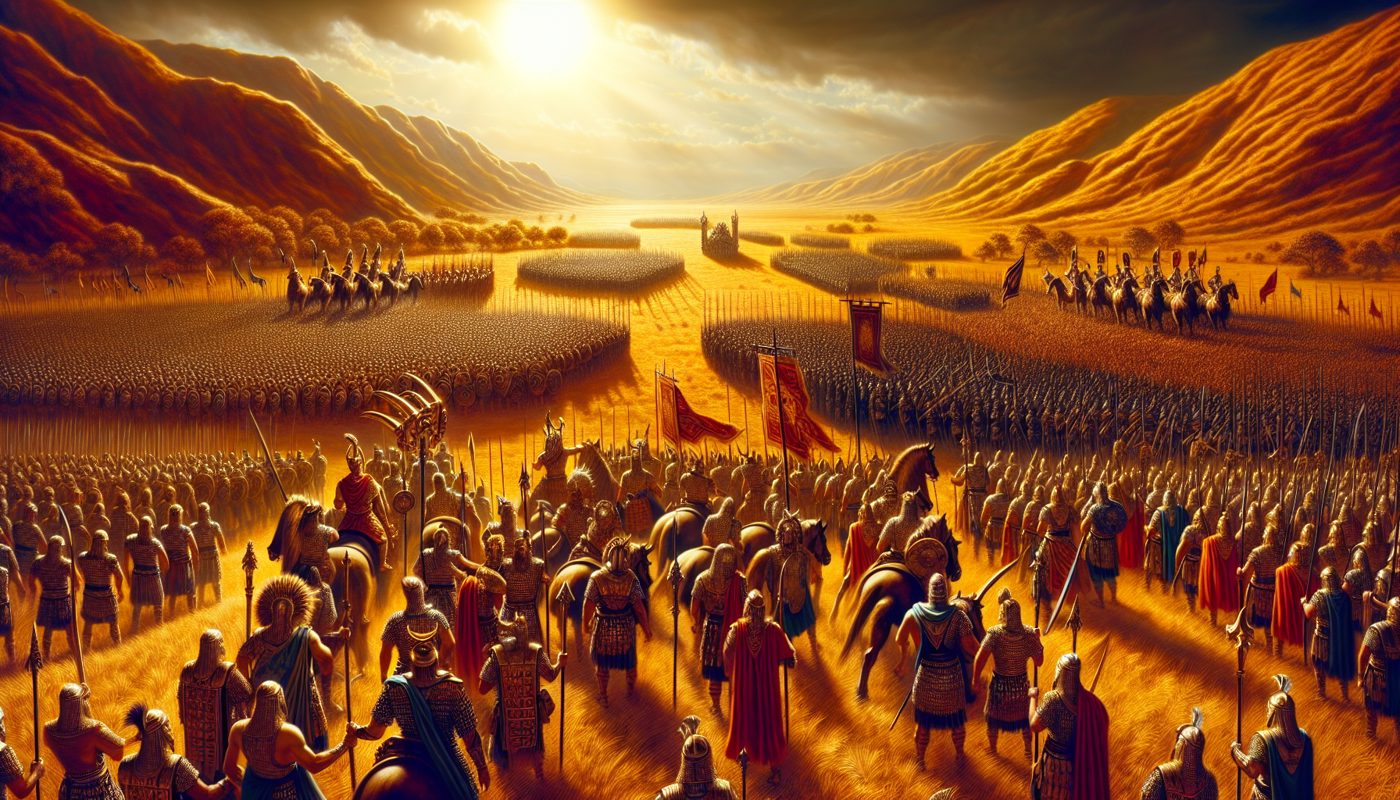
The battle lines were drawn on the slopes of Mount Zemaraim, in the hill country of Ephraim. Abijah, king of Judah, had four hundred thousand chosen men. Jeroboam, king of Israel, had eight hundred thousand. The numbers alone told a story of odds that pressed hard on the smaller army. But Abijah did not speak first of numbers. He stood up on the mountain and called out to Jeroboam and all Israel, demanding that they hear him.
His speech was a direct challenge to the legitimacy of the northern kingdom. He reminded them that the Lord, the God of Israel, had given the kingdom to David and his sons forever, by a covenant of salt. That phrase—covenant of salt—carried the weight of permanence and preservation. Salt sealed agreements. It meant the promise was not to be broken. Yet Jeroboam, the son of Nebat, a servant of Solomon, had rebelled against his lord.
Abijah did not mince words about the men who had gathered around Jeroboam. He called them worthless men, base fellows, who had strengthened themselves against Rehoboam when Rehoboam was young and tender-hearted and could not withstand them. The rebellion was not a righteous uprising. It was a seizure of power by men who had no claim to it.
Then Abijah turned to the religious state of Israel. He pointed directly at the golden calves that Jeroboam had made for gods. He accused Israel of driving out the priests of the Lord, the sons of Aaron, and the Levites. In their place, Jeroboam had made priests after the manner of the peoples of other lands. Any man who came with a young bull and seven rams could be consecrated as a priest of things that were no gods at all.
Abijah drew a sharp contrast. For Judah, the Lord was their God, and they had not forsaken him. Their priests were the sons of Aaron, and the Levites performed their work. Every morning and every evening they burned burnt offerings and sweet incense. They set the showbread in order on the pure table. They lit the golden candlestick every evening. They kept the charge of the Lord their God. Israel had forsaken him.
Then Abijah made his boldest claim: God was with Judah at their head, and his priests had the trumpets of alarm to sound against Israel. He warned the children of Israel not to fight against the Lord, the God of their fathers, for they would not prosper. It was a speech that staked everything on the covenant and the worship that honored it.
Jeroboam did not answer with words. He answered with tactics. While Abijah was still speaking, Jeroboam set an ambush to come about behind Judah. The men of Judah suddenly found themselves caught between the main force of Israel in front and the ambush behind. The battle was before them and behind them. It was a moment that could have broken a lesser army.
But Judah did not break. They cried out to the Lord. The priests sounded the trumpets. Then the men of Judah gave a shout. And as they shouted, God smote Jeroboam and all Israel before Abijah and Judah. The children of Israel fled, and God delivered them into the hand of Judah. The slaughter was great: five hundred thousand chosen men of Israel fell dead on that field.
The chronicler gave the reason plainly: the children of Judah prevailed because they relied upon the Lord, the God of their fathers. It was not their numbers or their strategy that won the day. It was their trust in the covenant that Abijah had proclaimed from the mountain. And they did not stop at the battle. Abijah pursued Jeroboam and took cities from him: Bethel with its towns, Jeshanah with its towns, and Ephron with its towns.
Jeroboam never recovered strength in the days of Abijah. The Lord struck him, and he died. Abijah, for his part, waxed mighty. He took fourteen wives and fathered twenty-two sons and sixteen daughters. The rest of his acts, his ways, and his sayings were written in the commentary of the prophet Iddo. The chapter ends with that quiet note—a record kept, a prophet who wrote it down, and a king who had stood on a mountain and spoken the truth into the face of a much larger army.
Comments
Comments 0
Read the discussion and add your voice.
Members only
Sign in to join the conversation
We keep comments tied to real accounts so the discussion stays clean and trustworthy.
No comments yet. Be the first to add one.