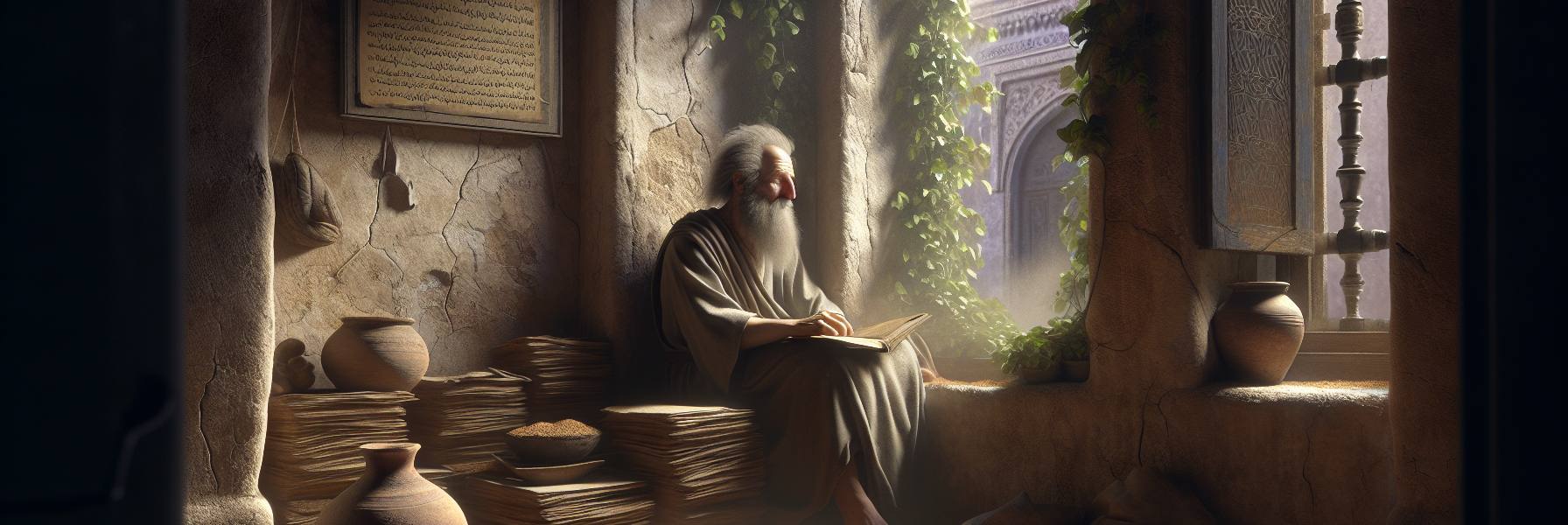

The air in the small chamber was still and close, thick with the smell of old parchment and dry clay. Ezekiel sat by the open window, but no breeze came from the east, only the unrelenting afternoon heat that made the dust in the alleyways glow like finely ground brass. His bones ached, a familiar ache that had nothing to do with his years and everything to do with the weight of the word that settled upon him, a weight like a millstone hung around his spirit.
He had been thinking of vines. Not the lush, fruitful ones of the old songs, the ones that spoke of climbing up walls and bursting with clusters. No. His mind kept snagging on a particular memory from his youth, before the exile, before the bronze walls and the stranger’s bread. He remembered a farmer, a neighbor out near Anathoth, clearing a scraggly plot of land. The man had torn out an old, neglected vine. It wasn’t a tree, never had been. It was a gnarled, twisty thing, all tendon and knot, that had produced nothing but a few bitter, shrunken grapes for seasons on end. The farmer had looked at the tangled wood in his hands with a kind of weary contempt. He couldn’t carve a peg from it—the grain was wild, full of faults. It was too crooked for a tool handle. It wouldn’t even bear his weight as a walking staff without threatening to splinter. In the end, with a grunt of dismissal, he had tossed it onto the heap for the evening fire. It had flared up quick and hot, a brief, angry light, and then was gone, leaving only a blackened, useless curl of charcoal.
The memory crystallized, sharp and sudden, into a knowing. The pressure in the room shifted. The Lord’s hand was upon him, not in a whirlwind, but in that silent, pressing clarity.
“Son of man,” the voice was not in the air, but in the substance of his thought, “how is the wood of the vine better than any wood, the vine branch that is among the trees of the forest?”
Ezekiel’s inner eye saw it again—that worthless scrub-wood, surrounded by the tall, straight pines of Lebanon, the sturdy oaks of Bashan. A craftsman in the city, needing a beam for his roof, would pass over the vinewood without a second glance. A joiner, fashioning a stool, would scorn its twisted fiber. It had one purpose, one solitary reason for being: to bear fruit. And when it failed in that, it failed in everything.
The word unfolded within him, a terrible, logical equation. “Is wood taken from it to make anything useful? Do men take a peg from it to hang any vessel on it?” The answer, obvious and dismal, hung in the silent chamber. No. It was fit only for fuel.
And then the fire. The vision was not of a warming hearth, but of a consummation. “Behold, it is given to the fire for fuel. When the fire has consumed both ends of it, and the middle of it is charred, is it useful for anything?”
Ezekiel saw the flames lick up from the pile. The ends of the branch caught first, blazing into nothingness. The heart of it, the middle, did not burn clean; it smoldered, blackening into a brittle, grotesque core. He saw a man, perhaps that very farmer, poke at the remnant with his staff. It was worse than useless now. It would not hold a nail, could not be shaped. It crumbled into ash at the touch. Was *that* made for anything? The question was its own verdict.
The application fell like a heavy stone, and the name of the charred wood was Jerusalem. The city, perched on her hills, had been chosen not for her inherent strength, not like the mighty nations of the forest around her. She was a vine, chosen for one purpose alone: to be the fruitful planting of the Lord. Her value was derived, contingent upon her connection to the root, upon her fidelity. And she had been barren. Barren in justice, barren in mercy, barren in the faithfulness that was her only reason for being. She had produced only the wild grapes of idolatry and oppression.
Therefore, the word came, heavy with finality, “Thus says the Lord God: Like the wood of the vine among the trees of the forest, which I have given to the fire for fuel, so have I given up the inhabitants of Jerusalem. I will set my face against them. Though they escape from the fire, the fire shall yet consume them.”
The imagery was relentless. Even those who fled the first onslaught—the sword, the famine—would not find safety. They would be like the middle section of the branch, escaped from the initial blaze only to be caught and charred by the spreading flames. There would be no remnant of structural integrity left to salvage. The fire of His judgment would pursue them until the worthlessness of the thing was fully exposed.
“And you shall know that I am the Lord, when I set my face against them. And I will make the land desolate, because they have acted faithlessly, declares the Lord God.”
The weight lifted, leaving a hollow silence. Ezekiel remained at the window. The sun was lower now, casting long, deep shadows across the courtyard below. He looked at his own hands, calloused and stained. He was not a farmer, but a priest in exile. Yet he understood the farmer’s dismissive grunt perfectly. Some things, when they refuse their purpose, become defined solely by their utility as fuel. The lesson was not one of grand catastrophe, but of profound, simple uselessness. A vine that does not vine is just kindling. A city that does not honor its covenant is just tinder. And the fire, when it comes, is not an accident. It is the only thing left for the wood to be good for.
He picked up his stylus and a fresh tablet. The clay was cool and pale. He began to press the signs into it, the shapes of the words that tasted of smoke and ash. The story of the worthless vine.