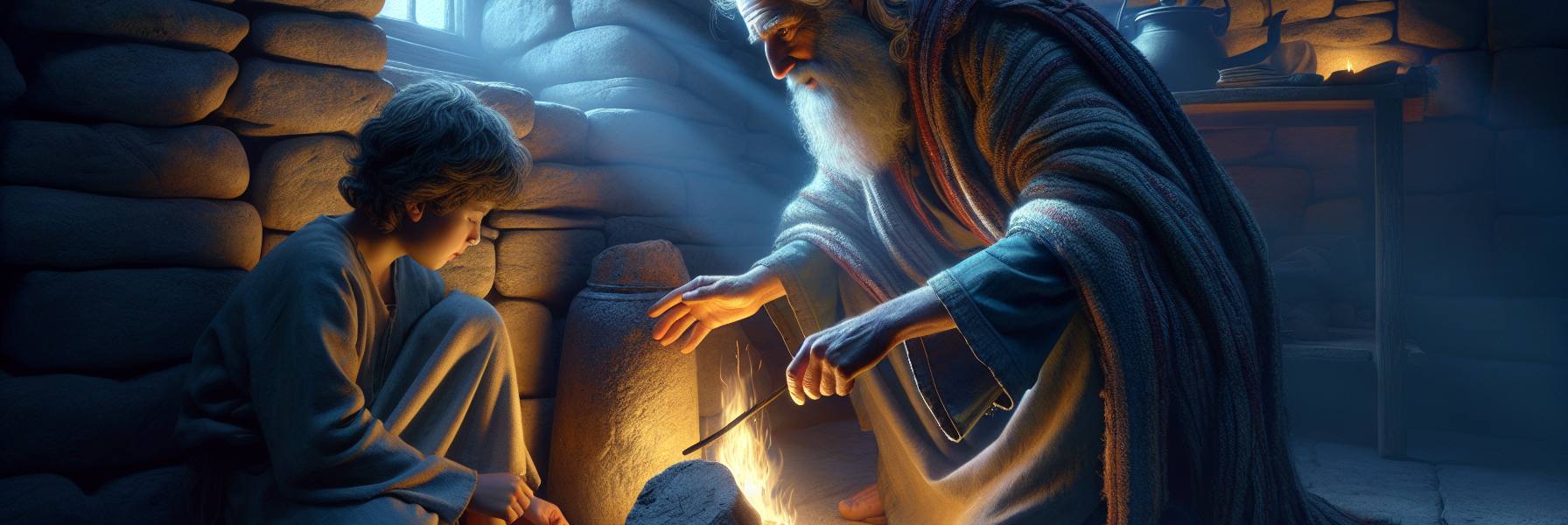

The air in the stone house still held the deep chill of the night, though a thin blade of dawn light cut through the high window. Elidad stirred the embers of the hearth fire, the rasp of bronze on ash a familiar morning sound. His grandson, Micah, watched him, knees drawn to his chest, eyes still heavy with sleep.
“Why is today different, Grandfather?” Micah asked, his voice a soft intrusion on the quiet.
Elidad did not answer immediately. He placed a small, rough log on the glowing coals and watched a flame finger its way along the bark. “It is not just today,” he said finally. “It is a pattern. A breath. The Lord our God breathes in and out across the seasons, and He has given us the rhythms of His breath to keep. We are to mark the time not by the hunger of kings or the turning of market days, but by His holy appointments.”
He settled onto a worn cushion, the leather creaking. “You remember the barley harvest? How we brought the first sheaf to Abner the priest?”
Micah nodded, remembering the weight of the stalks in his arms, the dusty gold of them against the priest’s white linen.
“That was the beginning,” Elidad said. “The Feast of Firstfruits. That was the breath drawn in. And now, from that day, we count. Seven sevens of days. Today is the fiftieth day. Today is the Feast of Weeks.”
He described it not as a list, but as a memory unfolding. The flat, hot weeks of the counting, the barley fields giving way to the taller, whispering wheat. The communal tension as the crops swelled under the sun. And then the frantic, joyous labor of the harvest itself—men and women moving through the stalks, the sound of scythes, the shouts from the threshing floors. The air filled with chaff and promise.
“And we do not simply take it,” Elidad murmured, his gaze distant. “We take the finest flour. We leaven two loaves. Why two? Perhaps for the two tablets of the Law given in the fire of Sinai… around this very time, long ago. We bring them, with lambs and wine and oil, a wave offering before the Lord. It is a feast of gratitude, but also of community. No one works. The foreigner, the widow, the orphan, they eat with us. The harvest is not ours alone; it is a gift, and the gift must be shared.”
The story of the year unfolded from his lips, not as a calendar, but as the turning of the family’s life. The long, quiet pause after Weeks, the sun a fierce weight. Then, the haunting sound of a single ram’s horn one evening, piercing the twilight. Micah jumped at the memory.
“The Feast of Trumpets,” the old man said, a faint smile on his lips. “That sudden blast—*teruah*—it is an alarm to the soul. A shaking awake. Summer’s slumber is over. The King is coming. Ten days we have. Ten days to look inward, to mend what is broken between us and our neighbor, between us and Heaven.”
Those ten days, Elidad described with a palpable weight. The ordinary tasks of mending nets and drawing water carried out under a cloud of solemnity. The quiet apologies muttered, the debts forgiven in hushed tones at the city gate. A collective holding of breath.
“And then,” Elidad’s voice dropped to a reverent whisper, “the Day of Atonement. The one day the land itself rests utterly. No fire lit, no food taken. We afflict our souls. And in the Tabernacle… the High Priest alone, in smoke and blood, steps behind the veil into the very presence of God. For us. For all our stumbles and failings. He emerges, pale and trembling, and a sigh goes through the whole camp. It is finished. The slate is clean.”
The release after that day, he said, was not into mere normalcy, but into a profound, giddy joy. Which ushered in his favorite time: the Feast of Booths.
His eyes crinkled as he described it. The frantic, cheerful labor of building the *sukkah* in their courtyard—palm fronds and willow branches lashed to wooden frames, just enough cover to show the stars at night. For seven days they ate there, slept there in the cool autumn air. “We remember the wilderness,” he said. “We remember fragility, dependence. But we also celebrate the abundance He has given us in this good land. It is a feast of pure, unbridled gladness. We wave the *lulav*—the palm, the myrtle, the willow—and the fragrant *etrog*, lifting them to the four corners of the earth, praising the God who is everywhere.”
He fell silent for a moment, listening to the crackle of the now-steady fire. The light in the room had grown strong and clear.
“And so the circle completes,” Elidad concluded softly. “From firstfruits to full harvest, from trumpets of warning to trumpets of jubilee in its year, from atonement to abiding joy. These are the Lord’s appointed times. They are the skeleton of our year, the holy rhythm of our lives. They tell us who we are: a people redeemed, provided for, corrected, forgiven, and finally, called to rejoicing.”
Micah looked from his grandfather’s weathered face to the strengthening light at the window. He could smell the bread his mother was beginning to bake for the feast day—the two leavened loaves. He thought not of rules, but of a story. A story written in barley and wheat, in trumpet blasts and silent fasts, in fragile booths and shared meals. It was a story he was part of. The breath of the year, and his own breath, fell into step with it.
“Come,” said Elidad, rising with a soft groan. “The sun is up. It is a holy convocation. A day to cease, and to remember the rhythm.”