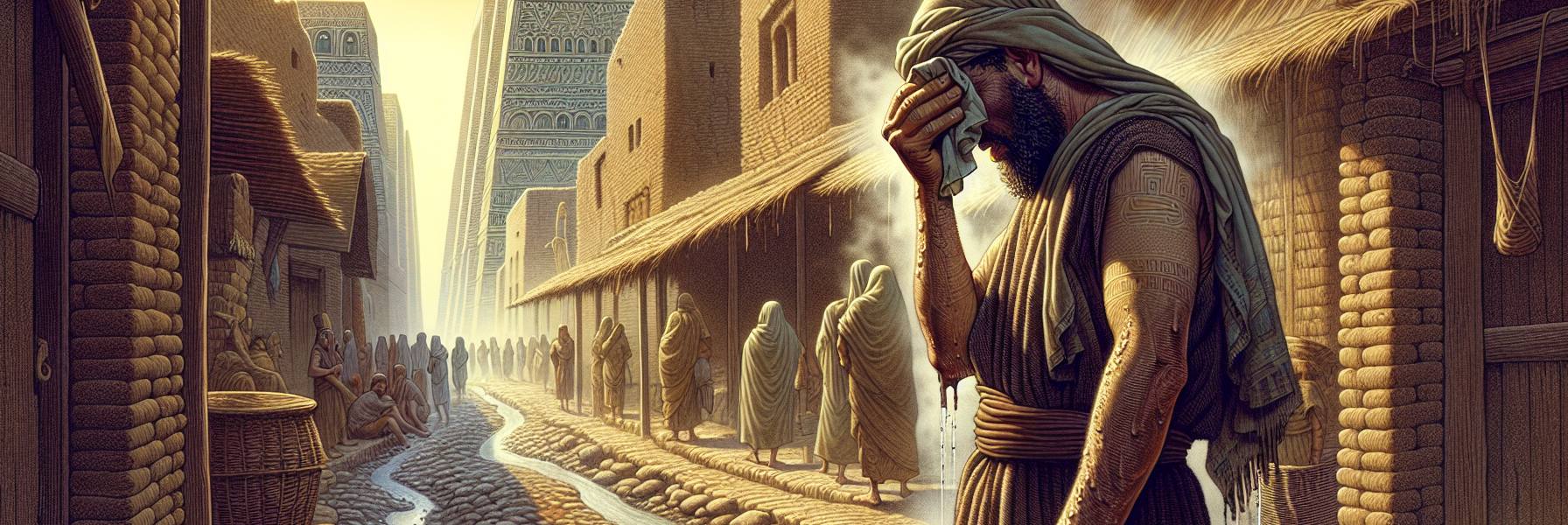

The heat in Babylon was a different kind of heat. It wasn’t the dry, familiar warmth of the Judean hills, but a thick, heavy thing that lay over the mud-brick houses and the strange, towering temples like a wool blanket. It carried the scent of the Euphrates—damp earth and slow water—and the smoke of sacrifices offered to gods with stone eyes.
Elnathan ben Jakin wiped the sweat from his brow with the back of his hand, leaving a smudge of clay dust. His sandals, worn thin from the walk, scuffed against the packed earth of the narrow street. Ten years. Ten years since the armies had come, since the world had been torn from its roots. He carried the memory of Jerusalem’s stones like a weight in his chest, a dull ache that flared when he heard the Levites singing by the irrigation canals, their psalms mingling with the foreign chatter of the market.
He was a potter. His father had been a potter in Jerusalem, his workshop near the Potsherd Gate. Here, in this allotted quarter of Tel Abib, he shaped the local clay into serviceable bowls and jars. The Babylonian clay was grittier, less forgiving than the fine silts of home. It was a constant, quiet rebellion to make something useful, something whole, from this stubborn earth.
Rumours were the other currency of exile. They flowed quicker than the canals. A prophet named Hananiah had stood in the square just the week before, his voice ringing with a fervour that made hearts leap. “Two years!” he had cried. “Thus says the Lord! Within two years I will break the yoke of the king of Babylon and bring us all back, with the vessels of the Lord’s house!” The hope had been a sweet, violent wine. Elnathan had felt it himself, a dizzying lift. But then the old, cold doubt settled back in. It didn’t match the shape of their reality. The empire around them was not cracking; it was settling, building, enduring.
The commotion came at midday. A group of men—Seraiah the priest, Elasah the scribe, a few others—were moving through the settlement, their faces set and serious. They carried a scroll, but not a Babylonian one. It was Hebrew parchment, travel-stained and sealed with familiar wax. A letter. From Jeremiah. The name itself was a fracture in the community. Some saw him as a traitor, a doom-monger who had told the king to surrender. Others, in quieter tones, wondered if his painful words had been the only true ones.
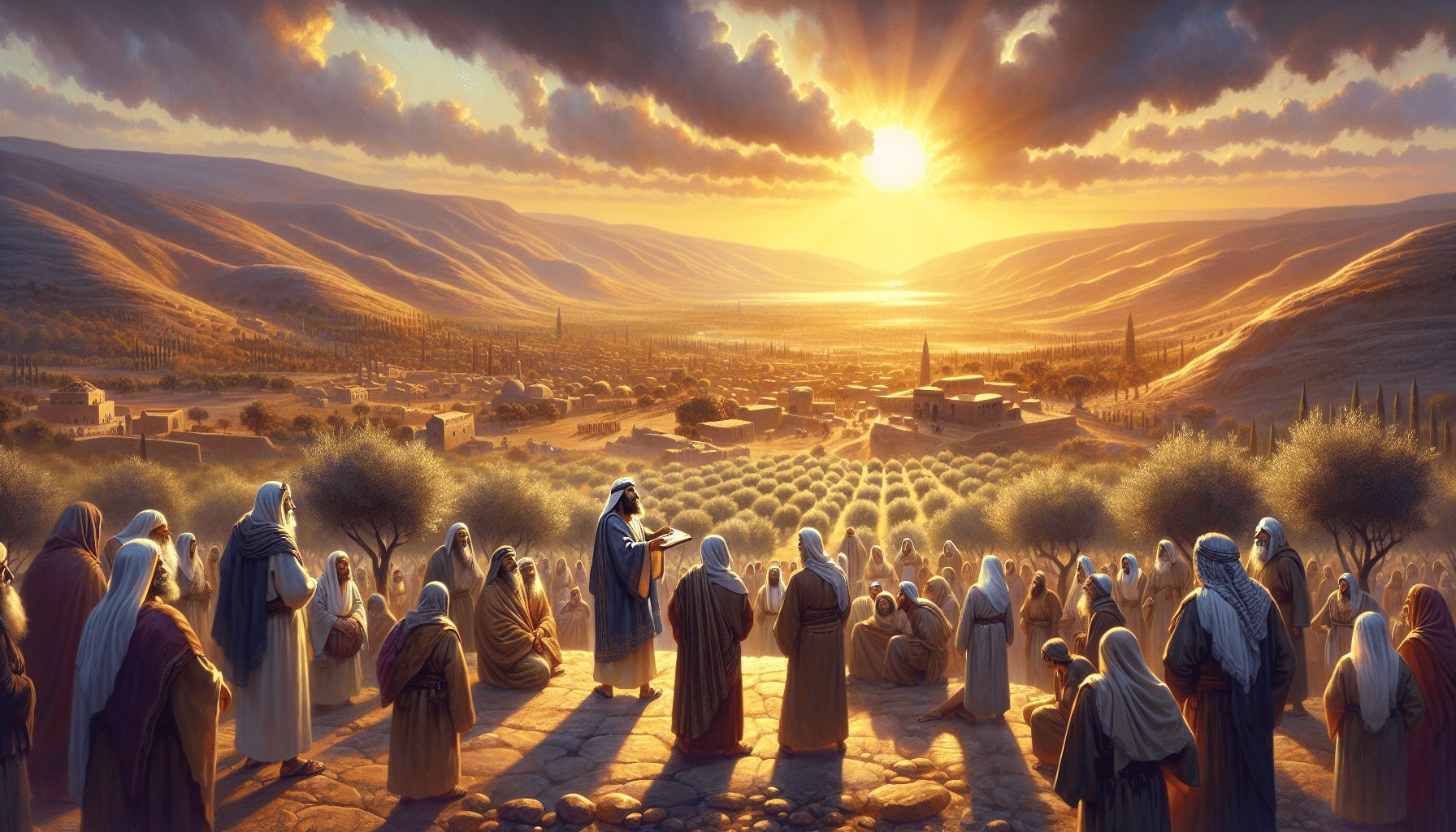
Elnathan put down his forming wheel and followed the growing crowd to the open space near the communal oven. Seraiah unrolled the scroll, his voice, trained for the Temple liturgy, now carried the prophet’s words to the dusty air of Babylon.
“Thus says the Lord of hosts, the God of Israel, to all the exiles whom I have sent into exile from Jerusalem to Babylon…”
The words were not what they expected. There was no fiery promise of immediate deliverance. Instead, they were instructions. *Build houses and live in them. Plant gardens and eat their produce. Take wives and have sons and daughters. Take wives for your sons and give your daughters to husbands, that they may bear sons and daughters. Multiply there, and do not decrease.*
Elnathan listened, a knot in his stomach. It was a call to life. A call to sink roots into the very soil of their captivity. To invest in a future here. It felt like a surrender. Murmurs rippled through the crowd. “He tells us to make peace with Babylon?” someone muttered bitterly.
But the priest read on. *Seek the welfare of the city where I have sent you into exile, and pray to the Lord on its behalf, for in its welfare you will find your welfare.*
That was the hardest pill. Pray for *Babylon*? For the city of their oppressors, the place of their shame? Elnathan looked at his hands, stained with the clay of this land. To seek its welfare was to accept it as a context for their lives, not just a temporary prison.
Then came the correction, the sharp axe to the root of false hope. *Do not let your prophets and your diviners deceive you.* The letter named Hananiah’s vision a lie. The exile would be long. Seventy years. A lifetime. Most of them would die here, in this strange heat, under this wide, pale sky.
A deep silence fell, heavier than the Babylonian afternoon. The hope of a quick return, that fragile vessel, had been shattered. Elnathan saw it on the faces around him—a kind of hollowing out. But as Seraiah’s voice continued, something else began to take shape within the emptiness.
*For thus says the Lord: When seventy years are completed for Babylon, I will visit you, and I will fulfil to you my promise and bring you back to this place. For I know the plans I have for you, declares the Lord, plans for welfare and not for evil, to give you a future and a hope.*
The words did not sparkle. They were not the stuff of instant triumph. They were a slow, deep current running beneath the years. *A future and a hope.* Not tomorrow, not in two years, but a promise planted in the long story of God, far beyond the span of their own seeing. The plans were God’s. The timing was God’s. Their task was to live—faithfully, honestly, prayerfully—in the meantime.
The crowd dispersed slowly, quietly. The fervent, desperate energy of before was gone, replaced by a sober, almost weary thoughtfulness. Elnathan walked back to his workshop. He looked at the lump of gritty clay on his bench. He picked it up. It was cool and dense in his hands.
He began to work it, centering it on the wheel with a steady pressure. He thought of his son, born here in Babylon, who knew the songs of Zion only as stories. He thought of the garden his wife tended behind their house, where Judean herbs struggled beside Babylonian cucumbers. He thought of the city outside his door, vast and pagan and full of people who were not his people.
But the Lord had said to pray for it. To seek its *shalom*. His hands moved, shaping the clay, drawing it up into the form of a water jar. It would be a good jar. It would hold water for a household. It was a small thing. But it was a thing made in the place where he was, with the material given to him.
The future was a long way off. The hope was a seed buried deep. But for today, there was a house to live in, a garden to tend, a family to love, a city to pray for, and a jar to make. And in the making, in the faithful waiting, in the seeking of a foreign city’s peace, he was, somehow, holding fast to the promise. The wheel turned, and his hands, covered in the dust of exile, shaped something useful for the journey.