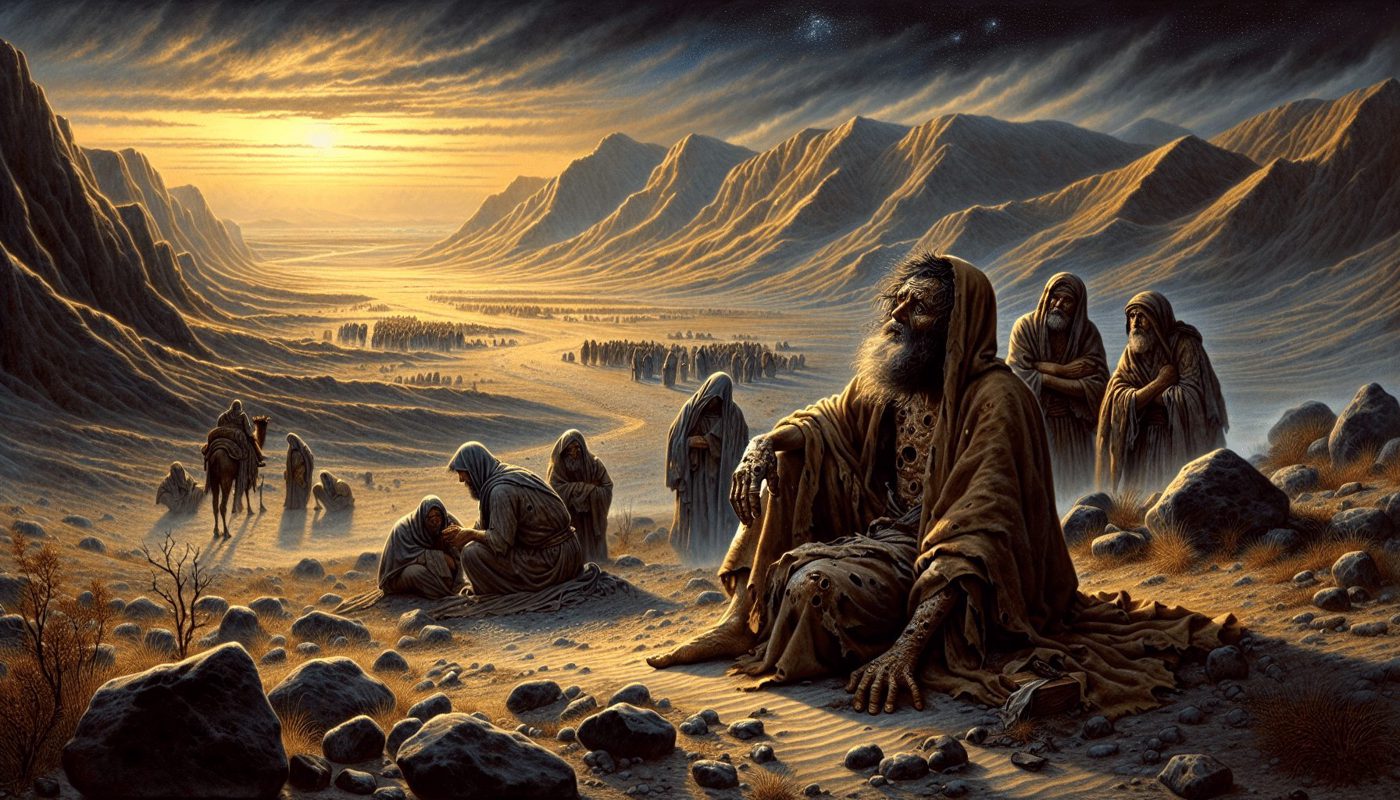
Job answered his friends, but his words were not a defense of his innocence. They were a confession of human helplessness before a God whose power and justice defy every human category. He began with a blunt admission: he knew that no man could be just before God. If a man wished to contend with the Lord, he could not answer even one charge out of a thousand. The gap between the Creator and the creature was not a matter of degree but of kind.
Job described a God who is wise in heart and mighty in strength. No one had ever hardened himself against the Lord and prospered. The evidence was written into the fabric of the world. Mountains, the most stable things a man could name, were removed and overturned in the Lord's anger without anyone noticing. The earth itself was shaken from its place, its pillars trembling like reeds in a storm.
He spoke of a God who commanded the sun not to rise and sealed up the stars. The heavens were stretched out by the Lord alone, and he trod upon the waves of the sea as if they were a path. The constellations—the Bear, Orion, the Pleiades—and the hidden chambers of the south were his handiwork. These were not idle wonders. They were acts of a power that did great things past finding out, marvelous things without number.
Yet the same God who moved the heavens passed by Job without being seen. He seized his prey, and no one could hinder him or ask what he was doing. The helpers of Rahab, the mythical chaos-monster, stooped under the Lord's anger. If such beings could not stand before him, how could a mere man answer him or choose words to reason with him?
Job pressed the logic further. Even if he were righteous, he would not dare to answer the Lord. He would only make supplication to his judge. And if the Lord called and answered him, Job still would not believe that he had been heard. The Lord broke him with a tempest, multiplied his wounds without cause, and filled him with bitterness. There was no room for a fair hearing.
He turned the question of justice over in his mind. If one spoke of strength, the Lord was mighty. If one spoke of justice, who would summon the Lord to court? Even if Job were perfect, his own mouth would condemn him. His integrity would prove him perverse. He declared himself perfect, but he regarded not himself; he despised his own life. The logic of the world had collapsed.
Job made a stark claim: the Lord destroyed both the perfect and the wicked. When the scourge killed suddenly, the Lord mocked at the trial of the innocent. The earth was given into the hand of the wicked, and the faces of the judges were covered. If the Lord was not behind this, who was? The question hung in the air without an answer.
His own days were swifter than a runner, fleeing away without seeing good. They passed like swift ships, like an eagle swooping on its prey. He tried to forget his complaint and put on a cheerful face, but he was afraid of all his sorrows. He knew the Lord would not hold him innocent. He was condemned, and he labored in vain.
Even if he washed himself with snow water and made his hands never so clean, the Lord would plunge him into a ditch until his own clothes abhorred him. The Lord was not a man that they could come together in judgment. There was no umpire between them, no mediator who could lay a hand on both. Job could only ask that the Lord take away his rod and remove his terror. Then he would speak and not fear. But he was not so in himself.
Comments
Comments 0
Read the discussion and add your voice.
Members only
Sign in to join the conversation
We keep comments tied to real accounts so the discussion stays clean and trustworthy.
No comments yet. Be the first to add one.