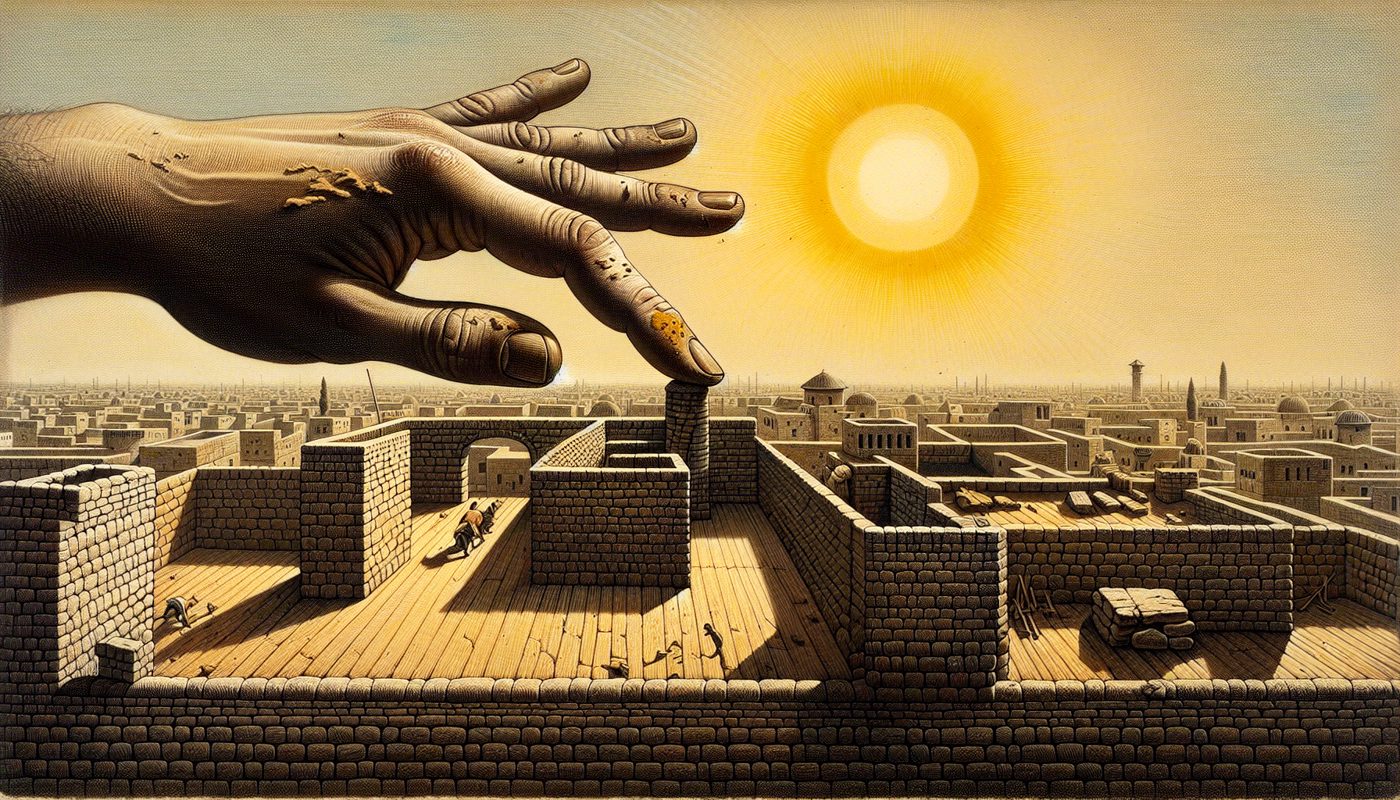
The Lord commanded Ezekiel to take a clay brick, set it on the ground, and scratch the outline of Jerusalem into its surface. This was not a map or a work of prophecy in words. It was a physical object turned into a sign. The brick became the city under siege, and Ezekiel was told to build forts against it, cast up a mound, set camps, and plant battering rams around it. All of this happened on a single tile, in plain sight, as a visible declaration of what was coming.
Then came the iron pan. Ezekiel placed it between himself and the brick city, a wall of iron separating the prophet from the city he was besieging. The Lord said this would be a sign to the house of Israel. The iron was not a weapon. It was a barrier. It stood for the unyielding separation between Jerusalem and the Lord, a wall that no prayer or sacrifice could breach until the days of the siege were finished.
After that, Ezekiel was commanded to lie on his left side and bear the iniquity of the house of Israel for three hundred and ninety days. Each day stood for a year of their iniquity. The Lord appointed the number and bound Ezekiel to it. The prophet could not turn from one side to the other until the days were accomplished. His body became a clock that measured the weight of the nation’s guilt.
When those days were finished, Ezekiel was to lie on his right side for forty days, bearing the iniquity of the house of Judah. Again, each day stood for a year. The Lord set his face toward the siege of Jerusalem, with his arm uncovered, and he was to prophesy against the city. The siege was not only drawn on a brick; it was acted out on the prophet’s own body, day after day, without relief.
The Lord also gave Ezekiel instructions for his food during those days. He was to take wheat, barley, beans, lentils, millet, and spelt, put them in one vessel, and make bread from the mixture. He would eat by weight: twenty shekels a day, at set times. He would drink water by measure: a sixth of a hin, also at set times. This was not a fast. It was a ration, calculated and enforced, a daily reminder of the scarcity that would fall on Jerusalem.
Then the Lord told Ezekiel to bake the bread over human dung, in the sight of the people. The Lord said that the children of Israel would eat their bread unclean among the nations where he would drive them. This was the point: the siege was not only about hunger but about defilement. The food itself would become a sign of their uncleanness among the Gentiles.
Ezekiel protested. He said that his soul had never been polluted, that from his youth he had not eaten anything that died of itself or was torn by beasts, and that no abominable flesh had ever entered his mouth. The Lord accepted the objection and allowed cow’s dung instead of human dung for baking the bread. The concession did not remove the sign. It only made it bearable for the prophet to perform it.
The Lord then spoke again. He said he would break the staff of bread in Jerusalem. The people would eat bread by weight and with fearfulness, drink water by measure and in dismay. They would lack bread and water, be dismayed with one another, and pine away in their iniquity. The sign on the brick, the iron wall, the days on the side, and the rationed bread all pointed to the same end: a city cut off from provision and from God.
The chapter does not explain how Ezekiel endured three hundred and ninety days on his left side. It does not describe the physical strain or the reactions of the people who watched him. What it gives is the command, the protest, the concession, and the meaning. The prophet’s body, his food, and his brick were all made into a single sign that the Lord set before the house of Israel. The siege was not yet real in stone and blood, but it was already real in the prophet’s house.
Comments
Comments 0
Read the discussion and add your voice.
Members only
Sign in to join the conversation
We keep comments tied to real accounts so the discussion stays clean and trustworthy.
No comments yet. Be the first to add one.