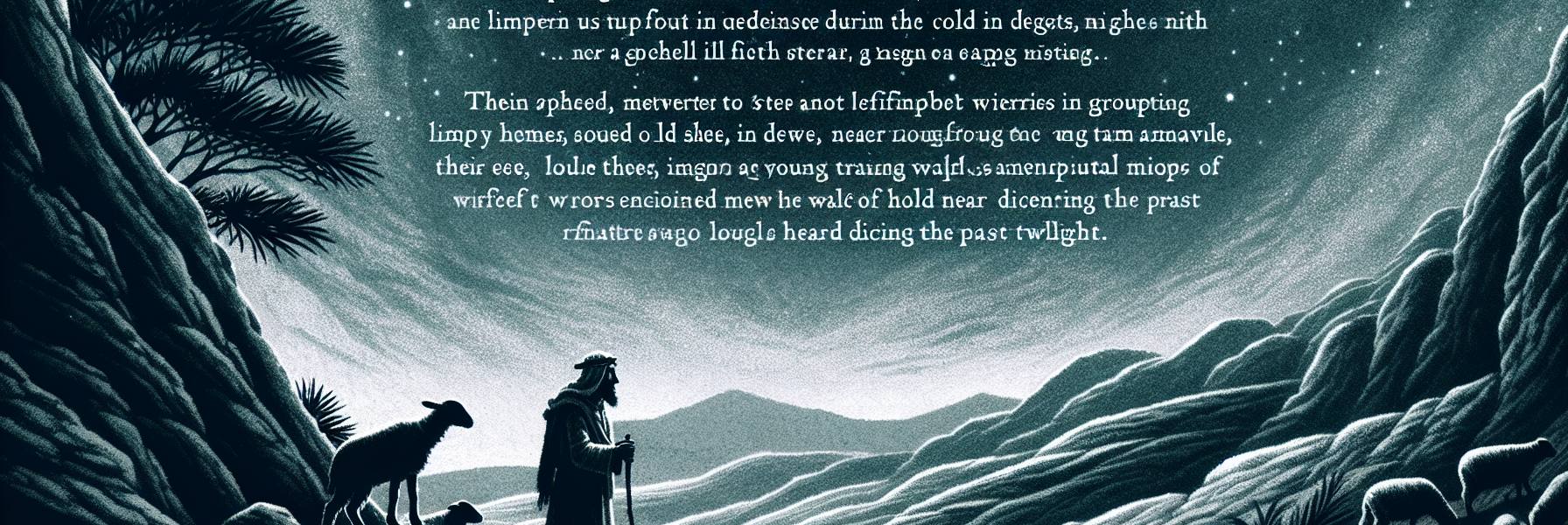

The air tasted of dust and distance. Eliav’s cloak was a thin defense against the chill seeping up from the stones of the hillside. His flock, a smattering of wooly shadows, huddled together, their occasional bleats the only sound breaking the vast silence of the Judean night. He was tired, a deep weariness born not just of walking, but of the small, constant worries that gnawed at a shepherd’s heart: a limp in the young ewe, the sparse grass near the ravine, the distant howl heard yesterday at twilight.
He leaned back, the rough wool of his cloak catching on the limestone. And then he looked up.
It was not the first time he had seen the stars. But tonight, the sky was not a blanket; it was a depth, a yawning, silent chasm of impossible black, pierced by countless fierce, unwavering points of light. The familiar constellations—the bear, the serpent—were not patterns pinned to a dome, but markers in an endless field, some burning with a cold blue fire, others a softer, gold-tinged glow. The moon, not yet full, hung among them, a clean, sharp sickle of polished silver, washing the hills in a light that was both gentle and severe.
A feeling rose in his throat, tight and wordless. It was not peace, not exactly. It was a kind of terrifying smallness. His worries, the boundaries of his life defined by this flock and these hills, seemed to shrink into nothing. He was a speck on a stone, under an infinity he could not fathom. The silence was no longer empty; it was the silence of great, moving things, of spheres turning on courses set long before his grandfather’s grandfather drew breath.
“O Lord,” the words escaped him, a whisper torn from the core of that smallness, “our Lord…” He had no more words. The title itself felt too large for his mouth. How was it that the name of the God of his fathers could be spoken here, under this? The glory was beyond telling. It was set above these very heavens.
A night bird called, a lonely sound. He looked from the silent, grand choir of the stars to the sleeping flock. One of the ewes shifted, a simple, earthly sound. And the thought came, unbidden and strange, as if placed in his mind by the very contrast: *What is man, that you are mindful of him?*
The question was not despairing, but awestruck. He looked at his own hands, calloused and dirt-stained, capable of lifting a lamb or throwing a stone. He thought of the great works of the city—the walls of Jerusalem, the rising Temple—works of human hands that seemed mighty until you raised your eyes to the mountains, and then to the stars that crowned them. What were they? What was he? A breath. A shadow. Here today, gone tomorrow, his name forgotten in a few generations.
Yet… the memory of the liturgy in the city came to him. The choir singing of the Lord establishing strength out of the mouths of babes and infants, to still the enemy and the avenger. Not from armies. Not from starry hosts. From the gurgling trust of a child, God fashioned a fortress. The thought was baffling. The great machinery of the cosmos, and the cornerstone of the defense was infant faith.
He gazed back at the sky, and now the terror began to mix with a dawning, humbling wonder. This God, whose fingers had spun Arcturus and Pleiades into their dances, had done something more. He had crowned man. The word settled on him. *Crowned*. Not tolerated. Not endured. Crowned with glory and honor.
Eliav understood it then, not as a king in a palace might, but as a shepherd on a dark hill. The dominion was real. The ewe that trusted his call, the ram that followed his staff—they were under his care, his charge given by the Maker of all this. The fields he crossed, the flocks he bred, the very wool on his back—it was all part of the world placed under human feet. Sheep and oxen, yes, and the beasts of the field. The birds he startled at dawn, the fish that silvered the Jordan’s depths—all under the stewardship of this fragile, crowned creature.
A young lamb, startled by nothing, scampered closer and nudged his knee. He laid a hand on its warm, wooly head, feeling the rapid beat of its life. The vast and the intimate existed together. The same mind that conceived the orbit of the moon cared for the birth of this lamb. The same will that marshaled the starry host had entrusted it to him.
The cold seeped into his bones, but the tightness in his throat had loosened. The smallness remained, but it was no longer a crushing weight. It was his place. He was the mindful one, the visited one, the crowned one—not for his own grandeur, but for a purpose as tangible as the staff in his hand. To tend, to name, to care for the works of those same divine fingers.
He looked up one last time. The moon had climbed higher, its light now catching the dew beginning to form on the grass. “O Lord, our Lord,” he whispered again, the name now a bridge between the infinite and the intimate, “how majestic is your name in all the earth.”
He pulled his cloak tighter, his eyes on the flock, his heart full of a quiet, staggering truth. The heavens still declared, but the declaration now included him.