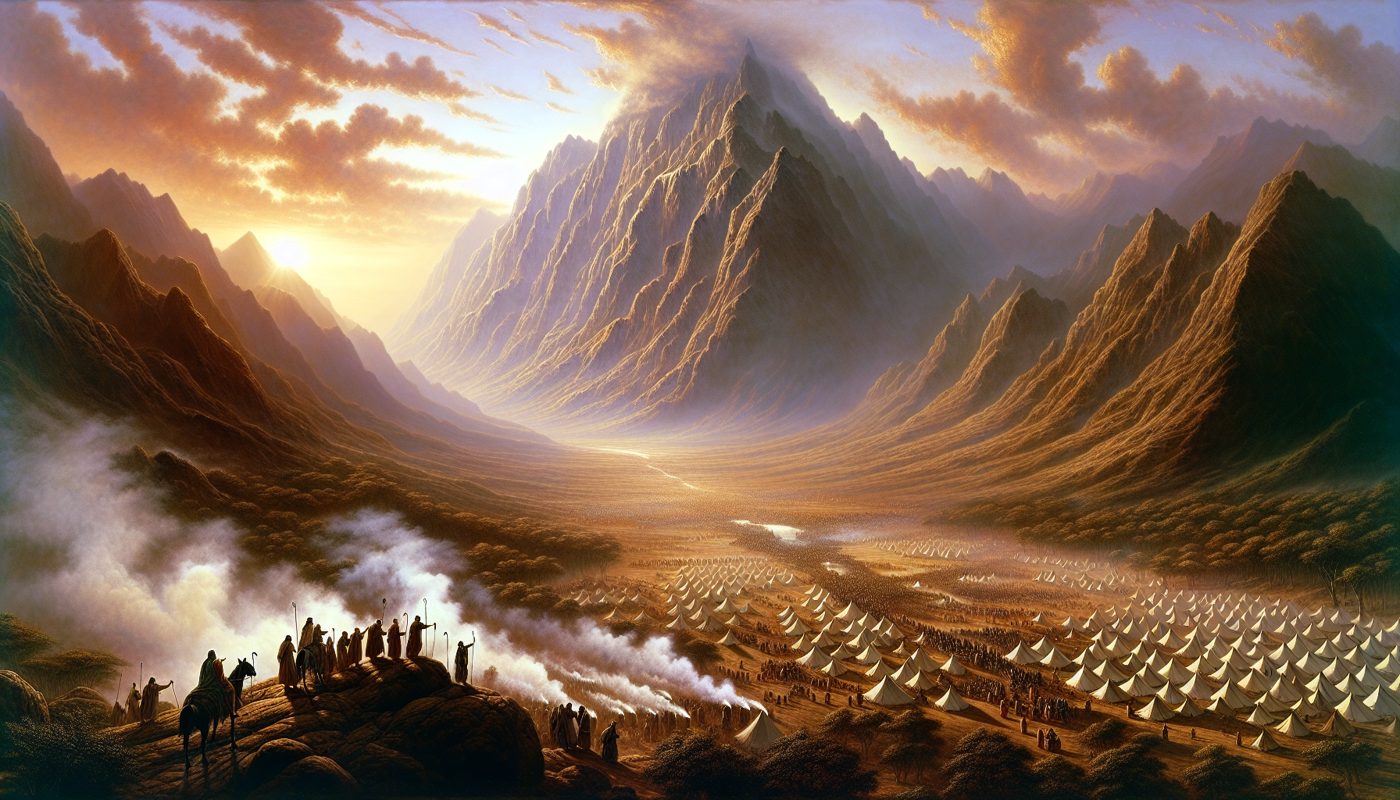
The Lord called Moses up the mountain, but the invitation had limits. Aaron, Nadab, Abihu, and seventy elders of Israel were to come part of the way, then worship at a distance. Only Moses could draw near to the Lord. The people were not to go up at all. The boundaries of access were drawn with precision before any ritual began.
Moses came down and told the people everything the Lord had spoken—all the words and all the ordinances. The people answered with one voice. They said they would do everything the Lord had spoken. That single response, given in unison, became the verbal seal of the covenant before any blood was shed.
Moses wrote down all the words of the Lord. Then he rose early the next morning and built an altar at the foot of the mountain. He set up twelve pillars, one for each tribe of Israel. The altar faced the Lord; the pillars faced the people. The structure itself declared that this covenant bound the whole nation.
Young men from among the Israelites offered burnt offerings and sacrificed peace offerings of oxen to the Lord. Moses took half the blood and sprinkled it on the altar. The other half he kept in basins. The blood was divided because it had two destinations: the altar, which represented God, and the people, who would receive the covenant.
Moses took the book of the covenant and read it aloud to the people. They responded again, promising to do all that the Lord had spoken and to be obedient. The second affirmation matched the first, but now it came after hearing the written words directly.
Moses took the blood from the basins and sprinkled it on the people. He said, “Behold the blood of the covenant, which the Lord has made with you concerning all these words.” The blood did not merely seal a document. It marked the people themselves as parties to the covenant. The altar had already been consecrated with the other half of the blood. Now the people were bound to it.
After the blood ceremony, Moses, Aaron, Nadab, Abihu, and the seventy elders of Israel went up the mountain. They saw the God of Israel. Under his feet was what looked like a paved work of sapphire stone, as clear as the sky itself. The text does not describe God’s face or form. It describes what was under his feet. The vision was real but restrained.
The Lord did not stretch out his hand against the nobles of Israel. They beheld God, and then they ate and drank. The vision did not kill them. It did not even interrupt their meal. The covenant had been sealed with blood, and now it was confirmed with a shared meal in the presence of God.
The Lord told Moses to come up into the mountain and stay there. He would give him the tablets of stone, the law and the commandment that the Lord himself had written, so that Moses could teach them. Moses rose up with Joshua, his assistant, and went up into the mountain of God.
Before he left, Moses told the elders to wait for them until they returned. Aaron and Hur were left in charge. Anyone who had a dispute was to go to them. The leadership structure was clear. Moses and Joshua ascended; the elders stayed behind; Aaron and Hur handled the cases.
The cloud covered the mountain. The glory of the Lord settled on Mount Sinai, and the cloud covered it for six days. On the seventh day, the Lord called to Moses from inside the cloud. To the Israelites watching from below, the appearance of the glory of the Lord looked like a devouring fire on the top of the mountain.
Moses entered the cloud and went up into the mountain. He stayed there forty days and forty nights. The covenant had been spoken, written, sealed with blood, and confirmed by a vision. Now Moses waited inside the cloud for the stone tablets that the Lord himself had written.
Comments
Comments 0
Read the discussion and add your voice.
Members only
Sign in to join the conversation
We keep comments tied to real accounts so the discussion stays clean and trustworthy.
No comments yet. Be the first to add one.