
The dust of the return still clung to everything, a fine, persistent powder that settled in the folds of robes and lined the creases of weary hands. Jerusalem was a city of echoes—the echo of former glory, the echo of shattered stone, and now, the tentative echo of hammers and saws. Among those who had come back, whose names were carefully inscribed on the scroll carried by the chronicler, was a man named Ahimaz.
His was not a famous name. It wouldn’t be found among the warriors or the princes in the earlier chapters. Ahimaz was of the lineage of Aaron, but from a branch that had long been entrusted with a different kind of service. His fathers had been gatekeepers. Not warriors at the gates, but guardians of the thresholds of the House of God. Now, standing before a pile of roughly hewn stones that was meant to be the foundation of a new wall, he wondered what it meant to keep a gate that did not yet exist.
The list had been read aloud in the assembly—the families of Judah, Benjamin, Ephraim, and Manasseh who had returned. Priests, Levites, the Nethenim, the temple servants whose history was woven into the very fabric of Solomon’s court. Ahimaz had heard his own name, and the names of his cousins: Meshelemiah, Obed-Edom, Jehiel. Names that sounded like old prayers. They were all here, not because they owned the best land, but because they had a duty. A memory of duty.
His wife, Elisheba, worked beside him, her strong arms helping to shift a smaller stone into place. She was from the family of Shallum, a chief gatekeeper from the old days. Their marriage had been arranged in Babylon, a pact of memory between two families clinging to an identity defined by a temple in ruins. “Shallum,” the chronicler had recited, “son of Kore, son of Ebiasaph, son of Korah.” The lineage was a rope thrown across the chasm of the exile. Ahimaz felt its rough fibers in his hands every day.
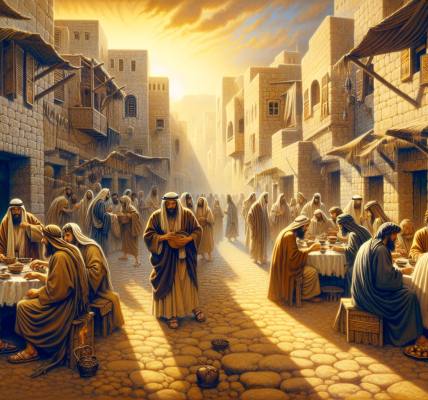
The work was brutally physical. Their section of the city, near the Old Gate, was a labyrinth of collapsed dwellings and charred timbers. Yet, in the evenings, after the sun had bled out over the western hills, the real work began. The elders would gather, their faces lit by a small fire, and they would talk. Not of building, but of ordering.
“The gatekeepers were on the four sides: east, west, north, and south,” old Pedaiah would say, his voice a dry rustle. “Their kinsmen in their villages had to come from time to time and serve with them for seven days.” He wasn’t giving orders; he was rebuilding from memory, stone by sacred stone.
Ahimaz listened, his calloused fingers tracing invisible patterns in the dirt. East. That was the king’s gate. A place of honor. Shallum’s lot, long ago. He tried to imagine his ancestor standing there, watching the dawn break over the Mount of Olives, the first light striking the gold of the doors. All he saw now was a tangle of weeds and broken masonry.
Other details emerged from the remembered lists. The keepers of the storehouses. The keepers of the sacred vessels, the fine flour, the wine, the oil, the incense. The musicians, whose duty was “free from other service, for they were engaged in their work day and night.” That phrase always struck Ahimaz. *Day and night*. While the city slept, someone was to be awake, singing the songs of Zion. Who sang now? The wind through the ruins had a hollow tune.
One morning, a discovery was made. A team of men clearing a cellar near what had been the court of the priests found a cache of pottery, shattered but recognizable. Among the shards was a single, intact clay lamp, simple and unadorned. It was handed to Ahimaz, as one entrusted with thresholds. He held its cold, gritty weight. It had never held the oil of the sanctuary. It was a common thing. But it had been left behind, or hidden, by someone who thought they would return. He carefully placed it in a niche in the wall of his own makeshift shelter.
Weeks turned into months. The lists became flesh. Here was Jehoiada, with the oversight of the army of the Aaronites. Here was Zechariah, a discerning counselor, from the family of Asaph the seer. They were not characters on a scroll; they were sunburned, argumentative, hopeful men sharing their meager bread. The genealogy was becoming a community, imperfect and struggling.
The day came when the first gate—a simple, timber-framed thing—was set into place at the entrance to the priests’ quarter. It was not beautiful. It did not gleam. It squealed on its leather hinges. But it was a gate. That evening, Ahimaz took his position beside it. He had drawn the first watch. Elisheba brought him a cloak as the cool night air descended.
He stood there in the deepening twilight, the unlit lamp at his feet. From a nearby shelter, he heard a sound—a low, tentative hum. It was old Pedaiah’s grandson, a boy with a clear voice, practicing a melody Pedaiah had taught him. A fragment of a song of ascent. The notes were unsure, but they were persistent. They pierced the vast, star-dusted silence of the night.
Ahimaz looked out past the gate, past the jagged silhouette of the city walls, to the hills of Judah. The list was not just names. It was a gathering of fragments. A shard of pottery. A remembered melody. A squealing hinge. A man standing a watch at a threshold that was more promise than reality. The chronicler’s record was a blueprint, not of a building, but of a people being patiently, painfully reassembled by the hand of the God who remembers. And Ahimaz, keeper of the gate, kept his watch, a sentinel for the dawn he could not yet see, but in which he had no choice but to believe.