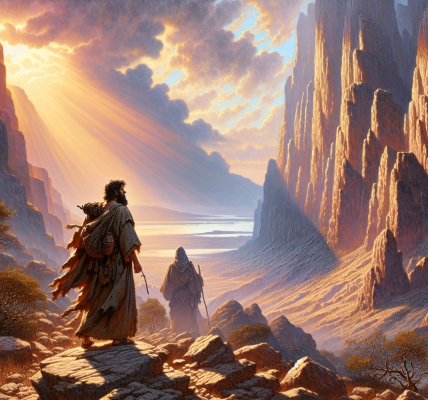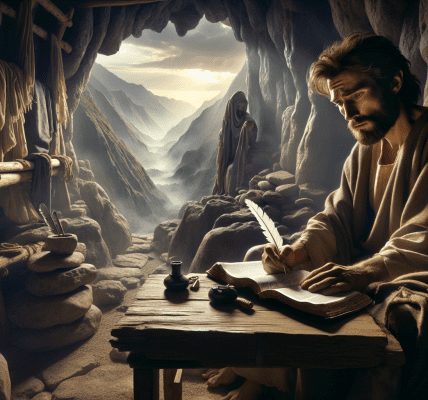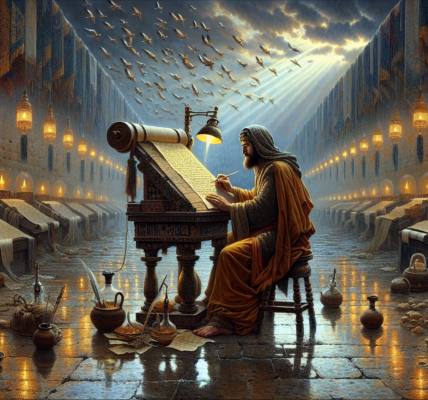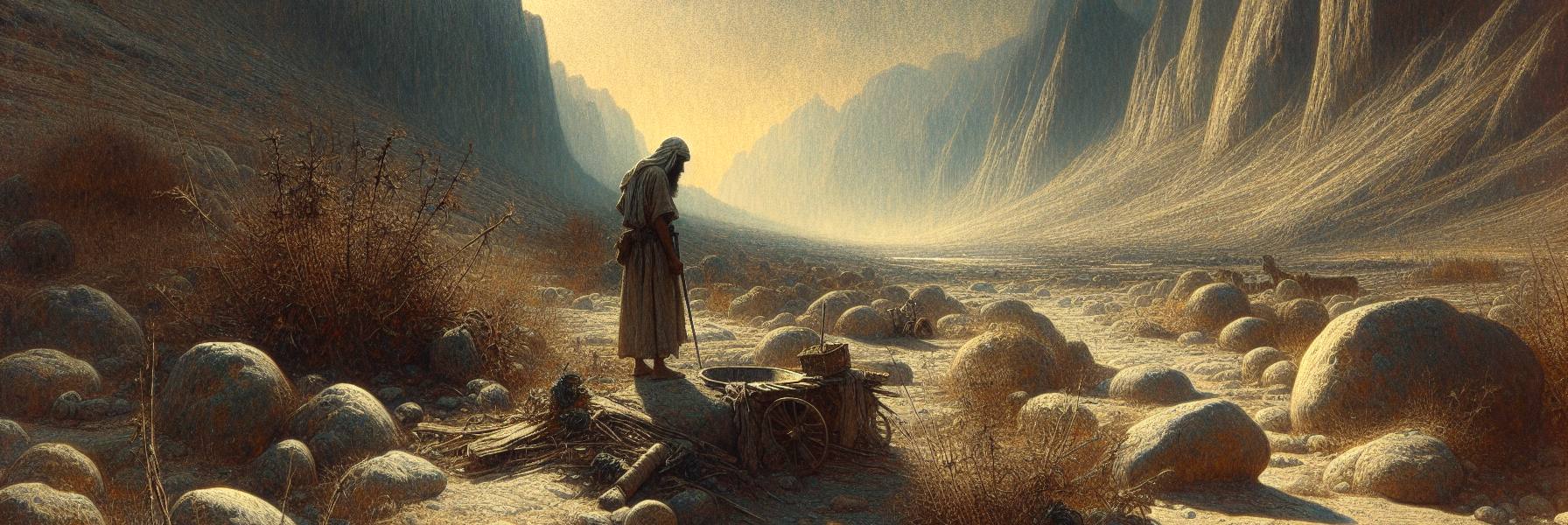

The air in the wilderness was a dry, gritty thing. It tasted of dust and the faint, metallic hint of distant rain that never fell. For forty days and nights, the man from Nazareth had known nothing but this vast, silent expanse of stone and sky. His body, once strong from the woodworker’s trade, felt hollowed out, a vessel emptied by a hunger that had long since passed from a sharp pain into a dull, constant presence. The sun was a white, merciless eye.
It was in this state of profound emptiness that the voice came. It did not boom from the heavens or echo from the canyon walls. It was quieter than that, more intimate, a thought that was not his own, slipping into the quiet spaces of his mind like a serpent through dry grass.
“If you are the Son of God,” it whispered, the words smooth and reasonable, “command these stones to become loaves of bread.”
He looked down. At his feet lay a scatter of limestone rocks, bleached pale by the sun, their shapes mockingly similar to the flat, round loaves baked in the clay ovens of Nazareth. The temptation was not merely about the gnawing in his gut. It was a question of identity, of power. To use his Sonship for his own comfort, to turn from the path of dependence to one of self-preservation. He closed his eyes for a moment, not against the sun, but against the allure of the thought. And the words that rose in him were not his own invention, but an ancient breath, a truth etched into his people’s story.
“It is written,” he said, his voice raspy from disuse but clear, “‘Man shall not live by bread alone, but by every word that comes from the mouth of God.’”
The silence that followed was different. The presence did not leave, but it shifted. The air grew still and heavy.
Then he was in Jerusalem, standing on the highest pinnacle of the Temple, the wind plucking at his worn tunic. How he got there, he did not question. The world below was a mosaic of tiny courtyards and ant-like people. The Kidron Valley was a deep gash of shadow. The voice was beside him now, companionable, logical.
“If you are the Son of God,” it said, “throw yourself down, for it is written, ‘He will command his angels concerning you,’ and ‘On their hands they will bear you up, lest you strike your foot against a stone.’”
The temptation was brilliant, a twisting of the very scripture he had just wielded. It was a temptation to spectacle, to force the hand of God, to trade the quiet, hidden path of faithfulness for a public, breathtaking miracle that would compel belief. To leap from this holy place and be saved by angels would announce his arrival in a way no sermon ever could. He could feel the dizzying pull of the drop, the allure of the air waiting to receive him.
But he saw the flaw in its glittering logic, the vanity at its core. It was not trust; it was a test. A performance.
“Again it is written,” he answered, his gaze steady on the horizon, not the drop beneath him, “‘You shall not put the Lord your God to the test.’”
The air grew cold. In an instant, the holy city was gone. They stood now on the crest of a mountain so impossibly high that all the kingdoms of the world and their glory were spread out beneath them like a rich tapestry unrolled at his feet. He saw the gleaming white marble of Roman forums, the smoke of a thousand village hearths, the dark lines of armies on the march, the sun flashing off distant seas. The power of it all, the sheer scale of human ambition and ache, was laid bare in a single, terrifying vision. The voice was no longer a whisper or a companion. It was a ruler, offering a crown.
“All these I will give you,” it said, and the offer held the weight of genuine authority, “if you will fall down and worship me.”
This was the final, unadorned truth of it. The shortcut. The avoidance of the coming suffering, the cross he knew waited somewhere in the future. He could have the world without the cost. He could have the crown without the thorns. All it required was a single act of allegiance, a bending of the knee to the prince of this world. The hunger, the vertigo, they were nothing compared to this. To hold the salvation of all these countless souls in his hands, right now, for the price of a single, hidden bow.
A profound weariness washed over him, deeper than his physical hunger. He looked from the glittering kingdoms back to the presence that offered them.
“Be gone, Satan!” he commanded, and the words were not a shout, but a final, irrevocable decree, solid as granite. “For it is written, ‘You shall worship the Lord your God and him only shall you serve.’”
And with that, the vision shattered. The mountain, the kingdoms, the presence—it all vanished like a mirage swallowed by the desert heat. He was alone again, kneeling on the sun-baked earth, the grit pressing into his knees. The silence was no longer oppressive, but clean. And then he heard it, a sound he had not heard in forty days: the gentle rustle of wings. He looked up to see angels, their forms both terrifying and comforting, moving toward him through the shimmering air. They did not speak. One brought him a clay jar of water, cool and clear. Another offered a simple cake of bread. He ate and drank, the simple acts feeling like a sacrament, and strength began to seep back into his limbs.
The wilderness was behind him. He walked out of the barren hills and down toward the green ribbon of the Jordan, his purpose honed to a finer, sharper edge. The news reached him in the fishing villages by the lake: John had been silenced, taken by Herod’s soldiers. The time for waiting was over.
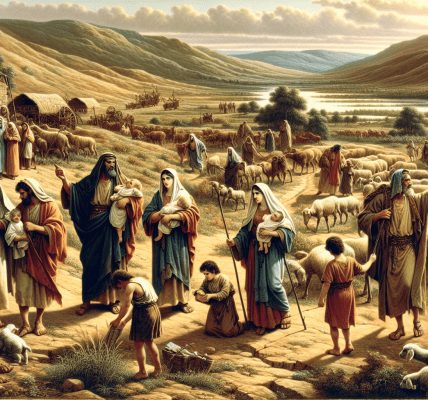
He came to Capernaum, a town of fishermen and tax collectors, the smell of the sea and drying nets thick in the air. Walking along the pebbled shore, he saw two brothers, Simon called Peter and Andrew, their backs bent as they cast a circular net into the water. Their movements were practiced, rhythmic, a dance of labor and hope.
“Follow me,” he called to them, his voice carrying over the lap of the waves. It was not a plea or a suggestion. It was the same voice that had commanded the Tempter to leave. “And I will make you fishers of men.”
The two men straightened up. They looked at him, then at each other. There was a long, silent moment where the only sound was the net, sinking into the dark water. Then, without a word, they pulled it in, waded to the shore, and left it there, glistening on the stones. They fell into step behind him.
A little farther on, he saw another pair of brothers, James and John, the sons of Zebedee. They were in their boat with their father, mending their nets, their fingers swift and sure with the tarred twine. He called to them with the same simple, impossible command. And immediately, they left the boat and their father, the nets lying half-mended in the bottom of the skiff. They followed him.
He walked ahead of them, along the road that skirted the sea, and they followed, these rough, unlearned men, their minds full of questions, their hearts strangely stirred. He was leading them now, not into a wilderness of temptation, but into the villages and synagogues of Galilee, to proclaim the news that the long night was ending, and that the kingdom of heaven had, at last, drawn near.