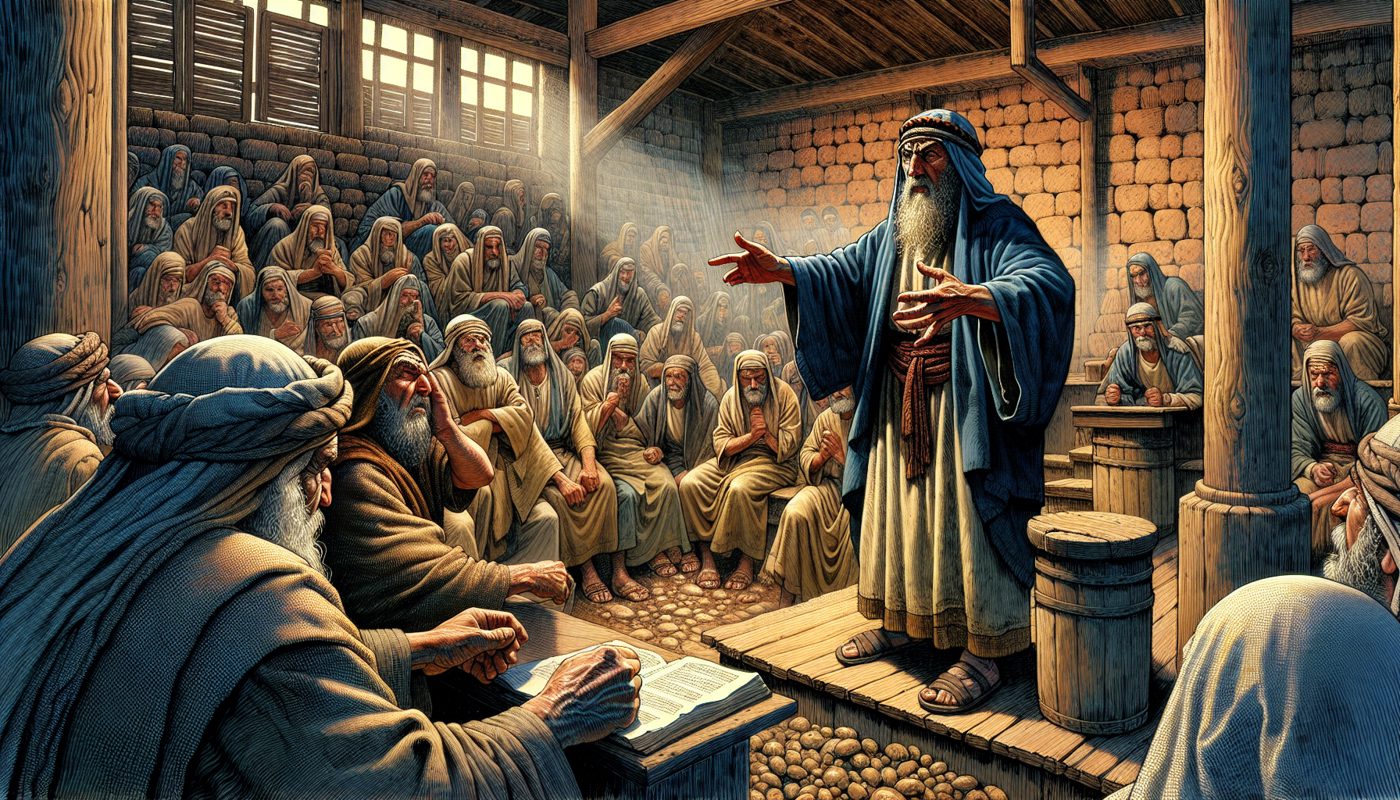
The air in the assembly room was thick, and not just with the heat of the gathering day. It was a weight Elazar felt on his skin, a prickling humidity of unspoken grievances. He sat on a low bench near the back, the rough-hewn cedar digging into his shoulders, and watched as the community of believers in Pella fractured before the morning prayers had even concluded.
Old Matthias, his hands knotted like olive roots, was pointing a trembling finger at a younger man, Joshua, whose face was flushed a deep, angry red. The argument was over a plot of land near the irrigation channel—a strip of earth that suddenly seemed to hold the value of Solomon’s mines. Words like “promise” and “right” and “deception” sliced through the murmured prayers of the women in the corner. Elazar closed his eyes, the words of the letter from Yakov, the Lord’s brother, echoing in his memory with a sharper clarity than the shouts. *From where do wars and fights among you come? Is it not from this: from your passions that war in your members?*
He had copied that very passage just last week. Now he saw it enacted in dust and fury.
The meeting dissolved without blessing, a cloud of bitter dust rising as men stalked away. Elazar didn’t follow the others back toward the village. Instead, he turned his steps toward the rocky hills that cradled their valley, a place of thorns and stubborn, fragrant herbs. He needed the emptiness. As he climbed, the quarrel replayed in his head, but his own thoughts soon joined the cacophony. He’d petitioned the Jerusalem council for months for funds to expand the meeting house, a righteous cause, surely. Yet each messenger returned empty-handed. A slow burn of resentment had begun to coil in his gut. *They withhold*, he thought. *They sit in their stone houses and forget we are here, baking in this Transjordan sun.*
He found a flat stone in the shade of a carob tree and sat, wiping his brow with his sleeve. Below, the village was a smudge of tan and grey, peaceful from a distance. He pulled a small, creased scroll from his girdle—Yakov’s letter. His eyes found the fourth chapter again.
*You ask and do not receive, because you ask wrongly, to spend it on your passions.*
The sentence landed like a physical blow. The prayer for the meeting house… was it for God’s glory, or for his own? Would a larger building ease the sting he felt when messengers from Jerusalem arrived and he had only this humble shelter to show? He had imagined himself standing in a new portico, receiving their approving nods. The vision now tasted like ash.
A lizard darted over the rock, still in the sun. Elazar watched it, his inner war laid bare. He was no different than Matthias and Joshua. His passions were just quieter, dressed in the robes of ministry. *Adulterers!* Yakov called his readers. The word had shocked him at first. But here, in the silence, he understood. His friendship with the world was not in revelry or sin he could name; it was in this deep, craving desire for recognition, for a legacy that bore his imprint, not God’s. It was the pride of life, whispering that his worth was tied to what he built and what others thought of it.
The afternoon sun began its long slant. A verse floated to the surface of his mind: *God opposes the proud but gives grace to the humble.* It wasn’t a gentle promise. It was a stark law of the spirit, as real as gravity. In opposing God through his pride, he had made God his adversary. The funding wasn’t withheld by a council; it was withheld by the order of a universe where pride had no currency.
A deep, shuddering sigh escaped him. It was not a sigh of despair, but of release. The fight went out of him, not into the air, but down into the dust at his feet. “Submit to God,” he whispered the text aloud, the words rustling like dry leaves. It was an act of will, a conscious lowering of the banner of his own cause. He didn’t feel a rush of warmth or light. He felt simple, and small, and very tired.
Then, haltingly, he began to pray. Not for a building, but for cleansing. For a right spirit. For the community below. For Matthias and Joshua. The words were clumsy, inelegant. They were interrupted by the cry of a distant hawk, by the sudden memory of Joshua’s young son, ill last winter. He prayed for that boy. The petition for funds came last, and when it did, it felt different—detached, placed into hands far more capable than his or the council’s. *If the Lord wills*, he heard himself say, and for the first time, it was not a pious formula but a genuine surrender.
He stood as the shadows stretched long. The bitterness was gone. In its place was a quiet grief for the time wasted in hidden war, and a fragile, newfound peace. He descended the path as the first cool breath of evening stirred the thistles.
The next morning, he went to Matthias first. The old man was sullen, shelling bitter almonds in his doorway. Elazar did not mention the land. He sat, took a handful of almonds, and began to shell them too. He spoke of the drought two years past, of how Matthias’s knowledge of the old cistern had saved the village’s goats. He spoke of Joshua’s skill with the sick lamb of Matthias’s granddaughter. The words were slow, circling. The anger, deprived of fuel, began to smolder and die.
Later, he found Joshua mending a wall. He took up a stone and fitted it into a gap without being asked. “The boundary stone by the channel,” Elazar said, not looking up from his work. “It is weathered. Perhaps we could walk there tomorrow and discern it anew. Together. With Matthias.”
Joshua was silent for a long time, the only sound the scrape of trowel on mortar. “Perhaps,” he finally grunted. It was not agreement, but it was not war.
A week later, a messenger from Jerusalem arrived. He brought no bag of silver. He brought a young physician, trained in Alexandria, fleeing the unrest in the city, seeking a community. “We heard of your need,” the messenger said, “and Markos here is a gift of the body.”
Elazar looked at the young doctor, then at the humble meeting house. He thought of the sick boy, of old aches, of the true health of a community. He laughed, a soft, surprised sound. Grace had come. Not as he had demanded it, but as a gift he had finally made room to receive. He clasped the young man’s shoulder and turned to the village, his heart, for the moment, strangely clean. The war was over. The peace, he knew, would be a daily choosing.
Comments
Comments 0
Read the discussion and add your voice.
Members only
Sign in to join the conversation
We keep comments tied to real accounts so the discussion stays clean and trustworthy.
No comments yet. Be the first to add one.