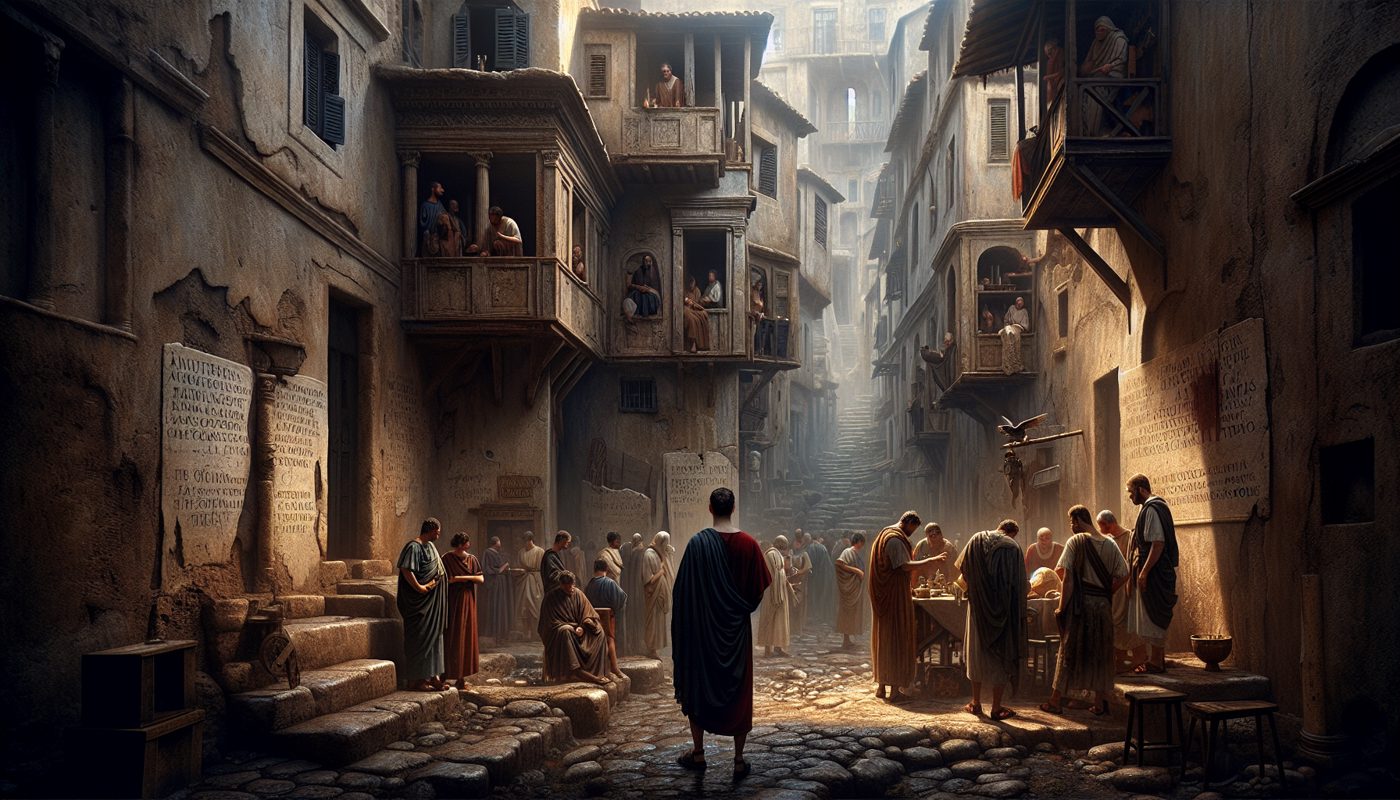
The heat in the city was a physical weight, a blanket of dust and despair that seemed to press down on every stone and every soul. My name is Marcus, and I served in the household of a minor magistrate on the Aventine Hill. The law was the air we breathed—the law of Rome, the law of my master, the older, deeper law of my own failures that whispered to me in the quiet hours before dawn. I knew the shape of my own lack, the precise measurement of where I fell short. It was a ledger I carried in my bones.
That afternoon, I’d been sent to the Trans-Tiber district, a maze of cramped insulae and workshops. The errand was trivial, but my spirit was heavy. I passed a small gathering in the dim ground-floor room of a tenement, the door propped open for air. I knew what they were. Followers of the Way. My master spat the name. Yet, the sound that came from within wasn’t chanted ritual or heated argument, but a low, resonant murmuring. A kind of collective sigh. Curiosity, or perhaps a weariness with my own thoughts, made me pause in the shadow of a doorway across the narrow street.
An older man was speaking, his voice not lecturing but sharing, worn smooth like a river stone. He spoke of a different law. Not the law of tablets and decrees that condemns the gap between what is and what should be, but a law of the Spirit. He called it the very breath of life in the Anointed One, Jesus. This breath, he said, had set him free from the other law—the law of failure and death. The words struck me with a strange, physical force. It wasn't an idea; it was a possibility. A door cracking open in a wall I thought was solid.
I didn’t go in. I stood there in the grimy Roman sunlight, the smells of sewage and baking bread thick in the air, and felt something I had no name for. A kind of aching hope, sharp as a splinter. The man inside spoke of being led by this Spirit. Not driven by fear, but guided. As a son. That word, *son*, echoed. I was a slave. The concept was so foreign it felt like hearing a story from a country that couldn’t possibly exist.
Weeks bled into months. I couldn’t shake the hearing of it. My own internal ledger grew more oppressive. I saw the gaping chasm between the man I was—angry, fearful, covetous—and any semblance of peace. I felt the "groaning" the man had mentioned, though I hadn’t understood it then. It was the whole world, myself included, bent and frustrated, like a beautiful melody played on a broken flute. I groaned under my master’s injustices. My body groaned with fatigue. My spirit groaned with a longing for a home I’d never seen.
Then, one evening, I found myself back in that street. It was raining, a cold, persistent drizzle that slicked the cobbles. The meeting was happening again. This time, I stepped inside. The room was close, lit by a few oil lamps that painted shifting shadows on the damp walls. They were praying. Not the formal, recited prayers to Jupiter or the Emperor, but a messy, heartfelt spilling out of fears, thanks, confusion. One woman, her face lined with hard work, whispered, "We don’t even know what to ask for… but your Spirit pleads for us." And I felt it. In that stuffy room, amid the smell of wet wool and burning wicks, I felt a presence that did not condemn my silence, but inhabited it. A deep, wordless intercession. It was as if my own wordless groan had been heard, taken up, and given a voice I could not provide.
That was the beginning. The learning was slow. The "leading" wasn’t a voice from the clouds. It was a gradual, often painful, reorientation of desire. It was the impulse to hold my tongue when insulted, not out of cowardice, but from a stubborn, quiet knowledge that my identity was no longer rooted in a slave’s honor. It was a resilience in suffering that felt borrowed, as if a stronger current was carrying me through a season of sickness and my master’s increased brutality. I learned to view the lash marks not merely as wounds, but as odd, painful badges of a shared story with the crucified Lord. Suffering didn’t become good, but it lost its final word.
The greatest battle was in my own mind. The old ledger was tenacious. In moments of doubt or fresh failure, the accusations would flood back: *Imposter. Slave. Unclean.* The old man’s words returned to me: "There is therefore now no condemnation for those who are in the Anointed One, Jesus." I had to learn, slowly, doggedly, to let that truth drown out the whispers. It was a discipline of the heart—to set my mind on the substance of the Spirit, which was life and peace, rather than on the substance of the flesh, which was only death. Some days I succeeded only in clinging to the promise like a man hanging from a cliff.
And then came the fire. It started in a baker’s shop near the foot of the Aventine and spread with a terrifying hunger through the dry, cramped quarters. Our own insula was threatened. Chaos reigned—screams, the crash of timbers, the terrible roar of the flames. In the frenzy, I was separated from the other household slaves. Amid the smoke and panic, a profound, eerie calm settled over me. It wasn’t bravery. It was a settled knowledge, deeper than the fear. *If God is for us, who can be against us?* The words formed not as a quote, but as my own breath. The magistrate could die. I could die. The entire city could burn. But none of it—not hunger, not peril, not the sword of authority, not even the raging fire—could untangle me from the love of God that had been poured into my heart through that Spirit. It was a love found in the Anointed One, Jesus our Lord.
I survived that night, face smudged with soot, lungs raw. The world was still broken. I was still a slave. The groaning continued. But the axis of my existence had shifted. I was no longer a prisoner to a ledger of debt, but a son, however stumbling, waiting in a patient, hopeful ache for a redemption that would include even this weary body. The dawn, I knew, was inevitable. And in the meantime, there was this breath, this Spirit, this unshakable, quiet love holding me fast. Nothing in all creation could come between us and that. Not even the fire.
Comments
Comments 0
Read the discussion and add your voice.
Members only
Sign in to join the conversation
We keep comments tied to real accounts so the discussion stays clean and trustworthy.
No comments yet. Be the first to add one.