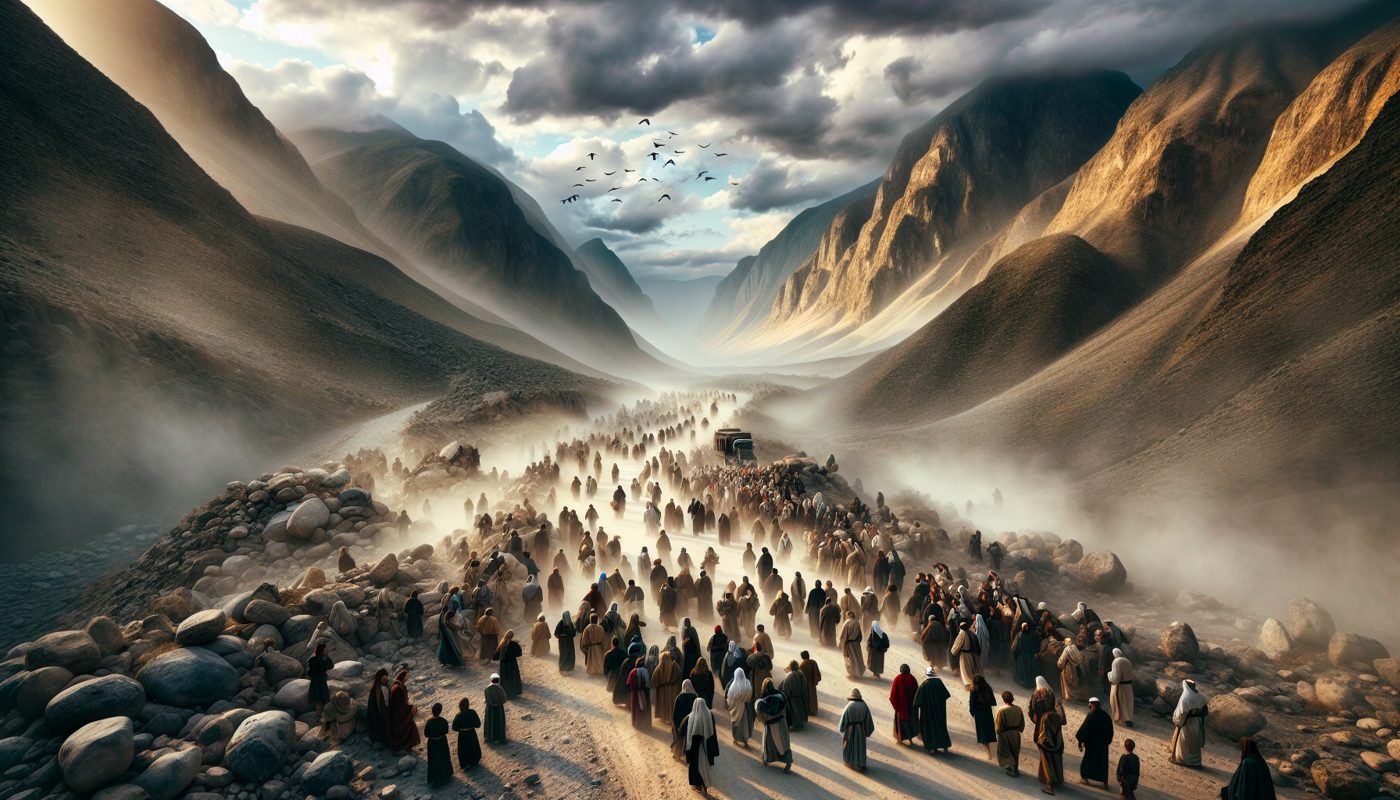
The road was dust, and the dust was everything. It coated the tongue, gritted the teeth, and rose in lazy, taunting plumes with every shuffle of worn sandals. It was on this road, somewhere between the rocky hills of Galilee and the distant, misted shoulders of Samaria, that the Teacher stopped again, not for rest, but because the crowd—a ragged assembly of the hopeful, the skeptical, and the simply curious—pressed in with their relentless questions.
He spoke, and his words were not like the dust. They were hard, clear stones dropped into murky water. “It is impossible for stumbling blocks not to come,” he said, his voice carrying without strain, “but woe to the one through whom they come.” He looked not at the Pharisees, who lingered at the edges with arms crossed and brows furrowed, but through them, at some distant, grievous truth. The air grew heavy. He spoke of millstones and deep seas, of forgiveness offered not once, but seven times in a day if repentance was claimed. The disciples exchanged weary glances. The math of such grace was exhausting.
It was then that they said it, a plea wrapped in a kind of spiritual exhaustion. “Increase our faith!”
He turned to them, and a faint, sorrowful smile touched his lips. “If you had faith like a mustard seed,” he said, picking an imaginary speck from the air between his thumb and forefinger, “you could say to this mulberry tree, ‘Be uprooted and planted in the sea,’ and it would obey you.” It wasn’t a rebuke, not exactly. It was a dismantling. They had asked for more, and he told them the smallest, most insignificant thing they could imagine was already more than enough. The problem was never quantity. It was quality—a thing alive, planted, growing. Faith wasn’t a currency to be stockpiled; it was a seed to be sunk into the hard ground of obedience.
He shifted then, to a parable that felt like a bucket of cold well-water dashed on their preconceptions. “Which of you, having a servant plowing or tending sheep, will say to him when he has come in from the field, ‘Come at once and recline at table’? Will he not rather say, ‘Prepare something for my supper, and gird yourself and serve me while I eat and drink; and afterward you may eat and drink’?” He paused, letting the mundane, brutal truth of social hierarchy settle. “Does he thank the servant because he did the things which were commanded? I think not.” His eyes held them. “So you also, when you have done all the things which are commanded you, say, ‘We are unworthy servants; we have only done what was our duty.’”
Duty. The word hung there, unadorned. It stripped the gleaming varnish from their piety. There would be no heavenly bonus for basic obedience. The kingdom he spoke of operated on a different economy altogether, one where the first shock was the utter gratuity of mercy, and the second, harder shock was the unglamorous demand of steadfast duty.
The journey resumed, a slow current of humanity flowing south toward Jerusalem. The landscape began to bleed into the ambiguous territory between Galilee and Samaria, a place of political and spiritual unease. And there, outside a village whose name nobody bothered to recall, they saw them. Ten figures, standing far off, as the Law demanded. Their voices were a ragged chorus of despair, cutting across the still afternoon. “Jesus, Master, have mercy on us!”
They were lepers. The disease had made them a council of the damned, dissolving tribal animosities. Among them, by his accent, was a Samaritan. Their bodies were wrapped in torn cloth, their faces obscured but for eyes that held a desperate, dying hope.
He stopped. He didn’t approach. He didn’t stretch out a hand. He simply said, “Go and show yourselves to the priests.” It was a command dripping with impossible irony. The Law of Moses required a priest to certify cleansing. To go was to act on a healing not yet received, to walk in faith toward a verdict of ‘clean’ while still clothed in ‘unclean.’
For a heartbeat, nothing happened. Then, as one, they turned. They didn’t look down at their own hands, searching for a change. They simply went, their steps quickening from a shuffle to a jog as the sheer, audacious hope of his command took hold. And as they went, they were cleansed.
One of them, halfway to the village, skidded to a halt in the dust. He looked at his hands, turning them over and over. The flesh was whole, pink, and new like a child’s. He felt his own face, his cheeks, his brow. A sound escaped him, not a shout, but a deep, shuddering sob that seemed to come from the soles of his feet. He turned his back on the path to the priests, on his nine companions already disappearing toward religious validation. He ran back, his legs pumping, the dust flying around him. He didn’t stop until he was at the feet of the Teacher, and there, in a voice raw and loud with a praise that seemed to physically pain him, he glorified God. He threw himself on his face in the grime of the road, giving thanks.
Jesus’s voice was soft, but it carried to the edges of the silent crowd. “Were there not ten cleansed? But the nine—where are they?” He let the question hang, a lament for the nine who received the gift but forgot the Giver in their rush toward ritual acceptance. “Was no one found to return and give glory to God except this foreigner?” The word ‘foreigner’ was pointed. The one outside the covenant, the one least expected to understand, had understood the most. He had seen not just a cure, but a miracle. Not just a command, but an invitation to relationship. The Teacher looked down at the weeping man, still prone in the dirt. “Arise, go your way,” he said, and the tenderness in his tone was a balm. “Your faith has made you well.” The Greek word implied something more: ‘has saved you.’ The others had their skin healed. This one had stumbled into the very heart of the kingdom.
The crowd murmured, a buzz of awe and confusion. But the Teacher was already looking ahead, his gaze fixed on the road that led inexorably to Jerusalem. The disciples, sensing a shift, drew closer.
He began to speak again, but now his words were of a different order. They were not about mustard seeds or dutiful servants. They were about the Kingdom itself. “The kingdom of God is not coming with signs to be observed,” he said, and the predictive, apocalyptic fervor that thrummed in the air around them seemed to deflate a little. “Nor will they say, ‘Look, here it is!’ or ‘There it is!’ For behold, the kingdom of God is in your midst.”
It was a quiet thunderclap. The kingdom wasn’t a political coup to be plotted, nor a celestial event to be calculated. It was a presence, a reality as immediate and as overlooked as the air they breathed. It was here, now, in the act of forgiven duty, in the seed of faith, in the grateful heart of a foreigner lying in the dust.
But then, almost in the same breath, he spoke to them of days to come. Days of longing, of false messiahs and false assurances. He spoke of lightning splitting the sky from one horizon to the other, of the day of the Son of Man, sudden and inescapable as the flood in Noah’s time, as the fire on Sodom’s plain. He spoke of two in one bed, one taken and one left; of two grinding grain together, one taken and one left.
“Where, Lord?” they asked, fear and fascination warring in their voices.
He looked at them, and his answer was a vulture circling a carcass. “Where the body is, there also the vultures will be gathered.”
It was a grim, cryptic close. The road stretched on, white and hot. The disciples walked in silence, the echoes of cleansed lepers and distant lightning storms mixing in their minds. The kingdom was here, in their midst. And the kingdom was coming, on a day that would break upon them like a thief. They understood little, only that the dust on their feet was holy ground, and the duty before them was everything. They walked on, following the figure ahead, who moved toward a city that would not recognize its own time of visitation.
Comments
Comments 0
Read the discussion and add your voice.
Members only
Sign in to join the conversation
We keep comments tied to real accounts so the discussion stays clean and trustworthy.
No comments yet. Be the first to add one.