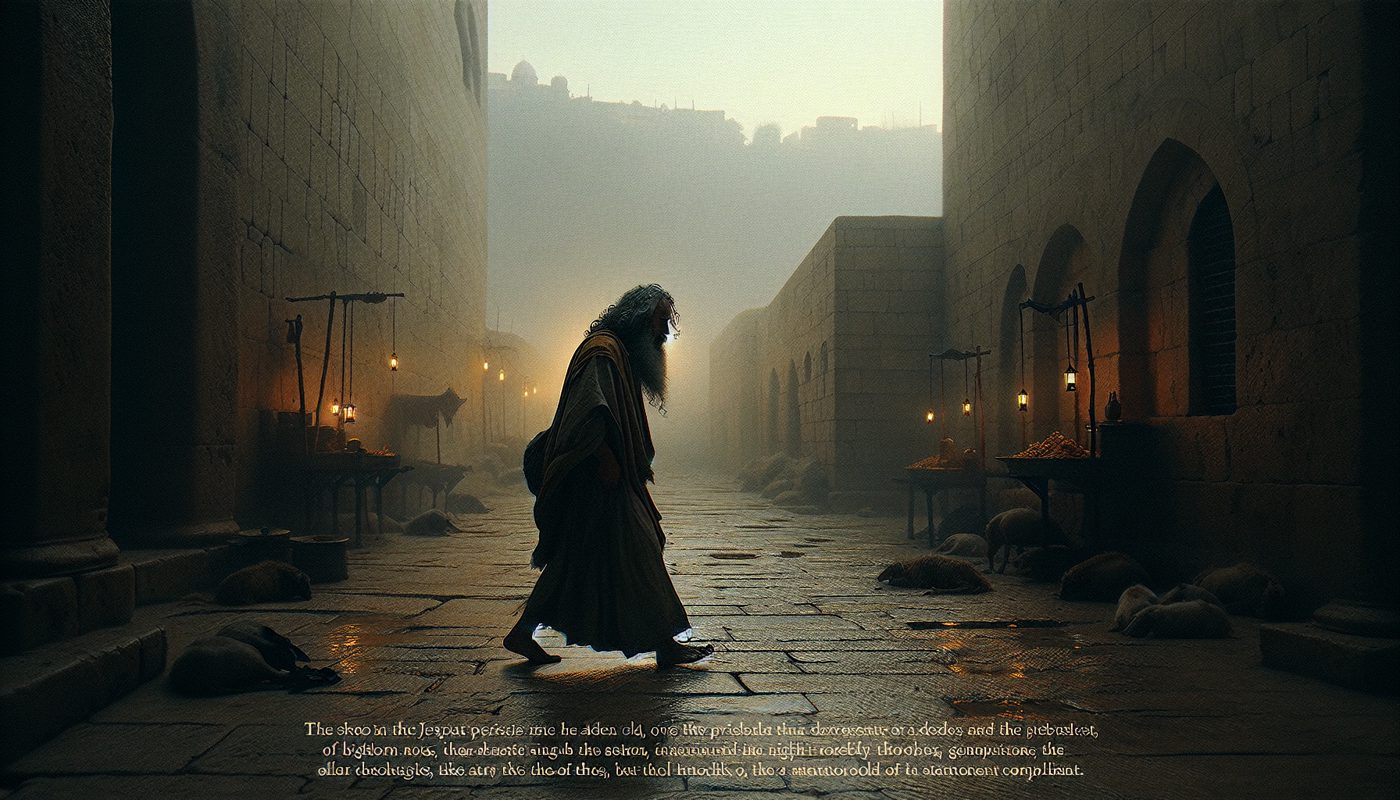
The dawn over Jerusalem was the colour of a dull bruise, grey bleeding into a tired yellow. Malachi felt it on his skin, this thin, tired light, as he made his way through the streets still shadowed and cool. The smell of last night’s refuse and old incense hung in the air. He moved without haste, a man carved from the same weary stone as the city walls, his thoughts a slow, deep river cutting through the bedrock of a complaint he could not shake.
He entered the Temple courts not with reverence, but with a heavy familiarity. The morning sacrifices were underway. The sound was a mechanical rasp—the drag of animal feet on stone, the low murmur of priests, the hiss and sputter of fat on fire. It should have been a symphony of devotion. To Malachi, it sounded like a market transaction gone stale.
He stood near the great altar, watching a priest he knew, a man named Jareb. Jareb’s hands moved with practised indifference. A man from the crowd, a farmer by the look of his worn tunic, presented a lamb. It was a pitiful thing, its fleece patchy, one leg slightly lame, its eyes clouded. The Law was clear: only the unblemished, the best of the flock. This was the dregs. Jareb didn’t even meet the farmer’s eye. He took the rope, gave the animal a perfunctatory glance, and nodded to an attendant. No challenge, no correction. The offering was accepted.
A fire, hotter than any on the bronze altar, ignited in Malachi’s gut. It was not just this one act. It was the pattern, the unspoken agreement that had settled over the people like dust. They had returned from exile, yes. The Temple was rebuilt, yes. But the heart had gone out of it all. Their worship was a sigh, an obligation, a muttered formula they no longer believed carried any sound to heaven.
The words began to form then, not as a sermon he would preach, but as a conversation he was overhearing, a dialogue between a weary people and a silence they had mistaken for absence. He heard their question before they even spoke it: *How have you loved us?*
The vision crashed over him, not of the future, but of a past judgement. He saw the hills of Edom, to the southeast. Not as they were now—broken, desolate, a land of jackals and crumbling red rock—but as they had been, proud and fortified. He saw the divine hand scrubbing at them, not in battle, but in a relentless, erasing fury. *“Esau I have hated,”* the Voice declared, and the words were not petty emotion but a cosmic verdict, a statement of historical choice and consequence. Edom had built again, but the Eternal would tear down, leaving them the *“wicked country”* and a people forever under the wrath of God. The love for Jacob, for Israel, was etched into the very landscape of history, a choosing they had come to treat as a boring inheritance.
He blinked, back in the court. The lame lamb was now smoke, a greasy, dark plume that seemed to struggle to rise. Jareb was wiping his hands on a cloth.
And the Voice came again, low, directed straight at the priests who stood making the whole enterprise unclean by their contempt. *“If I am a father, where is my honour? If I am master, where is the fear due to me?”* It was an accusation that cut to the bone of the covenant.
Malachi found his feet carrying him forward. He didn’t shout. His voice, when it came, was gravelly, carrying just far enough for Jareb and a few nearby Levites to hear. “You offer blind animals for sacrifice. Is that not wrong? You bring the lame and the diseased. Try offering that to your governor. See if he will be pleased with you, or receive you with favour.”
Jareb paused, his face a mask of offended routine. “The work is hard. The people are poor. God understands.”
“Understands?” Malachi’s whisper was fierce. “It is you who does not understand. You despise His name. You say, ‘The Lord’s table is defiled, and its food, its offering, is contemptible.’ You say, ‘What a burden this is,’ and you sniff at it with disdain.” He gestured at the altar, at the second-rate offerings waiting their turn. “When you offer the stolen, the lame, the sick, is that not evil? Would the Governor accept that? No. So why do you think the Lord of Hosts will?”
He left them then, their indignation a cold bubble behind him. He walked the city, the words now a torrent he could not contain, shaping the one-sided dialogue into a prophecy. They were robbing God, and daring to wonder why blessings were withheld. They were wearied by worship. And the great, terrible irony unfolded before his spiritual sight: a day was coming when the Lord’s name would be great among the *nations*, from the rising to the setting sun. In every place, pure offerings would rise. But here, in the very place chosen for His name to dwell? Here, the priests had made it a place of polluted food, of shrugged shoulders and muttered complaints.
His final thought was not of fire, but of a snuffed-out wick. The priests had led the people into this casual sacrilege. They called evil good and good evil. And the covenant with Levi—the covenant of life and peace, of true instruction and upright walking—was now a memory they trampled underfoot. They showed partiality in their rulings. They had caused many to stumble.
As the sun finally broke over the Mount of Olives, casting sharp, clean shadows, Malachi returned to his small room. The city was fully awake now, noisy with life. But the smoke from the morning offerings still hung in the valley, a stale, acrid testimony. He sat, the weight of the divine displeasure a tangible cloak on his shoulders. The word was delivered. It was a love letter, written in the ink of their own neglect, and they would read it as condemnation. He dipped his pen, and on a scrap of parchment, began to write the first lines of the argument they had started, and God had finished.
Comments
Comments 0
Read the discussion and add your voice.
Members only
Sign in to join the conversation
We keep comments tied to real accounts so the discussion stays clean and trustworthy.
No comments yet. Be the first to add one.