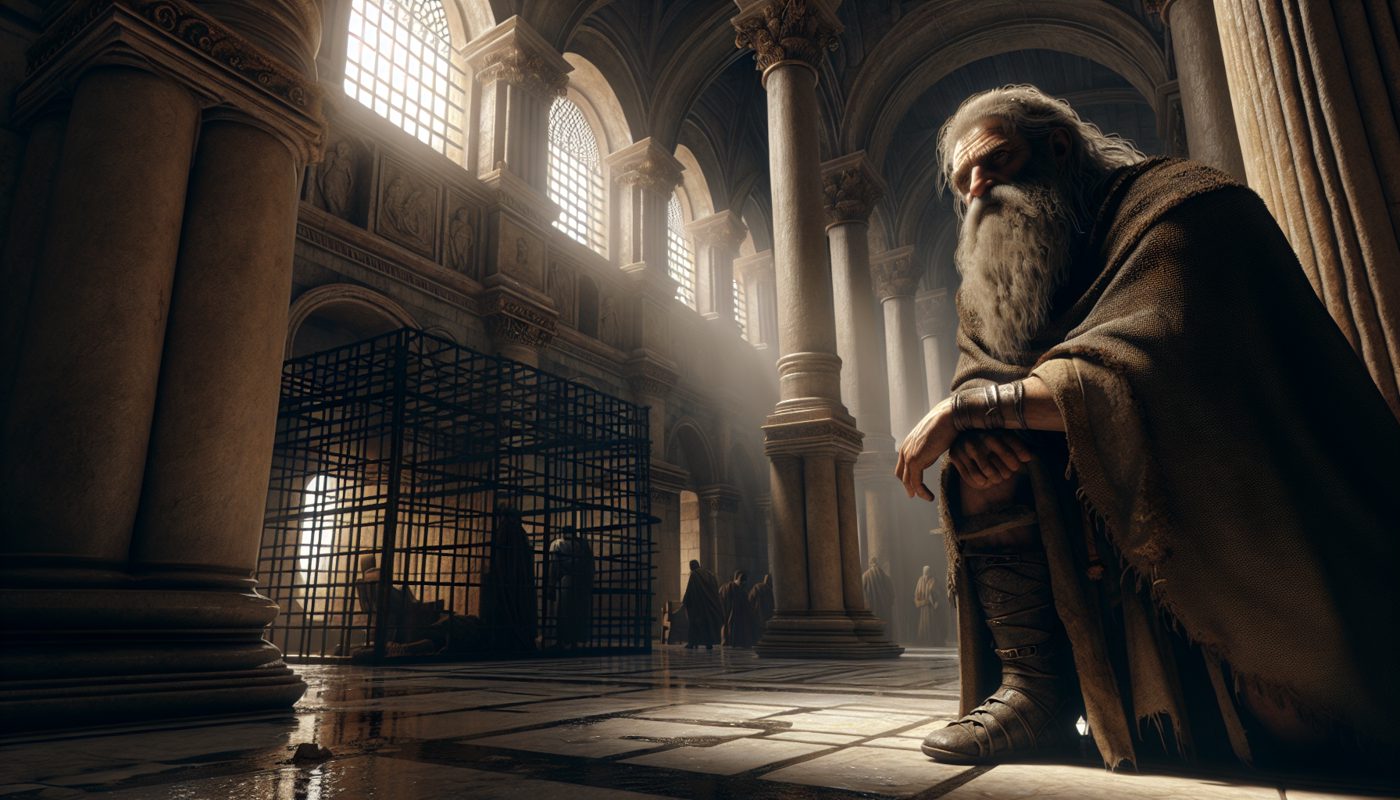
The new governor had been in the province only three days when the chief priests and the leading men of Jerusalem came to him with a request. They wanted Paul sent back to Jerusalem. The chapter does not say they told Festus why, but the text is plain: they were laying a plot to kill him on the road. Festus, a practical Roman, refused the favor. Paul was in custody at Caesarea, and Festus himself would be going there shortly. He told the accusers to come down with him and bring their charges in the proper place.
Within eight or ten days, Festus was seated on the judgment seat in Caesarea. He ordered Paul brought in. The Jews who had come down from Jerusalem stood around the prisoner, bringing many serious charges, but the text says they could not prove any of them. Paul’s defense was direct: he had done nothing against the law of the Jews, against the temple, or against Caesar.
Festus, however, wanted to gain favor with the Jews. He asked Paul if he would be willing to go up to Jerusalem and be judged there on these matters. It was a political question, not a legal one. Festus knew the charges were hollow, but he was new to the post and the chief priests were powerful. Sending Paul back would have been a concession to them, and the plot on the road would have done the rest.
Paul refused. He stood before Caesar’s judgment seat, he said, and that was where he ought to be judged. He had done no wrong to the Jews, and Festus knew it. Then he spoke the words that shifted the entire case out of Festus’s hands: if he had done anything worthy of death, he would not refuse to die. But if the accusations were false, no man could hand him over to the Jews. He appealed to Caesar.
Festus conferred with his council and then gave his answer: you have appealed to Caesar; to Caesar you shall go. The appeal was a legal right for Roman citizens, and it ended the provincial governor’s authority over the case. Paul would now be sent to Rome, to stand before the emperor himself. The plot of the chief priests had failed. Paul would not be ambushed on the road to Jerusalem.
Some days later, King Agrippa and his sister Bernice arrived in Caesarea to pay their respects to the new governor. They stayed for several days, and Festus used the time to lay Paul’s case before the king. He explained the situation: a prisoner left by Felix, accusations from the chief priests and elders in Jerusalem, a request for a death sentence that Festus had refused because Roman custom required the accused to face his accusers and make his defense.
Festus told Agrippa that when the accusers appeared, they brought no charge of the evil he had expected. Instead, the dispute was about their own religion and about a certain Jesus, who had died, but whom Paul claimed was alive. Festus admitted he was perplexed how to investigate such matters. He had asked Paul if he would go to Jerusalem, but Paul had appealed to the emperor, and Festus had ordered him kept until he could be sent.
Agrippa said he would like to hear the man himself. Festus promised that he would hear him the next day. The following morning, Agrippa and Bernice entered the audience hall with great pomp, accompanied by the chief military officers and the leading men of the city. At Festus’s command, Paul was brought in.
Festus addressed the assembled company directly. He pointed to Paul and said that all the Jews, both in Jerusalem and here, had cried out that he ought not to live any longer. But Festus had found that Paul had committed nothing worthy of death. Since Paul himself had appealed to the emperor, Festus had determined to send him. The problem was that Festus had no specific charge to write to his lord, the emperor. It seemed unreasonable to him to send a prisoner without also stating the charges against him.
The chapter ends with Festus explaining that he had brought Paul before Agrippa and the others so that, after an examination, he might have something to write. The case was unresolved, the charges were vague, and the governor was stuck with a prisoner he could neither condemn nor release. Paul would speak again, but the chapter closes on the note of administrative necessity: a Roman governor needing a report, a king curious to hear the prisoner, and a man in chains who had already set his course for Rome.
Comments
Comments 0
Read the discussion and add your voice.
Members only
Sign in to join the conversation
We keep comments tied to real accounts so the discussion stays clean and trustworthy.
No comments yet. Be the first to add one.