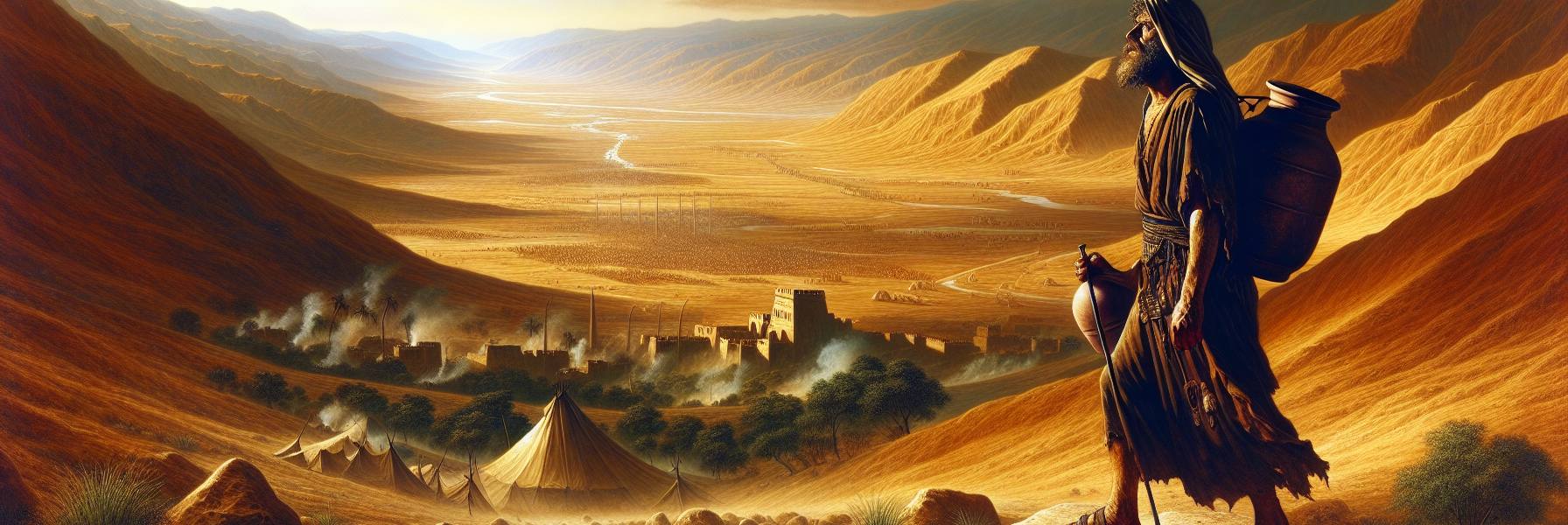

The heat was the first thing. It lay upon the hills of Judah like a heavy wool blanket, stale and suffocating. Eliab felt it in the creak of his sandals on the crumbling limestone path, in the slow trickle of sweat tracing a path through the dust on his neck. From his vantage, the valley below was a simmering bowl of shadow and ochre light. And there, upon the plain, like a festering sore upon the skin of the land, was the camp of the Assyrians.
He shifted the strap of his waterskin, the gesture more habit than need. The vessel was nearly empty. Everything felt empty. Lachish, that proud fortress city, was now a clenched fist against the horizon, besieged, surrounded by the endless, patient machinery of conquest. Eliab was not a soldier. He was a scribe, a man of letters and law, who had fled the city with a small group of shepherds and farmers when the vanguard appeared. Now he was a watcher, a useless witness to the devouring of his world.
His thoughts, as they so often did these days, turned inwards, into a dark and airless chamber. He looked down at the Assyrian host—thousands of men moving with the purpose of ants, the glint of spearpoints like a field of malicious stars. *They have no fear of God.* The phrase came to him unbidden, not as pious reflection, but as a cold, clinical observation. It was in their precision, their utter lack of reverence for the land, their defiling of the springs. They acted as if the cosmos were a clockwork they themselves had wound, as if the God of Abraham, of Isaac, of Jacob, was a local superstition, a tale for children and old women. A sigh escaped him, weary to the bone. *The fool has said in his heart, ‘There is no God.’*
He remembered the debates in Jerusalem before it all fell apart—the smooth-cheeked courtiers with their borrowed Babylonian philosophies, whispering that Yahweh was but one god among many, a tribal deity whose power ended at the border. He remembered the hollow ceremonies in the Temple, the priests going through motions while their eyes sought political favor. Corruption. That was the word. It was not merely evil; it was a rottenness, a turning away from the source of life until life itself became putrid. *They are corrupt, and have done abominable iniquity; there is none that does good.*
Eliab’s eyes scanned the ridge line. His people were there, hiding in caves, scattered in gullies. Good people, some of them. Brave women, stubborn old men, children with eyes too large for their faces. But were they *good*? In the crushing silence of the wilderness, petty jealousies flared. The strong hoarded the last of the grain. A man from Hebron had stolen a blanket from a weeping widow from Anathoth just the night before. Fear had peeled back the thin veneer of community, revealing the raw, self-interested pulp beneath. He saw it in himself—the quick, instinctive clutch at his own loaf of bread, the flash of resentment when a stranger drew too near his sleeping spot. *God looked down from heaven upon the children of men, to see if there were any that did understand, that did seek God.* The gaze he imagined was not one of anger, but of a profound, terrible loneliness. A father looking upon his sons, each one busily setting fire to his own portion of the inheritance, each one convinced of his own cleverness.
A sudden gust of wind, hot and gritty, whipped across the escarpment, carrying with it the distant, unmistakable sound of a ram’s horn—not the clear call of the Temple, but a harsh, blaring signal from the Assyrian lines. Activity rippled through the camp. Siege engines, monstrous wooden tortoises, began their slow, inexorable crawl up the ramp of earth and stone they had been building for weeks against the walls of Lachish. From this distance, the defenders on the walls were mere stick figures. He saw a shower of arrows arc from the battlements, pathetically small against the scale of the assault. Then came the answering cloud from the Assyrian archers, so thick it dimmed the sun for a moment. The sound that followed was not a crash, but a deep, grinding *thud* as the battering ram found its mark.
Eliab turned away, his stomach clenching. He did not need to see the breach. He knew what followed. The cries that were not of war, but of slaughter. The cruel efficiency of it. *Every one of them has turned aside; they have together become filthy; there is none that does good, no, not one.* The filth was not just in the act, but in the spirit that permitted it—the utter reduction of human beings, image-bearers of the divine, to obstacles or objects. The Assyrians consumed nations as a locust swarm consumes a field, with that same mindless, devouring hunger. And his own people, in their corruption, had made the land soft for the swallowing.
He sat heavily on a rock, the weight of despair a physical pressure on his chest. This was the end. Not just of a city, but of a story. The promise seemed a child’s fantasy now, drowned in the iron reality below. Where was the deliverance? Where was the mighty hand? Heaven was silent, a polished bronze bowl inverted over the world, reflecting only the smoke and the suffering.
For a long time, he heard only the dry whisper of the wind and the muffled, terrible din from the city. Then, a different sound. A scrabbling, a dislodging of pebbles. He started, hand going to the small knife at his belt. From a cleft in the rock behind him, a face appeared—streaked with dirt and terror, a young boy, perhaps ten years old. He was followed by a girl, his sister maybe, and then an old woman, her movements stiff with fear and age. Refugees from a village already overrun. They froze when they saw him.
Their eyes were huge, black pools of pure animal fright. They had seen the horsemen, the old woman whispered hoarsely. They had been hiding for two days. They had no food.
The learned phrases from the psalm echoed in Eliab’s mind: *Have the workers of iniquity no knowledge, who eat up my people as they eat bread?* Here it was, the verse made flesh. The Assyrians consumed people as casually as a man breaks his daily loaf. And yet, as he looked at this ragged, trembling remnant, a strange and quiet thought pushed through the despair. They were here. They had not been eaten. They had been found, not by the enemy, but by him.
Without a word, his earlier inner clutch of possessiveness gone as if it had never been, he uncorked his waterskin and handed it to the boy. He broke his last piece of bread, hard and stale, into three pieces. It was nothing. A meaningless gesture in the face of empire. But as the children ate with the frantic haste of the starving, and the old woman muttered a blessing so ancient the words seemed to crack in her dry mouth, Eliab felt the slightest shift in the air.
The siege below was the overwhelming reality. The corruption was undeniable, universal. But in this tiny, foolish act of sharing, there was a counter-reality, a whisper so faint it could be the wind. The workers of iniquity had their knowledge, their power, their consuming gods. But they did not have *this*. This fragile thread of care, this stubborn, irrational persistence of a kindness that expected no reward. It was not greatness. It was not goodness by the measure of the Law. It was a spark in a vast darkness.
As the sun began to bleed into the west, staining the sky the color of a bruise, the sounds from Lachish changed. The sharp clashes gave way to a lower, more dreadful roar—the sound of a city being sacked. Eliab put his arms around the shivering children, turning them from the view. The old woman wept silently.
*Oh, that the salvation of Israel were come out of Zion!* The final cry of the psalm was not a statement of fact, but a groan of longing, a cry flung from the very depths of the pit. Salvation was not here. Not today. Zion itself was trembling. But as Eliab sat in the gathering twilight, a broken man comforting broken strangers on a hill of despair, he understood the verse for the first time not as a failed promise, but as a direction. Salvation, if it ever came, would have to come *from elsewhere*. It would not arise from the goodness of men, for there was none. It would have to descend, like a stone from heaven, or it would not come at all.
And until then, there were only remnants. Scattered, frightened, corruptible people, waiting in the caves. And the unblinking gaze of heaven, which saw it all, and had not yet spoken its final word. The wind cooled. A single star pricked the violet sky. He held the children closer, and waited.