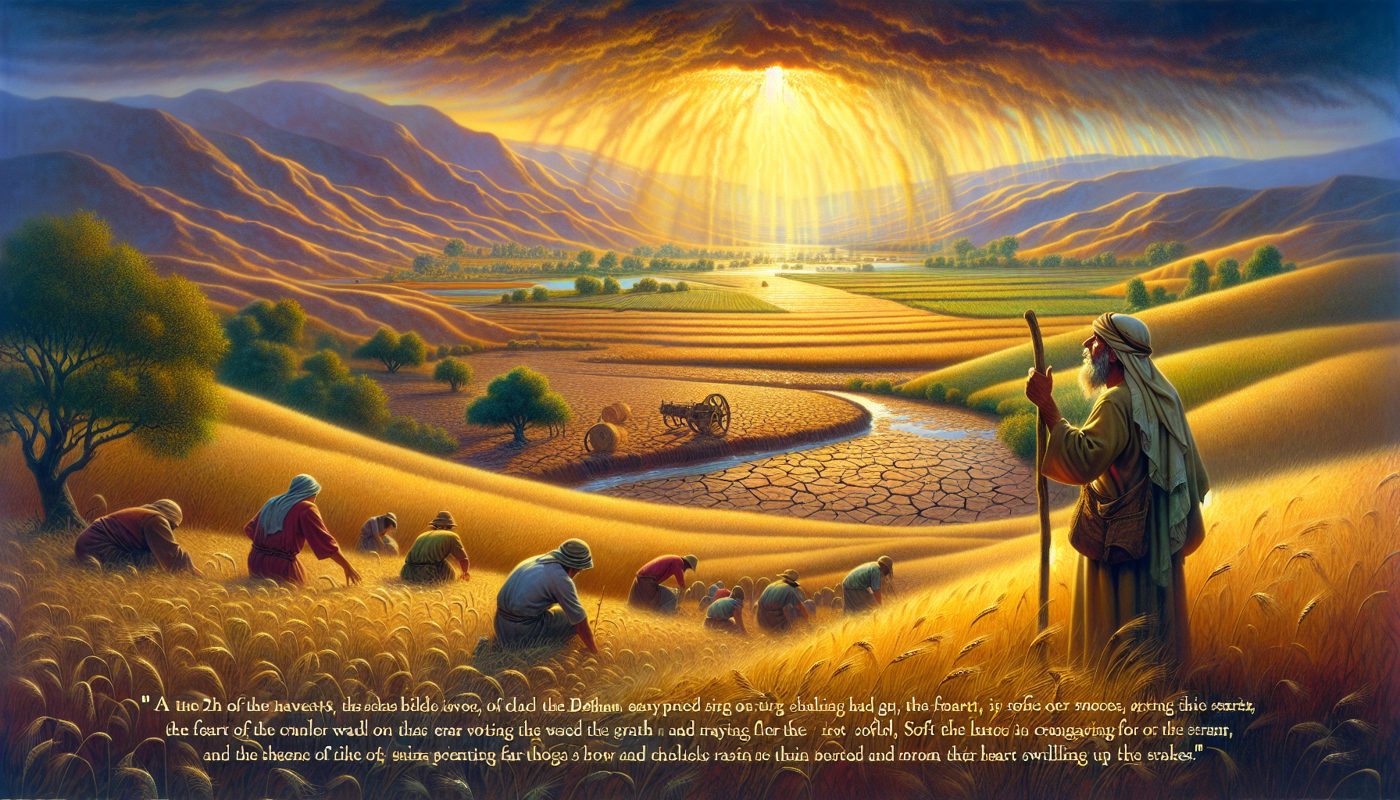
Psalm 65 does not begin with the harvest. It begins with silence. The psalmist says praise waits for God in Zion. That word—waits—carries the weight of a vow not yet fulfilled, of a congregation holding its breath. The temple courts are quiet, but the quiet is not empty. It is the stillness of a people who know that God hears prayer and that all flesh will eventually come to him.
What breaks the silence is not human initiative but divine forgiveness. The psalmist confesses that iniquities prevail, but the Lord forgives transgressions. This is the foundation of the entire song: before the grain grows, before the rain falls, the guilt is removed. The blessed man is not the one who works hardest but the one whom God chooses and causes to approach, to dwell in the courts of the holy temple. Satisfaction comes from the house of God, not from the field.
From that sanctuary confidence, the psalm turns outward. God answers with terrible things—awesome, righteous deeds that shake the earth and the seas. The God who forgives is also the God who sets the mountains fast by his strength, who girds himself with might, who stills the roaring of the waves and the tumult of the peoples. The same power that quiets the ocean quiets the nations. Those who dwell at the ends of the earth see his tokens and are afraid. The morning and evening themselves rejoice at his command.
Then the psalm narrows to one specific visitation. The Lord visits the earth and waters it. He greatly enriches it. The river of God is full of water. That phrase—the river of God—is not a metaphor for a gentle stream. It is the source of life itself, poured out from the throne of the one who controls the seas and the mountains. The Lord provides grain because he has prepared the earth. The preparation is not passive. He waters the furrows abundantly, settles the ridges, softens the soil with showers, and blesses the springing of the crop.
The harvest is not a lucky outcome of weather patterns. It is a crown. The Lord crowns the year with his goodness. His paths drip with abundance. The language is almost excessive: fatness, joy, shouting, singing. The pastures of the wilderness—places no one cultivates—are soaked in this bounty. The hills put on joy like a garment. The valleys are covered over with grain, and they do not merely grow; they shout and sing.
This is not a farmer's report. It is a liturgical vision. The whole earth becomes a temple choir. The pastures are clothed with flocks, the valleys with grain, and the response is not human gratitude but the land's own voice. The psalmist does not say the people sing. The pastures and valleys sing. The creation itself responds to the Creator's visitation.
But the psalm holds together only because of the opening. Without the forgiveness of transgressions, the abundance would be empty. Without the stilling of the seas, the river of God would be just another current. The same God who answers with terrible righteousness also answers with rain. The same God who chooses a man to dwell in his courts also crowns the year with goodness.
Psalm 65 does not ask for anything. It does not plead or lament. It simply waits, confesses, and watches. The harvest is not the point. The point is that the Lord who forgives and the Lord who waters are the same Lord. The year is crowned not by the grain but by the goodness that gives it.
Comments
Comments 0
Read the discussion and add your voice.
Members only
Sign in to join the conversation
We keep comments tied to real accounts so the discussion stays clean and trustworthy.
No comments yet. Be the first to add one.