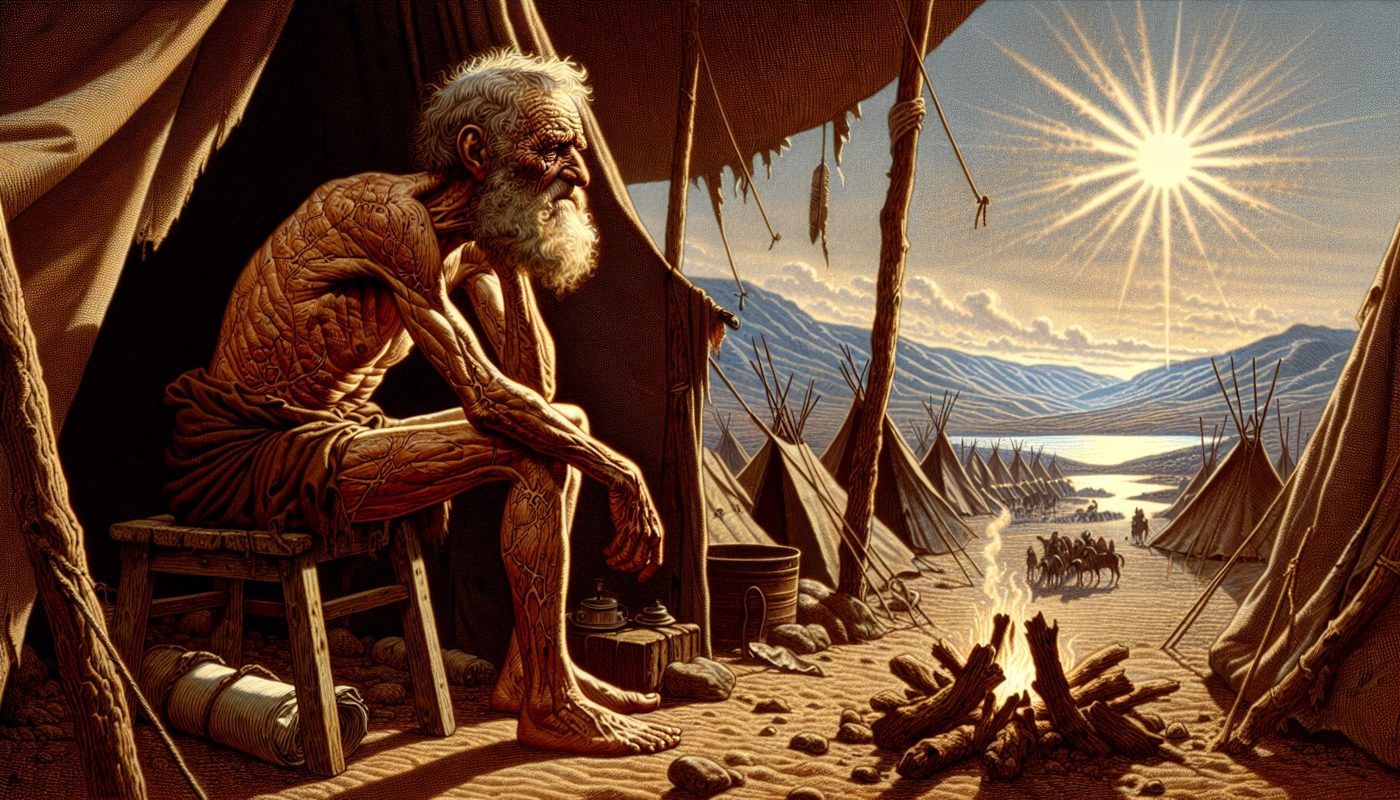
The Lord did not soften the message. He told Joshua plainly: you are old, advanced in years, and very much of the land remains to be possessed. There was no comfort in the phrasing, only a blunt accounting of what had not been done. The campaigns had taken a lifetime, but the map was still full of names that had not been subdued.
The chapter opens with a list of the unconquered territories. The regions of the Philistines, the five lords of Gaza, Ashdod, Ashkelon, Gath, and Ekron. The Geshurites. The Avvim on the south. The land of the Canaanites, the Sidonians, the Amorites. The Gebalites. All Lebanon from Baal-gad under Mount Hermon to the entrance of Hamath. The hill country from Lebanon to Misrephoth-maim. The Lord said he would drive them out, but the command to Joshua was immediate: allot the land as an inheritance anyway.
That is the strange pressure of the chapter. The land was not yet taken, but the Lord ordered it divided. Joshua was to act as though the conquest was finished, assigning parcels of ground that still held armed inhabitants. The inheritance was to be given before the enemy was removed. Faith and strategy folded into one motion.
The chapter then turns east of the Jordan, where Moses had already given land to the tribes of Reuben, Gad, and the half-tribe of Manasseh. The boundaries are recited with precision: from Aroer on the edge of the Arnon valley, through the plain of Medeba to Dibon, all the cities of Sihon king of the Amorites, and the kingdom of Og in Bashan. These were the lands Moses had taken in battle, and they were already assigned.
But the chapter also records a failure. The children of Israel did not drive out the Geshurites or the Maacathites. Those peoples still lived among them, and the text notes that they dwell in the midst of Israel to this day. The sentence is flat, almost clinical, but it carries the weight of unfinished business. The inheritance was given, but the clearing of the land was not complete.
The tribe of Levi received no territory. The Lord himself was their inheritance, as he had spoken to Moses. The offerings made by fire to the Lord were their portion. That arrangement set Levi apart from the other tribes, a reminder that the distribution of land was not purely about property. It was about how each tribe would relate to the Lord and to the rest of Israel.
The boundaries for Reuben are traced in detail: the edge of the Arnon, the plain by Medeba, Heshbon, Dibon, Bamoth-baal, Beth-baal-meon, Jahaz, Kedemoth, Mephaath, Kiriathaim, Sibmah, Zereth-shahar, Beth-peor, the slopes of Pisgah, Beth-jeshimoth. The list is dry, but it marks the ground that a tribe was expected to hold and defend. Every name was a place where families would live, flocks would graze, and enemies would test the border.
The chapter also notes that Balaam the son of Beor, the soothsayer, was killed with the sword among the slain of Midian. That detail is tucked into the land grant for Reuben, a reminder that the conquest had not been bloodless. The prophet who had been hired to curse Israel died in the same campaign that cleared the eastern territory.
Gad's inheritance ran from Jazer through Gilead, half the land of the Ammonites, and down to the Sea of Chinnereth east of the Jordan. The half-tribe of Manasseh received Bashan, all the towns of Jair, and half of Gilead. The chapter closes by repeating that Moses distributed these inheritances in the plains of Moab beyond the Jordan at Jericho, and that Levi received no land because the Lord was their inheritance.
The chapter is not a victory march. It is a survey of what remained, a legal document for land that was not yet fully possessed. Joshua was old, and the work was not finished. The Lord did not promise that Joshua would see it completed. He simply told him to divide the land and move on.
Comments
Comments 0
Read the discussion and add your voice.
Members only
Sign in to join the conversation
We keep comments tied to real accounts so the discussion stays clean and trustworthy.
No comments yet. Be the first to add one.