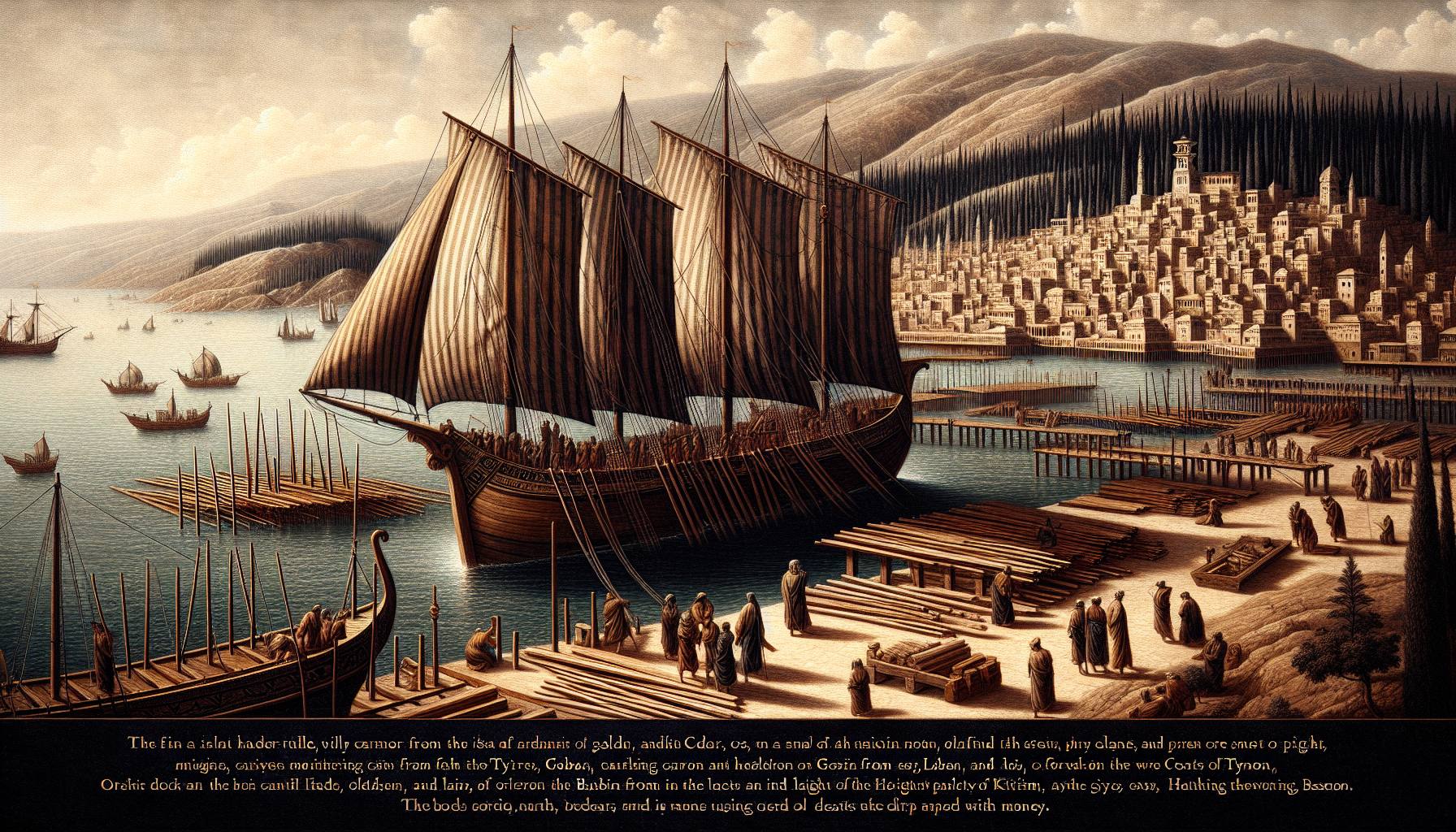
The Lord commanded Ezekiel to take up a lamentation over Tyre, and the prophet obeyed by building a ship. Not a real ship, but a poem of one, assembled from the finest materials the known world could supply. The fir trees came from Senir, the cedar from Lebanon, the oaks from Bashan, the ivory from the isles of Kittim. The sail was fine embroidered linen from Egypt; the awning was blue and purple from the isles of Elishah. The rowers were from Sidon and Arvad; the pilots were Tyre's own wise men; the caulkers were the old men of Gebal. The Lord did not describe a city. He described a vessel, perfect in beauty, built in the heart of the seas.
And that vessel was not only built to sail. It was built to trade. The Lord listed the merchants and their goods with the cold precision of a customs ledger. Tarshish brought silver, iron, tin, and lead. Javan, Tubal, and Meshech traded slaves and vessels of bronze. Togarmah brought horses and mules. Dedan traded ivory and ebony. Syria brought emeralds, purple, embroidered work, fine linen, coral, and rubies. Judah and the land of Israel traded wheat from Minnith, and pannag, and honey, and oil, and balm. Damascus brought wine of Helbon and white wool. Arabia and the princes of Kedar brought lambs, rams, and goats. Sheba and Raamah brought the finest spices, precious stones, and gold. The list went on. Tyre did not produce much of this. Tyre was the deck where the world's wealth changed hands.
The Lord made sure the reader understood the scope. The ships of Tarshish were Tyre's caravans. The city was replenished and made very glorious in the heart of the seas. It was not a boast. It was a statement of fact, spoken by the Lord himself, before he shattered the vessel.
Then the east wind came. The Lord did not describe a siege or an invasion. He described a shipwreck. The rowers brought Tyre into great waters, and the east wind broke her in the heart of the seas. The riches, the wares, the merchandise, the mariners, the pilots, the caulkers, the dealers, the men of war, the entire company—all of it fell into the heart of the seas on the day of her ruin. The Lord did not say the enemy broke her. He said the wind broke her. Tyre was not conquered. Tyre was sunk.
The pilots cried out, and the suburbs shook. The rowers and mariners and pilots came down from their ships and stood on the land. They cried bitterly, cast dust on their heads, wallowed in ashes, made themselves bald, and put on sackcloth. They wept in bitterness of soul with bitter mourning. They took up a lamentation and asked, 'Who is there like Tyre, like her that is brought to silence in the midst of the sea?' The question hung in the air, unanswered.
The Lord answered it indirectly. When Tyre's wares went forth, she filled many peoples. She enriched the kings of the earth. But in the time she was broken by the seas, her merchandise and all her company fell in the midst of her. The wealth did not save her. The merchants did not save her. The pilots did not save her. The east wind did not consult the trade routes.
The inhabitants of the isles were astonished. The kings were horribly afraid; their faces were troubled. The merchants among the peoples hissed at Tyre. She became a terror, and the Lord declared she would nevermore have any being. The lamentation ended not with a sigh, but with a finality. The ship was gone. The deck was empty. The sea was quiet.
The Lord did not write this lamentation for Tyre's benefit. Tyre was already sinking. He wrote it for Ezekiel, and for the people who would hear the poem and recognize the shape of their own pride in the hull of that beautiful, doomed vessel.