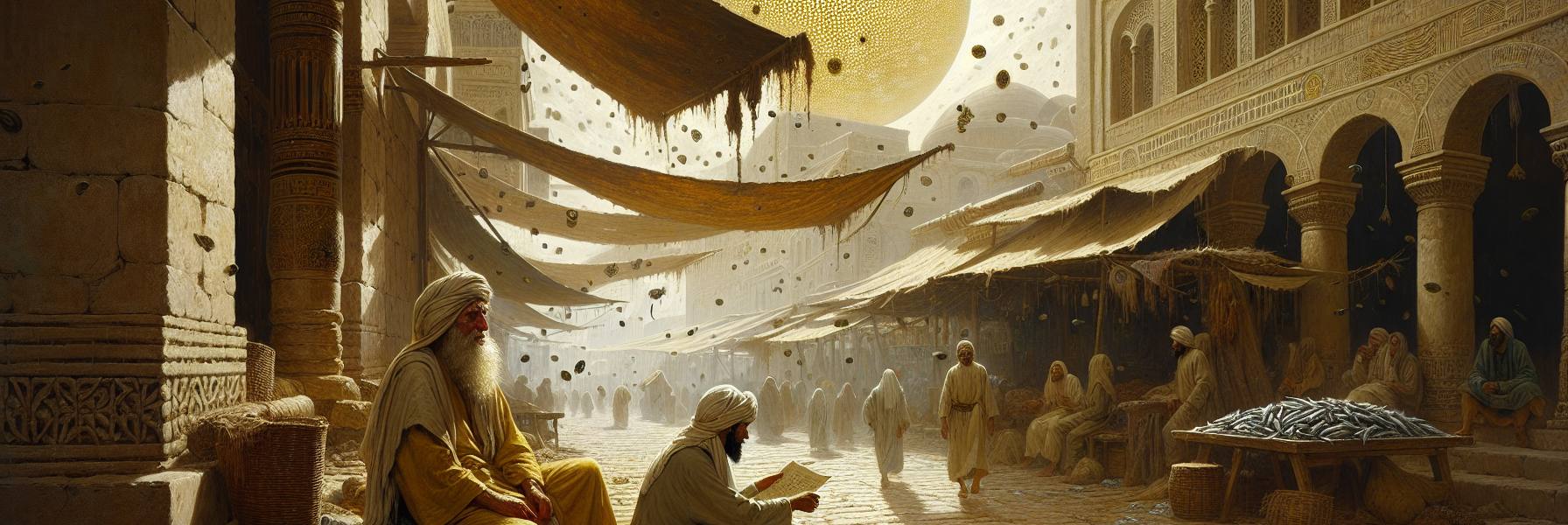

The sun was a white, hammered disc in a bleached sky, the kind of heat that made the very air over the cobbles waver. In the lower city, the stench of the fish market mingled with the dust, and the flies drew lazy circles in the heavy silence of midday. Old Jotham sat in the patch of shade provided by his sagging awning, a piece of worn papyrus on his knee. He wasn’t reading it. He was just looking at the street, his eyes like chips of flint.
A young man, Eliab, squatted nearby, fanning himself with a broad leaf. “You’re quiet today, teacher.”
Jotham grunted. “Watching fools at work. It’s a richer lesson than any scroll.”
Down the way, a commotion broke the stillness. A city official, a minor functionary in robes slightly too fine for the district, was attempting to direct the repair of a low retaining wall. His voice was high and reedy with insistence. “No, not that stone! The grey one! Place it there, by the—no, you’ve unbalanced it!”
The mason, a solid man with forearms like knotted rope, wiped sweat from his brow and said nothing. He had already laid a course of sturdy limestone. The official pointed at a pile of softer, sandy-colored rock, decorative but weak. “Use these. They have a more pleasing appearance for those approaching from the west.”
The mason looked at the stone, looked at the official, and gave a slow, almost imperceptible shrug. He began to dismantle the good work.
Eliab shook his head. “The wall will weep mud at the first rain.”
“A little folly,” Jotham said, his voice a dry rustle, “outweighs wisdom and honor. That one, with his fancy hem, is like a great prince who becomes hungry. He has the authority, but his judgment is empty. He thinks the sound of his own voice is the same thing as wisdom.”
The scene shifted. Later, as the sun began to slope, they saw a wealthy merchant’s son, drunk on new wine and his own inheritance, stumbling from a tavern. He decided, in his fog, to lead his own caravan train through the Needle’s Eye Gate instead of the wider Merchant’s Gate. The carts were too broad. He cursed the drivers, shouted at the oxen, creating a knot of chaos that blocked traffic for an hour. A quiet, dusty caravan master from Edom, watching from the sidelines, simply turned his camels and took a longer, quieter route around the city wall. He would be at the watering hole before the rich boy had even cleared the gate.
“The wise man’s heart leads him to the right,” Jotham murmured, more to himself than to Eliab. “The fool’s heart leads him to the left. And everyone following him just learns to curse under their breath.”
But the old teacher’s gaze grew darkest when he spoke of the palace on the hill. It was not open rebellion that troubled him; it was a slow, quiet decay. “I have seen servants on horses,” he said, his eyes distant, “and princes walking on the ground like servants.” He told of a shrewd scribe, born of nothing, who knew how to flatter and remember small favours, now overseeing the granaries, while a true-born son of a counsellor was sent to count tiles in a remote garrison. The order of things had become unmoored, not by conquest, but by a thousand small acts of cunning and neglect.
“He who digs a pit may fall into it,” Jotham said one evening, as they watched a cruel overseer, who had engineered the downfall of a rival, get caught in his own web of lies and be stripped of his position. The man’s face was ashen with a shock that was almost pathetic. “And whoever breaks through a wall, a serpent may bite him.” The tools of malice, he meant, have a way of turning in the hand.
The lessons were in the grain of the day. The careless boy who swung his sickle with wild, angry strokes and nicked his own leg. The woodcutter who didn’t take time to wet his axehead, so that the iron grew dull and he had to exhaust himself with double the blows. “Wisdom makes the tools effective,” Jotham would say. “But you cannot chop wood with the handle of an axe. You need the iron. You need the bite of it. Knowledge without application is just a noise.”
Eliab began to see it everywhere. The king’s quiet, restrained words that calmed a heated council were like the gentle, precious oil that ran down Aaron’s beard. But the rash, slanderous whisper of a courtier, that was the fly in the ointment—a small, dead thing that could make the whole batch of perfumer’s oil stink and be thrown out. The destruction was out of all proportion to the cause.
As the seasons turned, Eliab learned the weight of Jotham’s silent observations. The world, the teacher seemed to say, was not governed by a clean ledger of justice. Sometimes the ship of state, for all its size and grandeur, could be steered into ruin by a single, small, foolish rudder. The stones of a solid house could be undermined by the persistent gnawing of mice. And a curse, uttered without cause, was like a bird let loose from the hand—it might circle, it might land anywhere, but you could never truly call it back.
On Jotham’s last day, before he took to his bed for the final time, he looked at Eliab with a clarity that was startling. “Remember the bread of idleness,” he whispered. “It tastes sweet at first. But it leads to a house that leaks, a roof that sags. And the field of a lazy man… I have walked by them. The stones are many, and the thorns choke everything. It is a slow, green death.”
He died as the rainy season began. And when the first heavy storm washed down from the hills, Eliab heard that the low retaining wall in the lower city, the one built with the pretty, sandy stone, had slumped into a heap of mud, blocking the drain and flooding three shops. The official, they said, was blaming the mason.
Eliab walked through the dripping streets, the words of the Teacher now alive in the very mud on his sandals. It was all so… unnecessary. That was the haunting heart of it. The folly wasn’t always dramatic evil; it was so often just a bad choice, a lazy thought, a prideful whim, set against the patient, solid, unhurried way of wisdom. And the rain fell on both the wise and the foolish, but only one of them had built a roof that could keep it out.