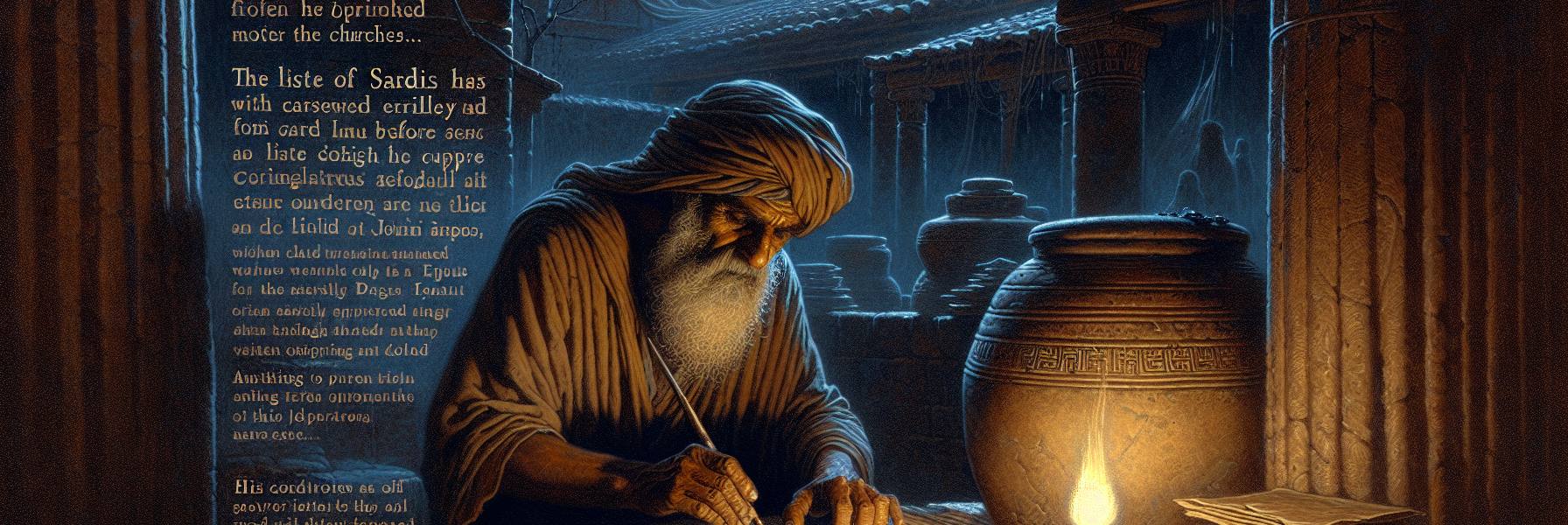

The ink was the cheap kind, gritty between my fingers as I ground it, the water from the cistern tasting faintly of clay. My lamp guttered, casting more shadow than light across the parchment. It was late, the kind of late where the great city of Ephesus finally falls into a murmuring quiet, and the weight of years settles on a man’s shoulders. My name is Linus, and I am old. My task, given by the elder John before his exile, was to copy and circulate the letters. Not just any letters—the words dictated by the Spirit to the churches. The one I worked on tonight was for Sardis, and it chilled me more than the night air.
“You have a reputation for being alive,” the words began, stark and unadorned. I could see Sardis in my mind’s eye—a city perched on a rotten tooth of a mountain, smug in its past glory. Its church was the same: all façade, no pulse. I dipped my reed pen. The description wasn’t of some grand apostasy, no roaring persecution. It was a death by minutiae. The slow seep of comfort. The unfinished deeds. The faith that had become a relic, polished for show but empty of breath. “Wake up!” the letter insisted, a shout into a tomb. “Strengthen what remains.” My hand shook a little. It’s easier to fight a dragon, I thought, than to resurrect a sleeping man.
I had been to Sardis once, years ago. I remembered the luster of their synagogue, the fine robes of their leading brothers. Their services were impeccably ordered. And yet, over a meal, the conversation had turned only to business, to the price of wool, to petty grievances. Not a word of Christ’s return. Not a hunger for the prophets. A living name on a dead body. The letter promised a few in Sardis who had “not soiled their garments.” They would walk with the Lord in white. I pictured them—a quiet weaver, perhaps, a slave girl praying in a corner, unknown to the great ones, known utterly to God. Their faithfulness was the true architecture holding the place up.
Before Sardis, I had copied the letter to Thyatira. That was a different sickness altogether. Not sleep, but a fevered, tolerant zeal. Thyatira was a guild town, and its church had learned to bend. A woman they called Jezebel, with a prophet’s voice but a serpent’s counsel, taught that deep knowledge meant freedom to dabble in the feasts of the trade guilds—feasts that ended in the back rooms of idol temples. It was a sophisticated compromise. “Love and faith and service and patient endurance,” the Lord acknowledged. Their recent works were even greater than the first. But they tolerated the lie. The imagery shifted from sleep to fire: “I will throw her onto a sickbed… and I will strike her children dead.” The severity was breathtaking. Love, it seemed, had a ferocious, unblinking edge when it came to truth. The promise to the overcomer there was visceral, earthy: authority over nations, a rod of iron, and the morning star. Not just peace, but a share in the coming, terrible, beautiful judgment.
And then Philadelphia. My heart always eased when I reached Philadelphia. A church with “little power.” They hadn’t bowed the knee to the clever synthesis, nor fallen into the stupor of Sardis. They had simply “kept my word and not denied my name.” The letter to them was all open doors. An open door no one could shut. The key of David. The synagogue of Satan—those who claimed the heritage of Abraham but traded in slander—would be made to bow before them. The promise was one of preservation from the “hour of trial” coming on the whole world. Not escape from suffering, but protection from the final, annihilating wrath. And a pillar in the temple, a permanent place, with the names of God, the New Jerusalem, and Christ’s own new name written on them. A place of unshakeable belonging. I sighed, a sigh of longing. That was the church I wanted to die in.
Last of the seven was Laodicea. Ah, Laodicea. The words were scalding. “Lukewarm.” Neither hot like the healing springs of Hierapolis, nor cold and refreshing like the snowmelt from Colossae. Tepid. Vomit-inducing. And their self-assessment! “Rich, prosperous, in need of nothing.” They were the bankers, the ophthalmologists, the textile magnates. They had solved their own problems. The Lord’s diagnosis was brutal: “Wretched, pitiable, poor, blind, and naked.” He counseled buying gold refined by fire, white garments, salve for their eyes. The irony was rich and painful. The one who had everything to sell had nothing they would buy from him. And then, the most haunting image of all: “Behold, I stand at the door and knock.” The sovereign Lord, outside his own church. Not a conquering king, but a patient suitor. If anyone *heard*—that intimate, personal act—and opened, he would come in and share a meal. Not a throne-room audience, but table fellowship. Intimacy offered to the complacent.
I finished the final line for Sardis, my neck stiff. The lamp flame dwindled to a blue bead. These were not ancient archives to me. They were mirrors. I saw Ephesus, where I now lived, in the warning about lost first love. I saw my own pride in Laodicea’s smugness. I found my hope in Philadelphia’s fragile fidelity.
The letters weren’t just condemnation or comfort. They were a revelation of a Christ who walked among the lampstands, his eyes like flame, his feet like burnished bronze. He knew. He knew the secret struggles, the hidden sins, the quiet faithfulness. He was the one who opens and no one shuts, who shuts and no one opens. He was the Amen, the faithful and true witness. He was the beginning of God’s creation, present at the dawn, present now in the stuffy back rooms of these provincial churches.
I blew out the lamp. In the perfect dark, the words seemed to glow on the back of my eyelids. “He who has an ear, let him hear what the Spirit says to the churches.” It was an invitation, not a conclusion. A summons to listen, now, in the present tense. The story wasn’t over. It was being written in the hearts of the weary, the compromised, the steadfast, and the sleeping. And the one who conquered… he would sit with the conqueror on his throne. Just as he, himself, had conquered and sat down with his Father.
The dawn would come soon. I would send the copies out. They would be read aloud in gatherings, a voice cutting through the smoke of incense and the rustle of daily life. And someone, somewhere, might just hear the knock on the door, and rise to open it.