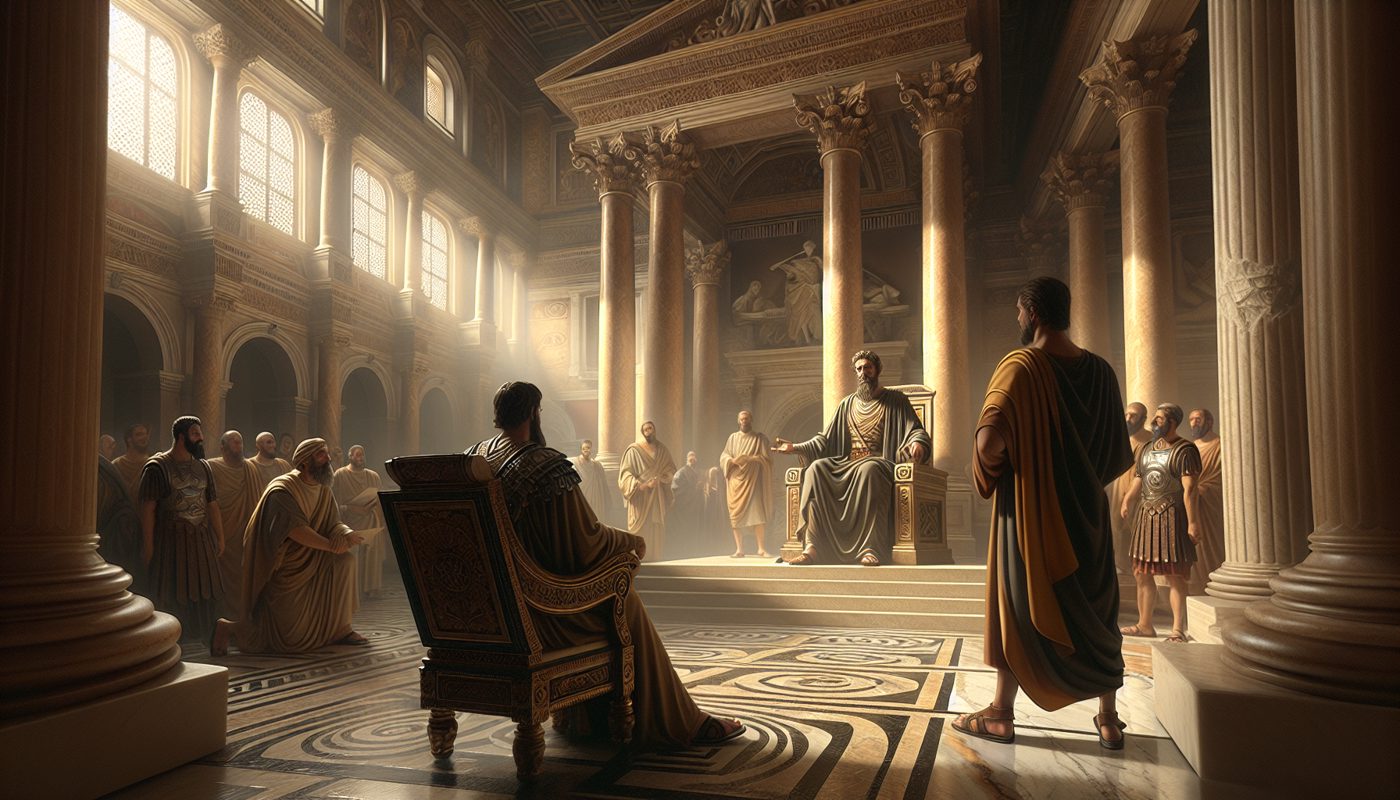
The hearing in Caesarea opened with a hired voice. Tertullus, an orator brought from Jerusalem, laid the flattery on thick before Felix the governor—peace through your foresight, reforms by your providence, all gratitude, most excellent Felix. The preamble was standard. The substance was not. Tertullus called Paul a pestilent fellow, a mover of insurrections among Jews everywhere, a ringleader of the sect of the Nazarenes, a man who tried to profane the temple. The charges were designed to sound like a threat to Roman order, but they rested on no evidence brought to the room.
Paul answered when Felix beckoned him. He spoke with the confidence of a man who knew the timeline worked against his accusers. Twelve days, he said. Twelve days since he went up to Jerusalem to worship. In that time, no one found him disputing in the temple, stirring up a crowd in the synagogues, or causing trouble anywhere in the city. The men from Asia who started the uproar were not present to testify. The council in Jerusalem had found nothing wrong with him except one thing—he had shouted about the resurrection of the dead.
Paul did not deny that he served the God of his fathers according to the Way, which his accusers called a sect. He believed everything written in the law and the prophets. He held the same hope his accusers claimed to hold—a resurrection of both the just and the unjust. That hope, he said, was why he exercised himself to keep a clear conscience toward God and men at all times. The offerings and alms he brought to his nation were the real reason he came to Jerusalem, not to cause trouble.
Felix had more exact knowledge about the Way. The text does not say how he acquired it, but he knew enough to see that this was not a straightforward sedition case. He adjourned the hearing, saying he would decide the matter when Lysias the commander came down from Jerusalem. In the meantime, Paul was kept in custody, but with indulgence. His friends were not forbidden to visit and help him.
Felix did not wait for Lysias. After some days, he sent for Paul again. This time his wife Drusilla, a Jewess, sat with him. Felix wanted to hear Paul speak about faith in Christ Jesus. Paul obliged, but he did not give a soft presentation. He reasoned with the governor about righteousness, self-control, and the judgment to come. The effect was immediate. Felix became terrified.
But terror did not produce release. Felix sent Paul away, saying he would call for him again when a convenient season arrived. The convenient season never came. Felix kept sending for Paul often, but the motive had shifted. He hoped Paul would offer him a bribe. The governor who had the authority to release an innocent man kept him in chains, waiting for money that never appeared.
Two years passed. Felix was succeeded by Porcius Festus. Before he left office, Felix did one last thing to gain favor with the Jews. He left Paul in bonds. The prisoner who had been found guilty of nothing remained in custody because a Roman governor wanted to stay on good terms with the people who had brought the accusation.
The chapter ends with Paul still in Caesarea, still waiting, still under guard. The hearing that began with polished rhetoric and vague charges had turned into a long, quiet stalemate. Felix had heard the truth, been terrified by it, and chosen to do nothing. The convenient season he waited for never arrived.
Comments
Comments 0
Read the discussion and add your voice.
Members only
Sign in to join the conversation
We keep comments tied to real accounts so the discussion stays clean and trustworthy.
No comments yet. Be the first to add one.