The psalm attributed to the sons of Korah begins with a direct, almost breathless confession: the Lord’s tabernacles are lovely. This is not a casual observation. The word carries the weight of something deeply desired, something that the speaker cannot stop thinking about. The psalmist does not describe the architecture of the temple or the rituals performed there. Instead, he speaks of a longing so intense that his soul faints and his heart and flesh cry out to the living God. The physical body itself is involved in this yearning.
The third verse introduces a peculiar and sharp image. The sparrow finds a house, and the swallow finds a nest where she may lay her young. These are small, common birds, not majestic temple fixtures. Yet the psalmist places them at the altars of the Lord of hosts. The point is not that birds are holy, but that even they have a settled place near God, while the psalmist himself feels like he does not. The altars are home to the birds, but the speaker is still outside, longing to get in.
The psalm then pronounces a blessing on those who dwell in the Lord’s house. These are people who never leave, who are always in the courts, and whose lives are spent in praise. The Selah that follows forces a pause. It asks the reader to sit with the idea that some people actually live there, and that their constant praise is not a burden but a blessed state.
A second blessing follows, this time for the man whose strength is in the Lord and in whose heart are the highways to Zion. This shifts the focus from those already inside to those who are still traveling. The highways are not literal roads. They are a disposition, a fixed intention to go to the place where God is. The strength to make the journey does not come from the traveler’s own legs but from the Lord.
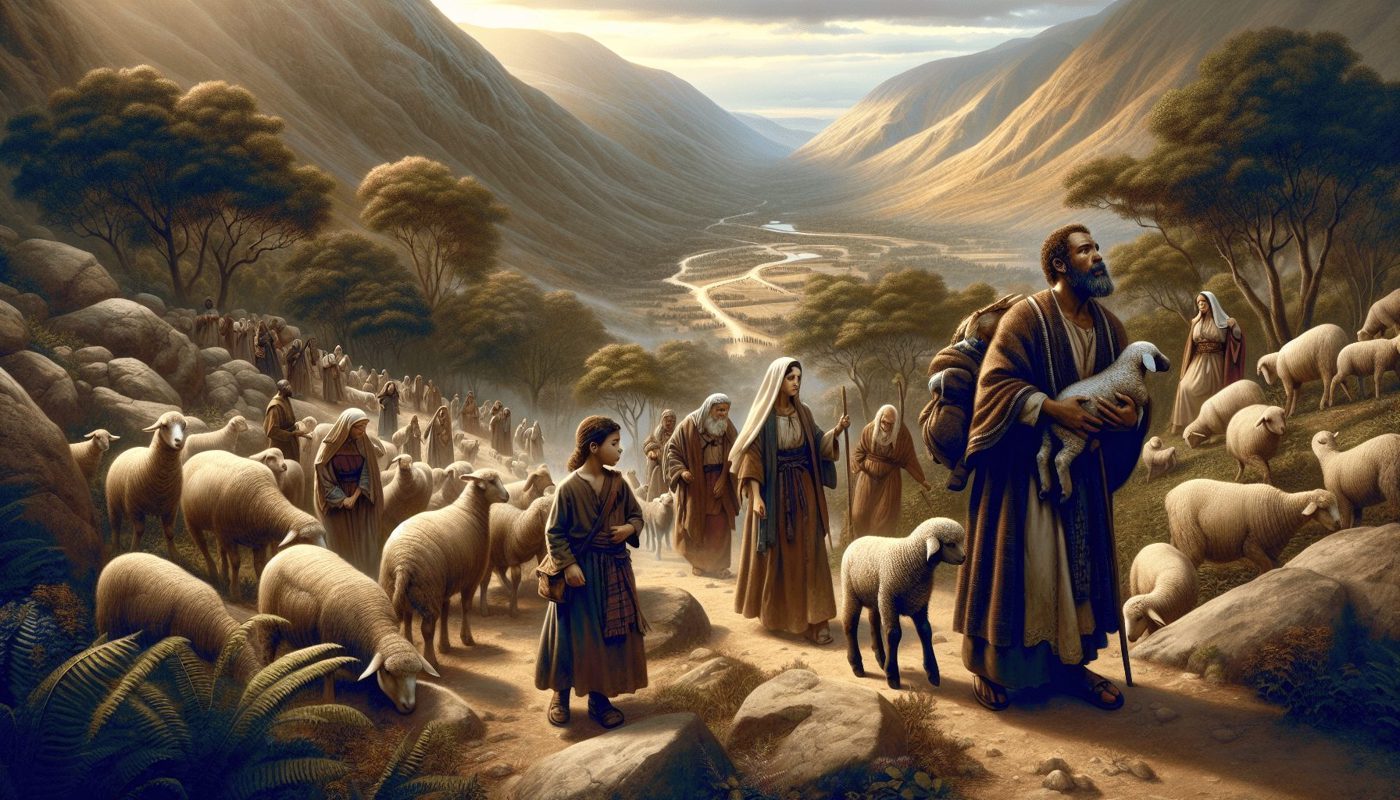
The journey itself is described in a single compact verse. The pilgrims pass through the valley of Weeping, and they transform it into a place of springs. The early rain covers it with blessings. The psalm does not explain how this happens. It simply states that the presence of the Lord, or the act of traveling toward it, changes the landscape of sorrow into something that gives water. The weeping valley becomes a source of refreshment.
These travelers go from strength to strength. They do not weaken as they walk. They grow stronger. And every one of them appears before God in Zion. The verse insists on the collective nature of the pilgrimage. No one is left behind. The entire company arrives.
At verse eight, the psalm turns into a direct prayer. The psalmist asks the Lord God of hosts to hear him, and the God of Jacob to give ear. He then asks God to look upon the face of his anointed. This is the only moment in the psalm where a specific figure is mentioned, and it is the king, the anointed one. The prayer is that God would see him and act on his behalf.
The tenth verse contains the most famous line of the psalm. A single day in the courts of the Lord is better than a thousand elsewhere. The psalmist then makes a choice that sounds absurd to anyone who values status or comfort. He would rather be a doorkeeper, the lowest servant in the temple, than to dwell in the tents of wickedness. The tents of wickedness may offer ease and wealth, but the doorkeeper stands at the threshold of something infinitely better.
The final two verses give the reason for this choice. The Lord God is a sun and a shield. He gives grace and glory. He withholds no good thing from those who walk uprightly. The psalm ends where it began, with a blessing. But this time the blessing is not for those who dwell in the house or those who travel to it. It is for the man who trusts in the Lord. Trust is the final posture. The courts, the altars, the journey, the weeping valley, the doorkeeper’s post—all of it rests on whether a man will trust the God who is sun and shield.
Comments
Comments 0
Read the discussion and add your voice.
Members only
Sign in to join the conversation
We keep comments tied to real accounts so the discussion stays clean and trustworthy.
No comments yet. Be the first to add one.