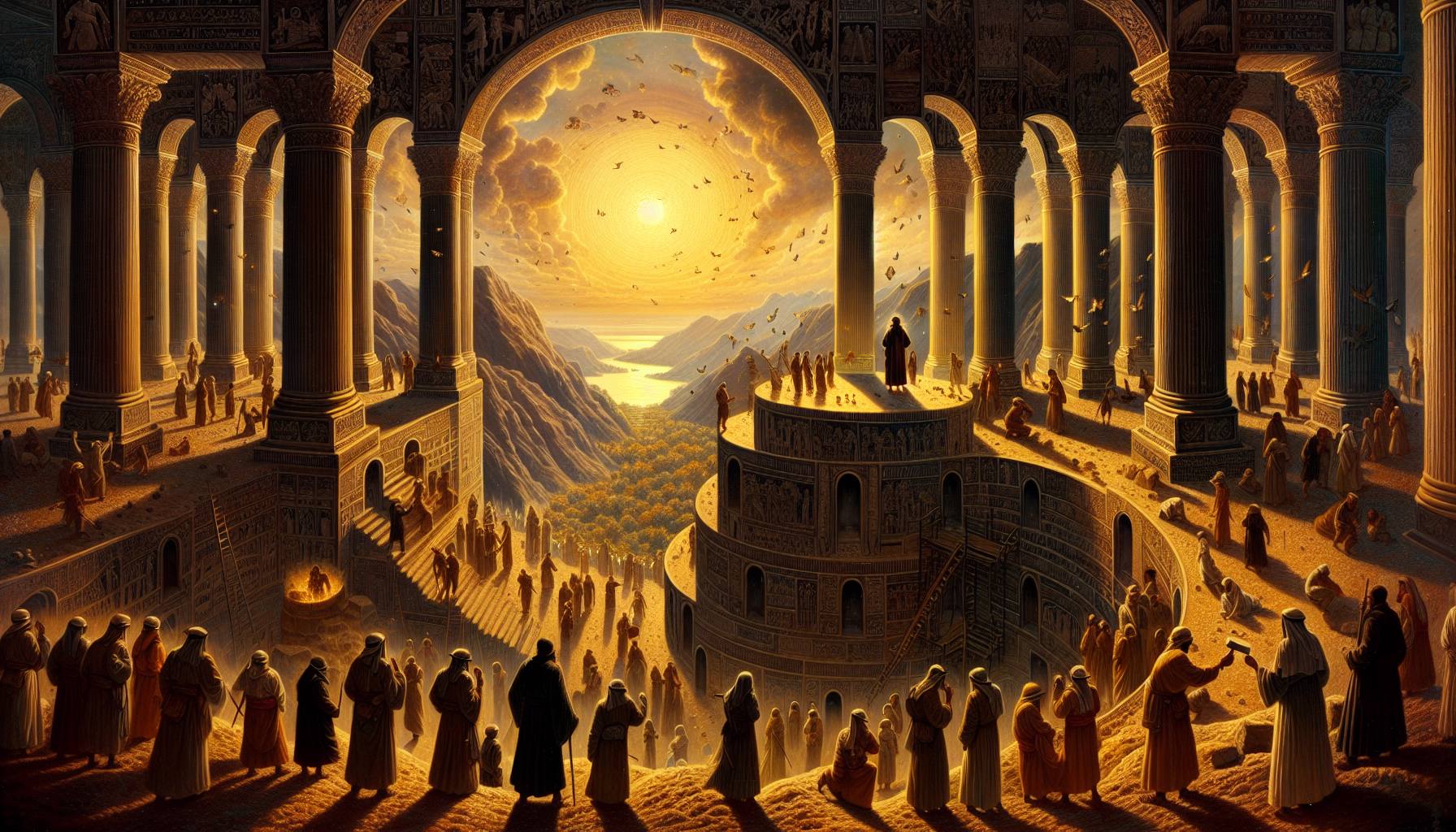
The chronicler gives no speeches when the temple foundation is laid. He gives a date: the second month of the fourth year of Solomon’s reign. That is all. The rest is measurement, material, and the slow inventory of a house being built for the Lord on Mount Moriah—the same mountain where the Lord appeared to David, the same threshing floor of Ornan the Jebusite where the plague stopped. The place had already been marked by judgment and mercy before a single stone was dressed.
The dimensions are given plainly: sixty cubits long, twenty cubits wide, using the old standard measure. That is the footprint. But the porch runs the full width of the house—twenty cubits—and rises to a height of one hundred and twenty cubits. That number is striking. The porch alone towers higher than anything else in Jerusalem. And the chronicler notes that Solomon overlaid it within with pure gold. Gold is not a decoration here. It is the interior skin of the house.
The greater house—the main hall—was paneled with fir wood, then overlaid with fine gold. On that gold the craftsmen carved palm trees and chains. Palm trees and chains: one speaks of life and abundance, the other of binding and connection. Together they form a pattern that repeats across the walls. The chronicler does not explain what they mean. He simply records that they were there, carved into the gold, covering the wood.
Then comes the garnishing: precious stones set into the gold for beauty, and the gold itself specified as gold of Parvaim. That name appears only here. No one knows exactly where Parvaim was. But the chronicler names it deliberately, as if the origin of the gold mattered—as if the Lord’s house required not just any gold, but gold from a place that carried its own weight of distance and cost.
The overlay extended to the beams, the thresholds, the walls, and the doors. All of it covered with gold. And on the walls the engravers cut cherubim. The chronicler does not describe their faces or their postures here. He simply says they were there, carved into the gold, guarding the walls the way they guarded the garden in Eden. The house was becoming a place where heaven and earth pressed against each other.
The most holy house—the inner sanctuary—was a cube: twenty cubits long, twenty cubits wide. The chronicler says Solomon overlaid it with fine gold, six hundred talents of it. That is a staggering weight. And then he adds: the weight of the nails was fifty shekels of gold. Even the nails were gold. Nothing in that room was common. The upper chambers were overlaid with gold as well. The chronicler is counting, calculating, making sure the reader understands that nothing was spared.
Inside the most holy house Solomon placed two cherubim of image work, overlaid with gold. Their wings stretched twenty cubits across the room. Each wing was five cubits long, so that one cherub’s wing touched the wall, and the other wing touched the wing of the second cherub. The second cherub did the same. Together their wings filled the width of the sanctuary. The chronicler says they stood on their feet, their faces toward the house—toward the room itself, not toward the entrance. They were looking inward, toward the place where the Lord would dwell.
Then the veil: blue, purple, crimson, and fine linen, with cherubim worked into the fabric. That veil would hang between the holy place and the most holy place, a woven barrier of color and thread and winged guardians. The chronicler does not say how thick it was or how heavy. He only names the colors and the cherubim. The colors come from the same palette used in the tabernacle of Moses, the same dyes that marked the curtains of the wilderness tent. The temple was new, but the pattern was old.
At the front of the house Solomon set two pillars. They were thirty-five cubits high, with capitals of five cubits each. He made chains for the oracle—the inner sanctuary—and placed them on the tops of the pillars. Then he made a hundred pomegranates and attached them to the chains. The pomegranates hung there, red and gold, at the entrance of the house. The chronicler names the pillars: the one on the right he called Jachin, and the one on the left he called Boaz. Jachin means “He will establish.” Boaz means “In Him is strength.” The pillars stood as names, not just supports. They told anyone who entered that the Lord establishes and the Lord gives strength.
The chronicler does not pause to admire the work. He does not tell us how the workers felt or what Solomon prayed. He gives the facts: the gold, the wood, the stone, the cherubim, the pillars, the pomegranates, the veil. The house was built. That is enough. The house was built on the mountain where judgment had fallen and mercy had intervened. And inside, from the nails to the ceiling, it was covered with gold and carved with the presence of the invisible.