
The dust of mourning still hung in the air, a fine, gritty taste that seemed to have settled permanently on the tongue. It clung to Joshua’s robes as he stood alone on the barren rise, looking west. Behind him, the vast, weary camp of Israel sprawled across the plains of Moab, a murmuring sea of tents and tired souls. Before him, beyond the deep, green slash of the Jordan Valley, the land rose into rugged hills, amber and grey in the late afternoon light. That was it. The Land.
His hand tightened around the smooth wood of the staff he now carried. It felt alien in his grasp, too large, holding the memory of a different hand. Moses’ hand. The weight of it was more than physical; it was the weight of a million expectations, of forty years of wandering, of a promise so old it seemed woven into the very stars.
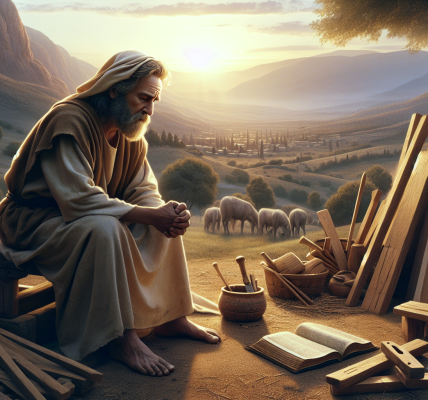
He hadn’t asked for this. He’d been a fighter, a commander, a shadow to a giant. He was comfortable with orders, with strategies, with the clean, hard lines of a battle plan. This was different. This was shepherding. This was the gnawing uncertainty of what came next, when the pillar of cloud and fire was gone.
A hot, dry wind snaked up from the valley, flapping the corner of his cloak. It carried the scent of water, of alien soil, of something wild and untamed. Fear, cold and familiar, coiled in his gut. It was the same fear he’d felt as a young spy, seeing the walled cities and the giants, the same fear he’d battled watching a generation fade into the wilderness sand. Now it was back, wearing a new face: the fear of failing *them*, and failing *Him*.
He didn’t know how long he stood there, trapped between the legacy of the past and the precipice of the future. The sun began to bleed into the horizon, painting the Canaanite hills in hues of fire. It was then, in the quiet collapse of the day, that the words came. Not with thunder or earthquake, but with a clarity that cut through the noise in his spirit like a knife through tent canvas.
“Moses my servant is dead.”
The statement was a brutal, necessary anchor to reality. It wasn’t a voice he heard with his ears, but a knowing implanted deep within his chest, resonant and undeniable.
“Now then, you and all this people, get ready to cross the Jordan River into the land I am about to give to them.”
The command was immediate. No period of extended mourning, no bureaucratic transition. A movement was required. A crossing. The words began to flow into him, a steady, strengthening stream.
“I will give you every place where you set your foot, as I promised Moses… No one will be able to stand against you all the days of your life. As I was with Moses, so I will be with you; I will never leave you nor forsake you.”
Joshua felt his knees tremble. *As I was with Moses.* The promise wasn’t about equaling Moses’ stature, but about the presence that had made Moses who he was. The same presence was offered to him, Joshua, son of Nun, the former slave of Egypt. The trembling didn’t stop, but its source shifted from dread to a profound, terrifying awe.
The words continued, firm and directive. “Be strong and courageous, because you will lead these people to inherit the land I swore to their ancestors to give them.”
*Strong. Courageous.* The phrases were repeated, hammered home like a tent peg securing a shelter in a storm. “Be strong and very courageous. Be careful to obey all the law my servant Moses gave you; do not turn from it to the right or to the left, that you may be successful wherever you go.”
There it was—the indispensable link between the promise and the path. Courage wasn’t a reckless bravery; it was rooted in obedience. Success wasn’t a military conquest alone; it was fidelity to the covenant. The law wasn’t a chain, but the map for the land he was to enter.
“Keep this Book of the Law always on your lips; meditate on it day and night, so that you may be careful to do everything written in it. Then you will be prosperous and successful.”
*Meditate.* The word suggested a low, constant murmur, a conversation with the text, a letting of its truths seep into his thoughts and decisions until they became his own instincts. He saw it then—his leadership would not spring from his own wisdom, but from a mind saturated with the words of God.
“Have I not commanded you? Be strong and courageous. Do not be afraid; do not be discouraged, for the Lord your God will be with you wherever you go.”
The final repetition broke the last resistance within him. It was a command, but it felt like an infusion of spirit. The fear uncoiled, not vanishing, but being outmatched by a greater certainty. The presence was the point. With that, the land, however formidable, was a secondary detail.
The vision of the hills seemed to sharpen. They were no longer just a daunting barrier, but a place where the promise would unfold. He turned from the view, the staff feeling less like a burden and more like a tool in his hand.
He walked back into the camp as dusk settled. The noises of the people—the crying of a baby, the clang of a pot, the murmur of conversations—sounded different. They were the sounds of the people he was to lead. He went straight to the elders, his bearing changed. The uncertainty was gone from his eyes, replaced by a resolved light.
“Prepare provisions,” he said, his voice raspy but clear. “For in three days we are crossing the Jordan to take possession of the land the Lord our God is giving us.”
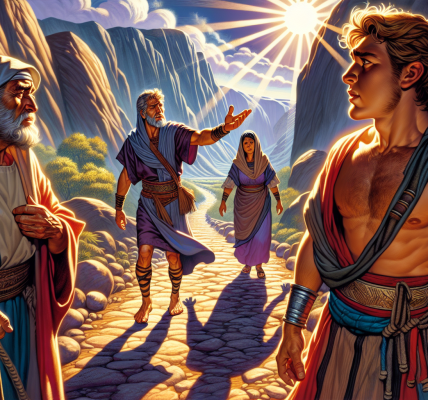
He then summoned the officers of the people and delivered the orders for the camp’s mobilization. Finally, he went to the leaders of the Reubenites, the Gadites, and the half-tribe of Manasseh, the tribes who had chosen their inheritance east of the Jordan. He reminded them of their sworn commitment to fight alongside their brothers until the rest was settled. Their reply was swift and united, a loyalty to him that mirrored his loyalty to the Lord.
“Just as we fully obeyed Moses, so we will obey you. Only may the Lord your God be with you as he was with Moses… Only be strong and courageous!”
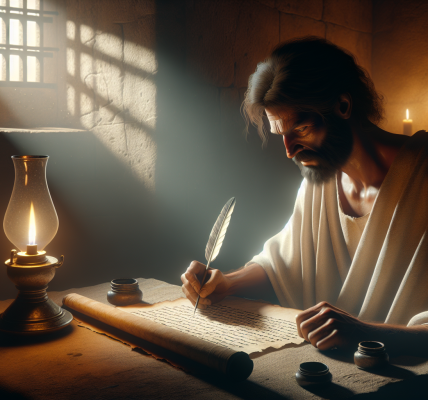
Their words echoed the divine command, a human confirmation of a heavenly charge. As they left his tent, Joshua sat alone again. The night was fully dark now. He reached for the leather scroll case, drawing out the Book of the Law. He unrolled it carefully. He did not read in a frantic search for answers, but slowly, letting the familiar words wash over him in the flickering lamplight. He murmured them under his breath, a low, steady sound. He was meditating. He was preparing to cross. He was, at last, becoming the leader he was called to be, not by the might of his own arm, but by the strength of a promise and the courage found in obedience. The three days had begun.