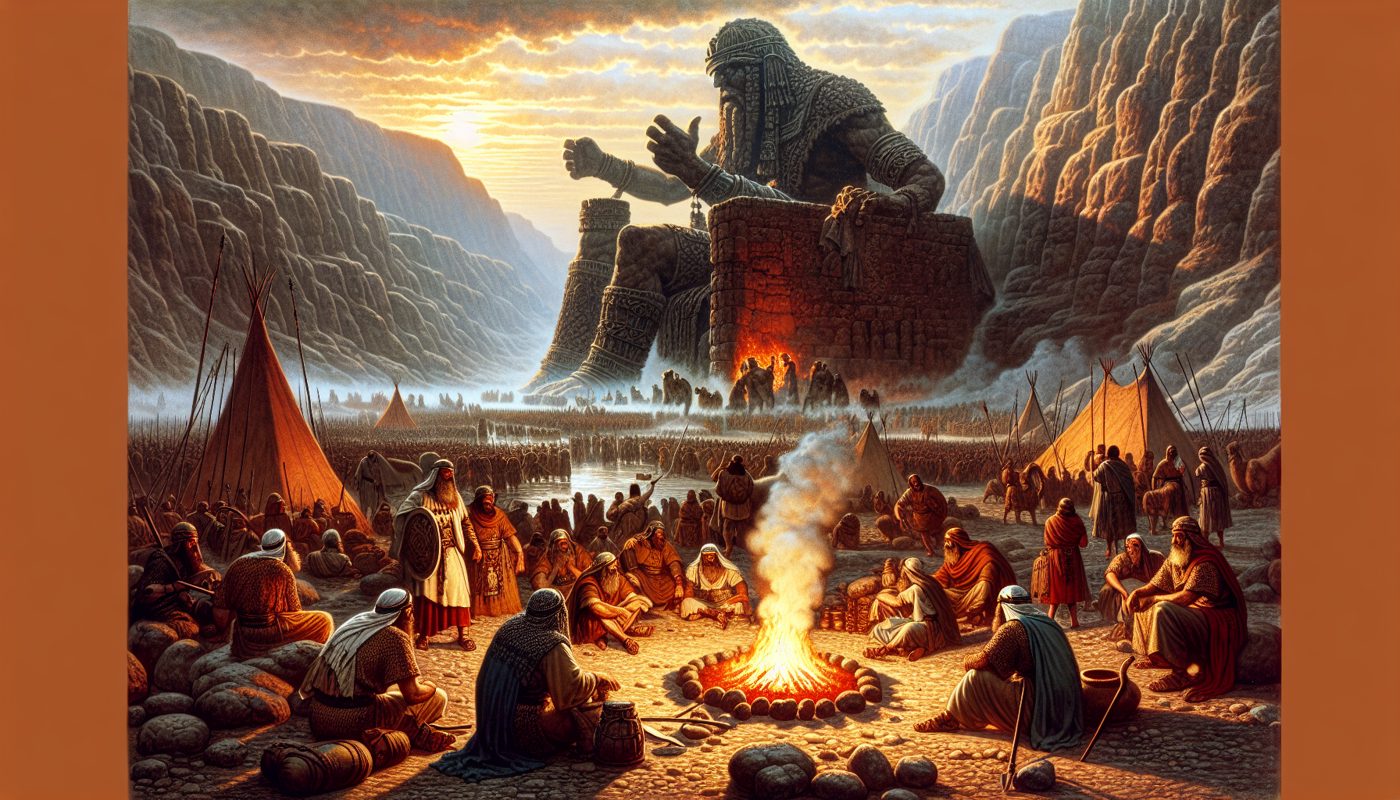
The chapter opens with a military report stripped of glory. Israel turned north into Bashan, and Og the king came out to meet them at Edrei. The text does not linger on the size of the army or the mood of the camp. It moves directly to the Lord’s command: Do not fear him. The fear was real enough to need a direct word. Og belonged to the remnant of the Rephaim, the old race of giants, and the chapter records the dimensions of his iron bedstead—nine cubits long, four cubits wide—still preserved in Rabbah of the Ammonites. The detail is not decorative. It anchors the memory in a measurable object, a piece of furniture that outlasted its owner.
The battle itself is compressed into a single verse. The Lord delivered Og and all his people into Israel’s hand, and they struck him down until no survivor remained. Then the chapter opens into a list. Sixty cities in the region of Argob, all fortified with high walls, gates, and bars, plus a great many unwalled towns. Israel took them all. The destruction was total: every inhabited city, women and children included, was devoted to the ban. Only the cattle and the spoil became plunder for the people. The text does not flinch from the scale of the killing, and it offers no apology. This is the recorded outcome of the Lord’s deliverance.
The land taken stretched from the valley of the Arnon to Mount Hermon, a territory with two names—the Sidonians called it Sirion, the Amorites called it Senir. All the cities of the plain, all Gilead, all Bashan as far as Salecah and Edrei, came under Israelite control. The chapter pauses to note that Og was the last of the Rephaim. His iron bed is a monument to what was finished. The giants were gone. The land was cleared.
Then the chapter shifts to distribution. Moses gave the land east of the Jordan to the tribes of Reuben, Gad, and the half-tribe of Manasseh. The boundaries are named with precision: from Aroer by the Arnon Valley, half the hill country of Gilead, the region of Argob, all Bashan. Jair the son of Manasseh took the whole region of Argob and renamed it Havvoth-jair, a name that lasted to the day the text was written. The land of the Rephaim had a new name and new inhabitants.
But the gift came with a condition. The men of Reuben, Gad, and the half-tribe of Manasseh were to cross the Jordan armed before their brothers. Their wives, children, and cattle would remain in the cities already given them, but the fighting men would not rest until the Lord gave rest to the other tribes on the western side. Only then could they return to their inheritance. The chapter frames this as a command, not a request. The land was not a reward for past loyalty. It was a staging ground for continued war.
Moses then turned to Joshua with a charge. He told Joshua that his own eyes had seen what the Lord had done to Sihon and Og. That same Lord would do the same to all the kingdoms Joshua would face across the Jordan. The command was plain: Do not fear them. The Lord himself fights for you. The words were spoken to Joshua alone, but they were written for every generation that would read them. The pattern of victory was established. The ground of confidence was the Lord’s action, not Israel’s strength.
Then the chapter turns sharply. Moses himself begged the Lord to let him cross over and see the good land beyond the Jordan—that goodly mountain and Lebanon. The request was denied. The Lord was angry with Moses because of the people, and he told Moses to speak no more of the matter. Instead, Moses was to climb to the top of Pisgah and look west, north, south, and east. He would see the land with his eyes, but he would not enter it. The chapter gives no further explanation of the offense. The refusal is final, and the narrative does not soften it.
The command that follows is the practical consequence. Moses was to charge Joshua, encourage him, and strengthen him. Joshua would go over before the people, and he would cause them to inherit the land that Moses could only see from a distance. The transfer of authority is not ceremonial. It is a direct response to Moses’ exclusion. The one who led the conquest east of the Jordan would not lead the conquest west of it. The one who saw the Lord’s hand against Og and Sihon would not see the Lord’s hand against the kings of Canaan.
The chapter ends in a valley opposite Beth-peor. The people stayed there, on the eastern side of the Jordan, with the land they had taken behind them and the land they would take still out of reach. The iron bed of Og was a relic of a defeated past. The view from Pisgah was a glimpse of a future Moses would not enter. The chapter closes with a camp waiting, a leader preparing to hand over his staff, and a people whose inheritance was still incomplete.
Comments
Comments 0
Read the discussion and add your voice.
Members only
Sign in to join the conversation
We keep comments tied to real accounts so the discussion stays clean and trustworthy.
No comments yet. Be the first to add one.