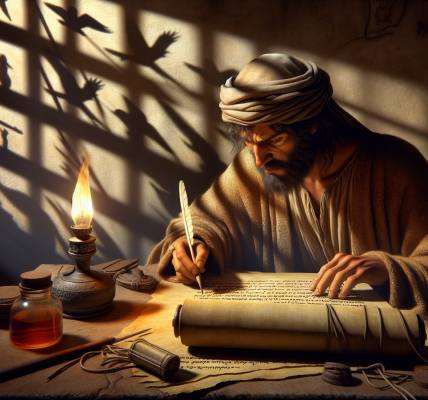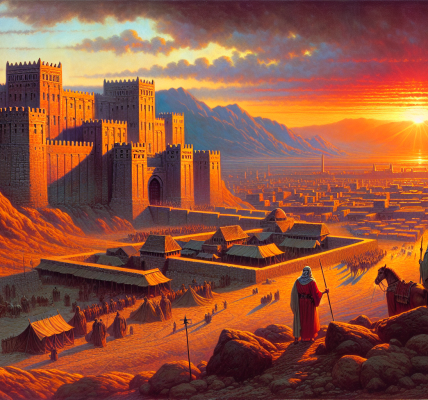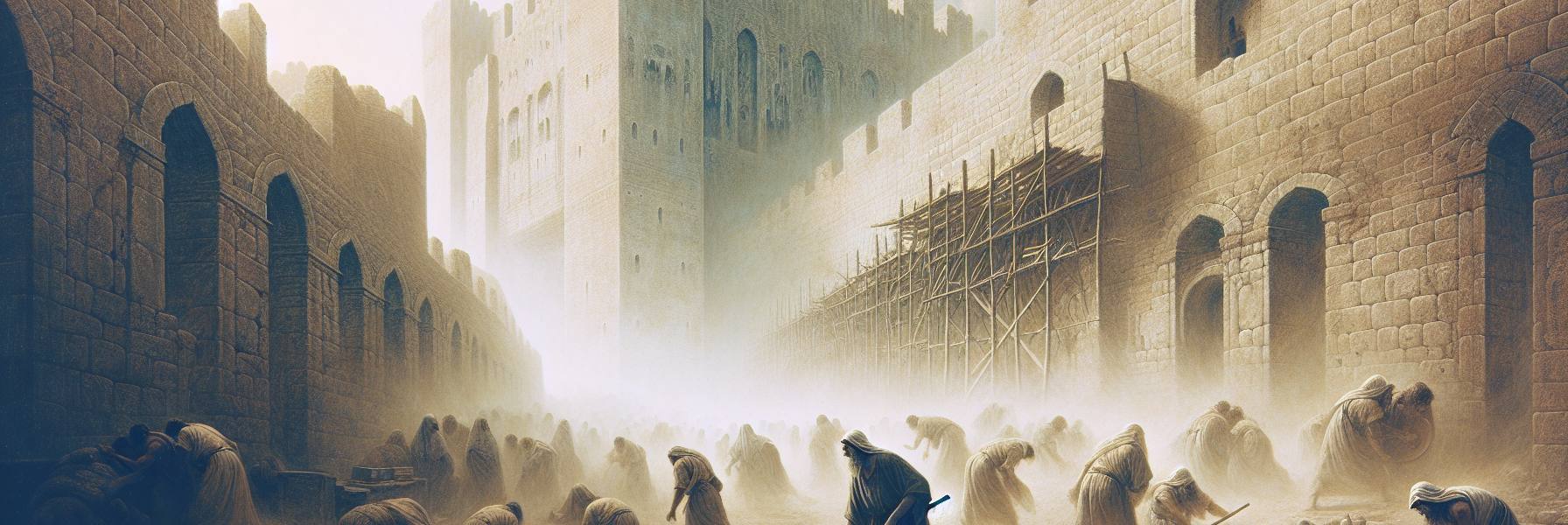

The air in the courtyard was still thick with the dust of returning exiles. Zechariah felt it grit between his teeth, a constant reminder of the long road from Babylon and the longer road still ahead. The walls of Jerusalem were a broken memory—jagged teeth of stone against the pale sky. He had come seeking clarity, a word in the midst of the rubble, and the sleep that finally found him was thin and fitful.
Then the vision came, not as a dream, but as a sudden, sharp clarity overlaying the sleeping world.
He saw a man. Not an angel, at first glance, but a figure holding a measuring line, the kind used by builders. The cord was weathered, the knotted markers dark with use. The man’s face was set with a practical, determined expression. He was striding with purpose, his eyes calculating the lines of the horizon where the city walls should be.
Zechariah understood without being told. The man was to measure Jerusalem. To define its length and breadth, to set its boundaries, to determine the scope of the restoration. It was a sensible thing. A necessary thing. You must know the limits before you can build.
But as Zechariah watched, a strange tightness formed in his chest. The measuring line seemed so small, so terribly finite against the vastness of the sky.
A second figure appeared. A younger man, though the term ‘man’ faltered as Zechariah beheld him. There was a lightness to his step that seemed to leave no imprint in the dust. He moved with an urgency that was not haste.
“Run,” this messenger said, his voice clear as water over stone, addressing Zechariah directly. “Speak to that young man with the measuring line. Say to him: ‘Jerusalem shall be inhabited as villages without walls, because of the multitude of people and livestock in it.’”
The words hung in the vision-air. *Villages without walls.* The very idea was a vulnerability, an insanity in a world of swords and siege ramps. A city defined not by its barriers, but by its lack of them.
Zechariah’s vision-self obeyed. He called out, and the surveyor with the line paused, turning a puzzled face. The message was delivered. The man looked at his cord, its knots meant for counting stones and laying foundations, and slowly, his grip loosened. The line went slack.
Then the first messenger spoke again, and his voice changed, becoming the Voice that had spoken to Moses from the bush, to Elijah in the silence.
“And I myself,” declared the Voice through the messenger, “will be a wall of fire all around her, and I will be the glory within her.”
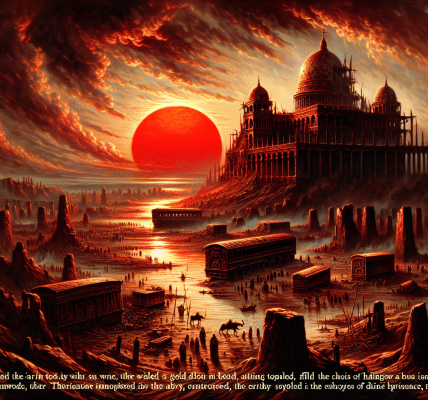
Zechariah felt the words like a physical shock. The dust in his mouth, the grit, it all vanished in a sudden, dry heat. He no longer saw crumbling masonry. He saw a ring of pure, roaring flame, white at its heart, blue and gold at its edges, encircling the entire city—no, not a city, a sprawling, open settlement of homes and fields and vineyards. The fire did not consume; it stood guard. It was a wall that could not be scaled, mined, or breached. And within that ring of protective flame, a softer, brighter light pulsed—a gentle, dwelling radiance in every courtyard, upon every threshold. The glory within.
The Voice continued, now a compelling whisper that pulled at the deepest parts of him. “Up! Up! Flee from the land of the north… for I have spread you abroad as the four winds of the heavens.”
This was not just for Jerusalem. It was for all the scattered ones, those still lingering in the far places of their exile. Babylon was the ‘land of the north,’ the place of comfortable captivity. The call was to escape, not from an enemy army, but from the inertia of belonging elsewhere.
“Escape, O Zion, you who dwell with the daughter of Babylon.”
The scene shifted. Zechariah was no longer looking at Jerusalem. He saw, as if from a great height, the kingdoms of the world—proud, gleaming, armed to the teeth. And the Voice spoke to these powers, a declaration that was neither plea nor negotiation, but simple, overwhelming fact.
“For thus said the Lord of hosts, following his glory sent me to the nations who plundered you, for he who touches you touches the apple of his eye. For behold, I will shake my hand over them, and they shall become plunder for those who served them.”
The apple of His eye. The most tender, guarded, vulnerable part. To threaten Jerusalem—this new, unwalled, Spirit-filled Jerusalem—was to poke a finger directly into the pupil of God. The consequence was an almost casual gesture: a shake of the hand. And the mighty would become the plundered.
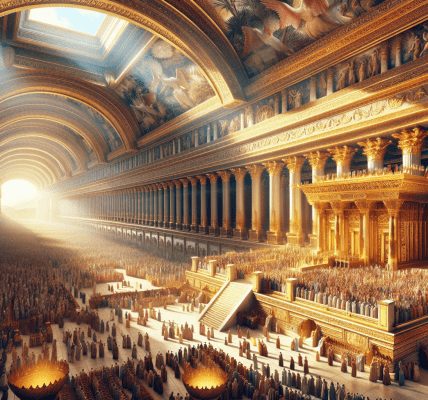
The final words came like a sunset, immense and quiet. “And you shall know that the Lord of hosts has sent me. Sing and rejoice, O daughter of Zion, for behold, I come and I will dwell in your midst… And many nations shall join themselves to the Lord in that day, and shall be my people. And I will dwell in your midst. And you shall know that the Lord of hosts has sent me to you. And the Lord will inherit Judah as his portion in the holy land, and will again choose Jerusalem.”
The vision faded, not with a snap, but like a slow inhalation. The predawn grey was returning to the courtyard. The jagged ruins were there again. But they were different now. They were not the end of a story, but a frame waiting for a picture too large to be contained.
Zechariah sat up. His body was stiff, but his spirit was alight. He could still feel the warmth of the wall of fire, not on his skin, but in his bones. He looked at the toppled stones, and instead of seeing limits, he saw space. Unmeasured, undefended, open space, waiting to be filled with a glory that needed no stone to protect it, and a people who would need to learn a new kind of safety—the safety of being the apple of God’s eye.
He rose, the dust of the exile still on his robe, and went to find the governor and the high priest. He had to tell them they were thinking too small. Their measuring lines were an insult to the future. They needed to prepare not for a fortress, but for a hearth. For God was not coming to rebuild a wall. He was coming to build a home.