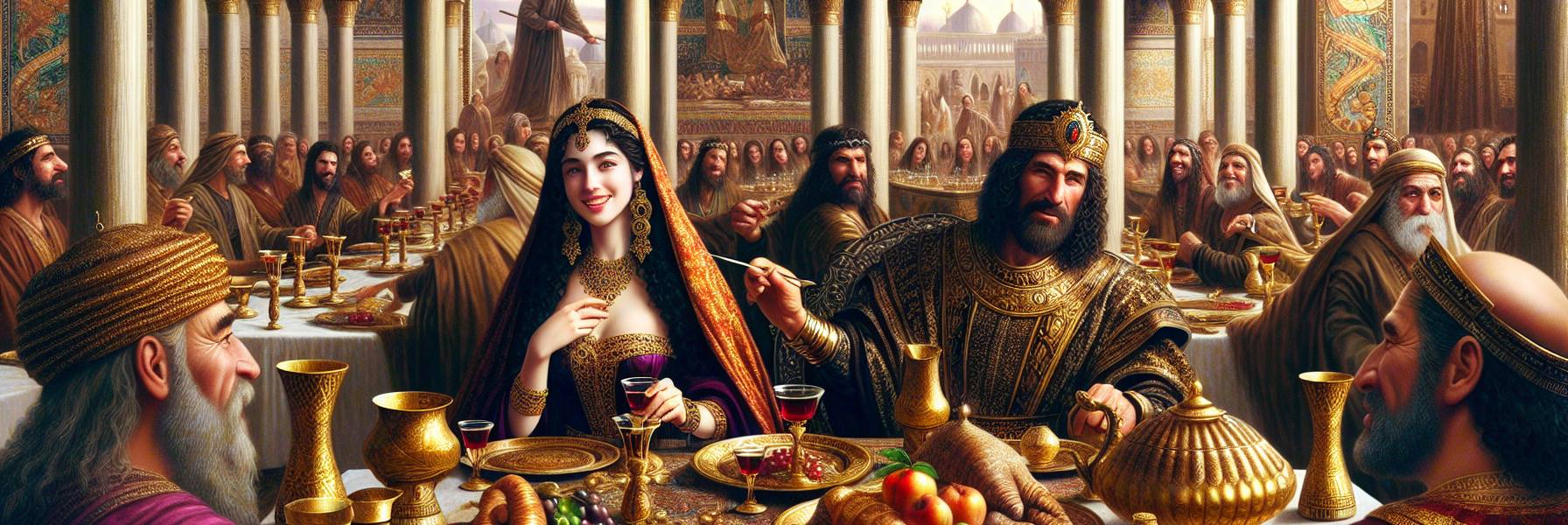

The air in the king’s private banquet hall was thick, heavy with the scent of spiced wine and roasted meats. It clung to Esther’s robes, a perfume of opulence that did nothing to calm the cold knot in her stomach. She sat across from Ahasuerus, the king’s face softened by drink and good company, and beside her, looming like a shadow cast by a tall cypress, was Haman. He was all smiles, his laughter a bit too loud, his eyes lingering on the king’s favor with a possessiveness that made Esther’s skin prickle.
This was her third banquet, the culmination of a dread-filled strategy. The gold and silver cups, the linen, the mosaic floor depicting triumphs of hunting—it all felt brittle, a beautiful shell about to crack. She had waited, and prayed, and now the moment pressed upon her, a weight as tangible as the royal diadem on her brow.
“What is your petition, Queen Esther?” the king asked, his voice warm. “It shall be granted you. Even to the half of my kingdom.” It was the same gracious offer, the same royal formula. But this time, the words were not a courtesy; they were the door swinging open.
Esther drew a breath, so quiet it was lost in the soft hiss of an oil lamp. She felt the eyes of the king, and of Haman, upon her. When she spoke, her voice did not ring out clear and brave as in the songs bards might one day sing. It was low, a thread of sound woven with genuine fear.
“If I have found favor in your sight, O king, and if it please the king, let my life be granted me as my petition, and my people as my request.”
The pleasant haze seemed to evaporate from the king’s countenance. He leaned forward, the fine lines around his eyes tightening. “Your life? What do you mean? Who is he, and where is he, who has dared to do such a thing?” The question was a blade, half-drawn.
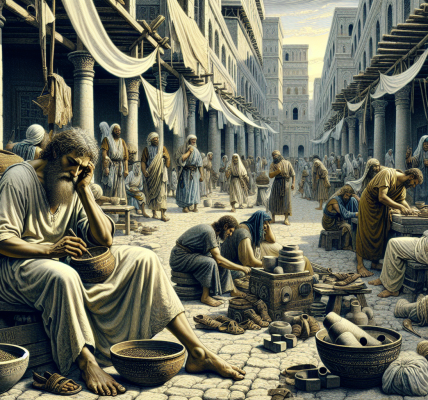
This was the precipice. She could still retreat, speak in circumlocutions, protect herself. But she thought of Mordecai’s sackcloth, of the whispered terror in the Jewish quarter, of the irrevocable edict posted in every language of the empire. There was no shelter left.
“A foe and an enemy,” she said, the words gaining strength now, “this wicked Haman.”
A silence fell, not peaceful, but like the dead calm before a storm at sea. Haman’s face underwent a terrible transformation. The smug assurance drained away, leaving behind the pallor of sheer, uncomprehending terror. His mouth opened slightly, but no sound emerged. He looked from the queen’s fierce, grief-stricken eyes to the king’s, which had turned dark as a thunderhead.
King Ahasuerus rose from his couch. The movement was not dramatic, but it carried the gravity of a mountain shifting. He said nothing. He did not need to. The air in the room became charged, unbearable. He turned and walked out, past the silk hangings, into the palace garden, seeking the cool evening air to master the furnace of his rage.
Haman remained. The reality of his situation crashed down upon him. He, the grand vizier, the second power in the empire, was alone with a queen whose death warrant he had signed. All his plots, his wealth, his towering pride, were now dust. In a frenzy of desperation, he stumbled from his couch and fell upon the couch where Queen Esther reclined, his hands grasping, his voice a choked plea for mercy.
It was at this precise, disastrous moment that the king returned from the garden. He took in the scene: his terrified queen, and his chief minister, sprawled across her couch in a grotesque parody of assault. The king’s voice, when it came, was colder than winter in Susa.
“Will he even assault the queen in my own presence, in my own house?”
The sentence hung in the air. As the words left the king’s mouth, the fate of Haman was sealed. It was no longer about an edict against a people; it was a personal, visceral violation of the king’s own person and honor. The attendants, who had been still as statues, now moved. Harbona, one of the eunuchs, saw his opportunity and stepped forward. His voice was a model of servile efficiency.
“Look,” he said, “the gallows, fifty cubits high, which Haman made for Mordecai—who spoke good on the king’s behalf—is standing at Haman’s house.”
The king did not hesitate. “Hang him on it.”
So they took Haman, his fine robes now soiled with terror, and led him away. The man who had come to feast in the king’s innermost circle was taken to the very instrument of his own spite, the monstrous pole he had erected in his courtyard in a fever of hatred for Mordecai. And there, upon it, he perished.
Only then, the text tells us, did the king’s anger subside. But the story does not end with a neat moral or a celebration. It ends with a quiet, almost stark, transition: the king gave Haman’s estate to Queen Esther, and Mordecai came before the king, for Esther had told him what he was to her. The king gave his own signet ring, taken from Haman, to Mordecai. And Esther set Mordecai over the house of Haman.
It is a scene of providential reversal, yes, but it is not tidy. The edict of annihilation still stands, written in the unchangeable laws of the Medes and Persians. The deliverance is only beginning. The gallows Haman built became his own end, a grim testament to the truth that the trap we set for others often first snaps shut on our own foot. And in the quiet after the storm, a Jewish queen and her cousin are left standing in a palace that is still a dangerous place, holding a ring of power that is both a tool and a target, trusting that the same hidden hand that guided them to this hour is not yet finished with its work. The feast was over. The real work was just beginning.