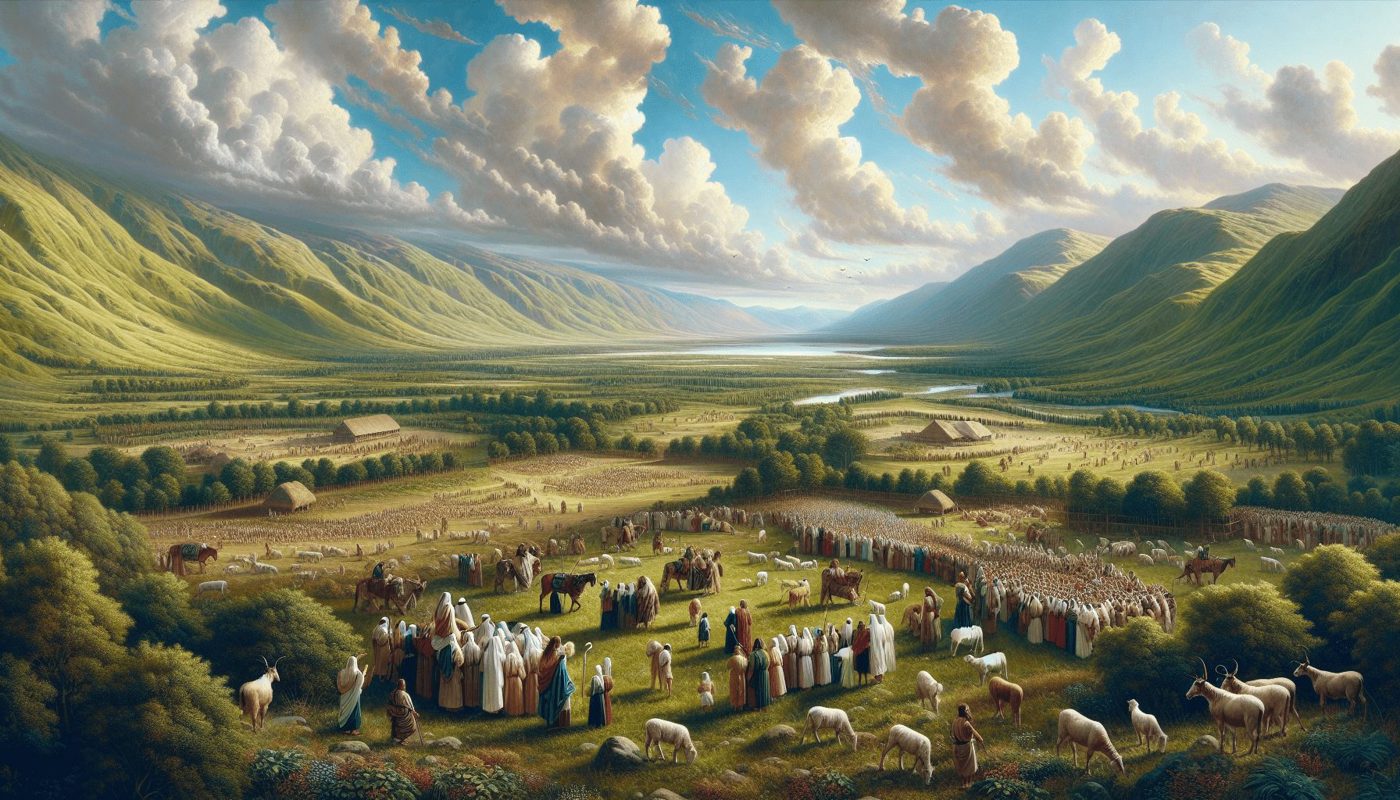
Deuteronomy opens not with law but with a speech. Moses stands on the plains of Moab, east of the Jordan, and begins to tell Israel what happened. The date is precise: the fortieth year, the eleventh month, the first day. The generation that refused to enter the land is dead. Moses is speaking to their children.
He starts at Horeb, the mountain where the Lord gave the law. The command there was clear: you have stayed long enough. Turn, journey, take the hill country of the Amorites, the Arabah, the lowland, the Negeb, the seacoast, the land of the Canaanites, all the way to the Euphrates. The Lord had set the land before them, sworn to their fathers Abraham, Isaac, and Jacob. It was theirs to possess.
But Moses also recalls his own limitation. The people had grown as numerous as the stars. He could not bear their burden, their strife, their disputes alone. So he told them to choose wise, understanding, and respected men from their tribes, and he appointed them as heads over thousands, hundreds, fifties, and tens, and as officers. He charged those judges to hear cases fairly, to show no partiality, to judge the small and the great alike, and to bring hard cases to him. The judgment was God's, not theirs.
From Horeb they traveled through the great and terrible wilderness, as the Lord commanded, and came to Kadesh-barnea. There Moses told them: the Lord your God has set the land before you. Go up, take possession. Do not fear or be dismayed.
But the people came to Moses with a proposal. Let us send men ahead to search the land and bring back word of the way and the cities. Moses thought the plan good. He took twelve men, one from each tribe, and they went up into the hill country, spied out the valley of Eshcol, brought back fruit, and reported that the land was good.
Yet the people refused to go up. They rebelled against the Lord's command. They murmured in their tents, saying the Lord hated them and had brought them out of Egypt only to hand them over to the Amorites. Their brothers had made their hearts melt with reports of tall people, fortified cities, and the sons of Anak.
Moses urged them not to dread or be afraid. The Lord who went before them, who fought for them in Egypt and carried them through the wilderness as a man carries his son, would fight for them again. He had shown them the way with fire by night and cloud by day. But they did not believe.
The Lord heard their words and swore in anger that not one of that evil generation would see the good land, except Caleb, who had wholly followed the Lord. Even Moses was barred from entering, because of the people. Joshua, who stood before Moses, would lead Israel in. The children, whom the people said would be prey, would possess the land. The rest were to turn and go back into the wilderness toward the Red Sea.
Then the people confessed their sin and said they would go up and fight. But the Lord told Moses to warn them not to go, for he was not among them. They did not listen. They went up presumptuously, and the Amorites came out against them like bees, chasing them from Seir to Hormah. The people wept before the Lord, but he did not hear them. They stayed in Kadesh many days.
Moses is not telling a story the people do not know. He is reminding them why they are still east of the Jordan, why the old generation is gone, and why the command to possess the land still stands. The speech is a rebuke wrapped in a history lesson. The failure at Kadesh-barnea is not ancient history to them. It is the reason they are listening now.
Comments
Comments 0
Read the discussion and add your voice.
Members only
Sign in to join the conversation
We keep comments tied to real accounts so the discussion stays clean and trustworthy.
No comments yet. Be the first to add one.