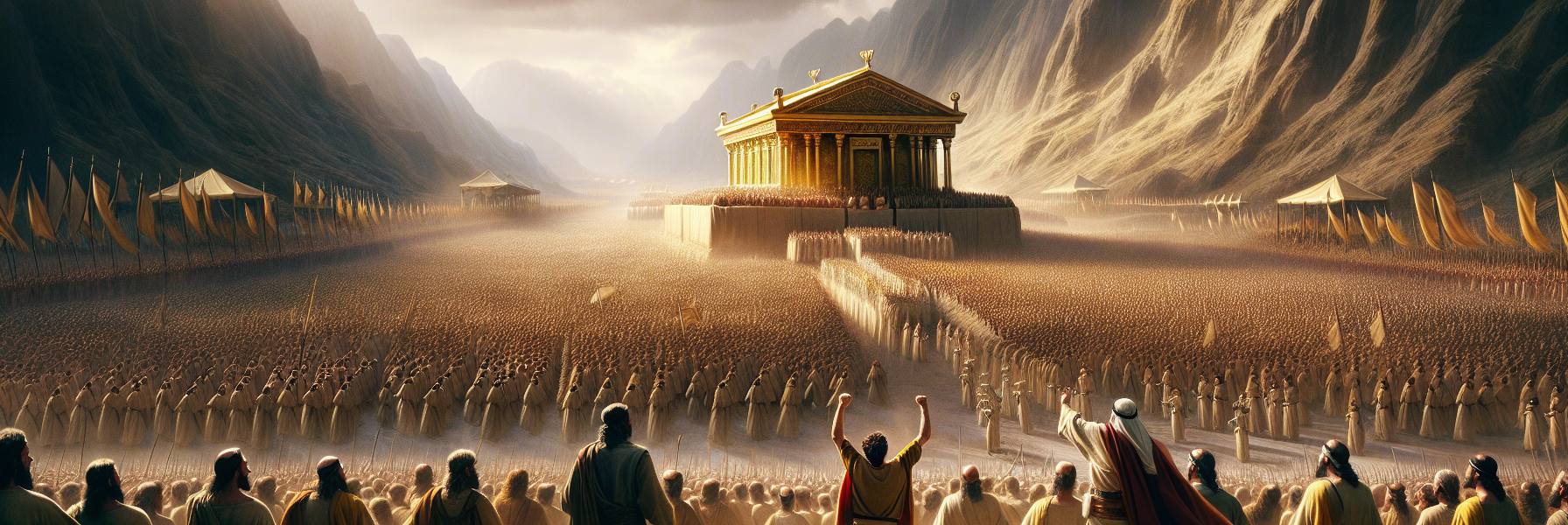

The air over the Valley of the Acacias was thick with dust and jubilation. It was a noise not heard in Israel for a generation, not since the ark had been a silent, dreadful guest in the fields of the Philistines and then a forgotten relic in the house of Abinadab. Now, King David had mustered thirty thousand chosen men, the elite of the army, not for war but for a procession. They were going to fetch the ark of God, to bring it up to the City of David.
David himself led them, his heart a drumbeat of pure, unfiltered joy. This was the culmination of everything—the years in the wilderness, the consolidation of the kingdom, the capture of Jerusalem. Now, God’s tangible presence would dwell in the heart of his capital. He imagined it resting under a new tent, a royal pavilion, a sign that the Lord of Hosts was finally, truly, home.
They came to the hill of Abinadab’s house, a place that had grown accustomed to quiet, fearful reverence. The ark sat in a side chamber, and beside it stood Uzzah and Ahio, Abinadab’s sons, men who had grown up in its shadow. They did what seemed practical, what seemed right. They placed the ark of God on a new cart, freshly built, its wood still smelling of the forest. Oxen were harnessed, and Ahio walked ahead to guide them. Uzzah, perhaps out of a sense of protective duty born of long familiarity, walked beside the cart, his hand never far from its gilded side.
The procession began again, a river of people flowing back toward Jerusalem. There was music—lyres, tambourines, castanets, and cymbals. David, stripped of his royal robes, wore a simple linen ephod like any priest, and he danced. He whirled and leapt before the oxen with an abandon that drew the eyes of every maidservant and soldier, a private ecstasy made public. The air thrummed with celebration.
Then, at the threshing floor of Nacon, the oxen stumbled. A lurch, a sudden shift of weight on the uneven ground. The cart tilted. The ark, the heavy, gold-overlaid chest containing the very stone tablets of the covenant, slid dangerously. Instinct took over. Uzzah, his lifetime of proximity breeding not contempt but a kind of casual guardianship, reached out. His hand touched the gold of the ark to steady it.
He was dead before he hit the ground.
The celebration didn’t end with a crash; it dissolved, like a wave hitting a cliff and falling back into a sudden, terrible silence. The music died mid-note. The dancing feet froze. All that remained was the lowing of the confused oxen and the sound of a man’s body collapsing into the dust. The anger of the Lord had burned against Uzzah. The holiness that had plagued the Philistines with tumors, that had made the men of Beth-shemesh ask, “Who can stand before the Lord, this holy God?” had manifested itself not on foreigners, but here, in the midst of Israel’s finest hour.
David’s joy curdled in his chest, first into a hot spike of fear, then into a cold, trembling anger. He was not angry at Uzzah, the faithful guard who had acted on reflex. He was angry at the terrible, unmanageable holiness he had tried to contain in a parade. He was furious at the God who could strike a man dead for trying to prevent a sacrilege. The scripture says David was afraid of the Lord that day. It was not the fear of a subject for a king, but the primal fear of a man who has touched a live wire, who has stood too close to the sun. “How can the ark of the Lord ever come to me?” he said, his voice low and strained in the silence.
The procession reversed. There was no music now, no dancing. The cart, with the ark still upon it and Uzzah’s body lying where it fell, was turned aside. They did not take it to Jerusalem. Instead, they took it to the house of a man named Obed-Edom, a Gittite—a foreigner from Gath. It was an act of desperate pragmatism. Let this holy, dangerous object reside with someone else, somewhere else.
For three months, the ark sat in the house of Obed-Edom. And for three months, a quiet, palpable blessing settled over everything he owned. His fields flourished. His flocks multiplied. His children were healthy. Word of it seeped back to Jerusalem, a whisper that grew into a steady report. David, nursing his bruised fear and ambition in his cedar palace, heard it all.
The fear remained, but it was now tempered by a dawning comprehension. The blessing on Obed-Edom’s house was a lesson. God’s holiness was not merely destructive; it was generative, life-giving. But it demanded respect, a protocol not born of human convenience but of divine ordinance. David went back to the scrolls, to the laws he had been too excited to consult. He learned how the ark was to be carried: not on a cart, but on the shoulders of consecrated Levites, using poles slid through its rings, so that no hand would ever need to touch it.
When he marched out again, it was a different king who led them. The jubilation was still there, but it was deeper, rooted in awe, not just excitement. After six paces, they stopped. Sacrifices were offered—a bull and a fattened calf. David, again in his linen ephod, danced before the Lord with all his might, but his eyes were now on the Levites bearing the weight, on the prescribed order of it all. This time, it was right.
The shouts that went up as the ark entered the city were not just of triumph, but of relief and reverence. Trumpets blared. The sacrifice of a bull and a fattened calf was made at every sixth step, a smoky, sweet-smelling pathway of devotion leading up to the tent David had prepared.
But as David, breathless and radiant, turned to bless the people from the entrance of the tent, he saw a face in the window of the palace above. It was Michal, his wife, Saul’s daughter. She was not cheering. She watched him, this king leaping and whirling like a common reveler, and her eyes were filled with something colder than the fear he had felt at Nacon. It was contempt, a bitter disdain for the un-kingly display. When David came home to bless his own household, she met him with words that cut like a winter wind.
“How the king of Israel has distinguished himself today,” she said, her voice dripping with sarcasm, “disrobing in the sight of slave girls like some vulgar fellow!”
David’s reply was heated, still thrumming with the energy of the day. “It was before the Lord, who chose me instead of your father and his house when He appointed me ruler over Israel. I will celebrate before the Lord. I will become even more undignified than this, and I will be humiliated in my own eyes. But those slave girls you spoke of—they will honor me.”
The story ends with a stark, sorrowful note: Michal, the daughter of a king who had lost God’s favor, had no child to the day of her death. It was a quiet, domestic tragedy set against the grand, public triumph. The ark was home, but the cost of that homecoming was etched in the dust of a threshing floor and in the barrenness of a queen’s chambers. It was a lesson in the terrible, beautiful weight of glory—a glory that could not be managed, only approached with trembling hands and an obedient heart.