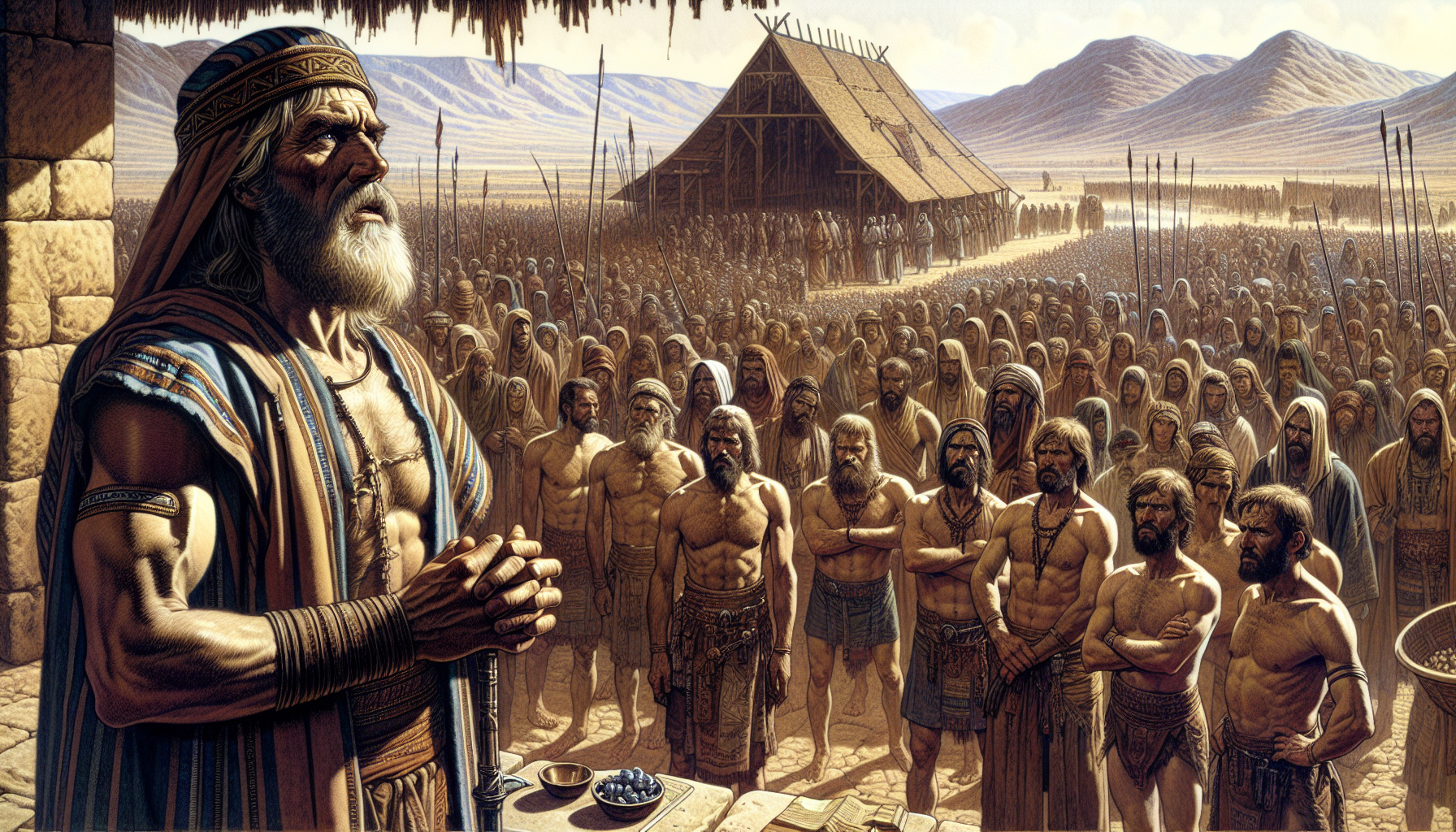
Joshua summoned the Reubenites, the Gadites, and the half-tribe of Manasseh to Shiloh. The war west of the Jordan was finished, and these men had kept their word. They had fought alongside their brothers for years while their own families and herds waited in the land Moses had given them east of the river. Joshua stated it plainly: they had kept all that Moses commanded, and they had hearkened to his own voice. They had not left their brothers during all those days. Now the Lord had given rest to the other tribes, and Joshua released them to go to their tents, to the land of their possession.
But the release came with a charge. Joshua told them to take diligent heed to do the commandment and the law Moses had commanded them: to love the Lord their God, to walk in all his ways, to keep his commandments, to cleave to him, and to serve him with all their heart and with all their soul. It was not a casual farewell. It was a binding instruction, meant to hold them to the same worship as their brothers across the river. Then Joshua blessed them and sent them away. He also told them to return with the wealth they had taken—much cattle, silver, gold, bronze, iron, and clothing—and to divide the spoil of their enemies with their brothers.
The men of Reuben, Gad, and the half-tribe of Manasseh departed from the children of Israel at Shiloh and headed east toward the land of Gilead, their possession. But when they came to the region about the Jordan, still on the Canaan side, they built an altar. It was a great altar, large enough to be seen. The text does not say they consulted anyone before building it. They simply built it there, by the river, in the forefront of the land of Canaan.
The children of Israel heard about it quickly. Word spread that the eastern tribes had built an altar in the region about the Jordan, on the side that pertained to Israel. The whole congregation gathered at Shiloh, and they did not gather to discuss. They gathered to go up against their brothers in war. The altar looked like rebellion. It looked like a rival place of sacrifice, a direct violation of the single altar at the tabernacle where the Lord had chosen to put his name.
Before any sword was drawn, the congregation sent a delegation. They sent Phinehas the son of Eleazar the priest, along with ten princes, one from each of the tribes of Israel, each a head of a father’s house among the thousands. These men traveled into the land of Gilead and confronted the eastern tribes. Their question was blunt and heavy: What trespass is this that you have committed against the God of Israel, to turn away from following the Lord by building an altar and rebelling against him?
Phinehas and the princes reminded them of the iniquity of Peor, a plague that had fallen on the whole congregation because of unfaithfulness. They reminded them of Achan, who had taken devoted things and brought wrath on all Israel. They offered a way out: if the land east of the Jordan was unclean, the eastern tribes could cross over and take possession among the western tribes. But they must not rebel by building an altar besides the altar of the Lord their God.
The Reubenites, Gadites, and the half-tribe of Manasseh answered. They spoke with an intensity that matched the accusation. They called on the Mighty One, God, the Lord—three times they repeated the name—as witness. If they had built the altar in rebellion or to offer burnt offerings, meal offerings, or peace offerings on it, they said, let the Lord himself require it. They did not want to be saved from the consequences if they were guilty.
Then they explained their real reason. They had built the altar out of carefulness, not rebellion. They feared that in time to come, the children of the western tribes might say to their children, “What have you to do with the Lord, the God of Israel? The Lord has made the Jordan a border between us and you. You have no portion in the Lord.” They worried that such words would cause their children to stop fearing the Lord. So they built the altar not for sacrifice, but as a witness. It was a copy, a pattern of the Lord’s altar, meant to testify that the eastern tribes also worshipped the same God and had a portion in him.
Phinehas the priest and the princes heard this explanation, and it pleased them well. Phinehas declared that now they knew the Lord was in their midst, because the eastern tribes had not committed that trespass. He told them they had delivered the children of Israel out of the hand of the Lord—meaning they had averted the wrath that would have come if the accusation had been true. The delegation returned to Canaan and brought word to the congregation. The report pleased the children of Israel. They blessed God and spoke no more of going up to war.
The eastern tribes named the altar. They called it Ed, which means witness. They said, “It is a witness between us that the Lord is God.” The altar stood there by the Jordan, not for sacrifice, but for testimony. It did not replace the tabernacle. It pointed to it. The crisis ended not with bloodshed but with words, with a careful explanation that saved the unity of the people and honored the Lord’s command for a single place of worship.