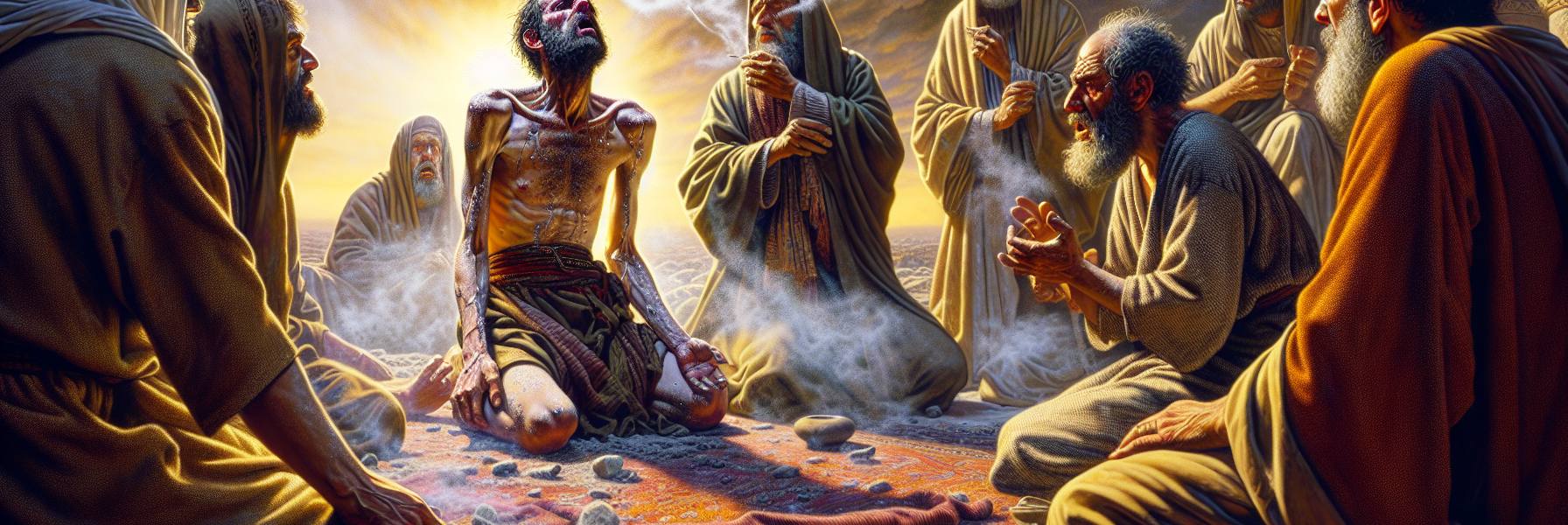

The heat was a physical presence in the air, a weight that pressed down on the shoulders and made every breath taste of dust. Bildad the Shuhite shifted on the rug, his joints aching from days of sitting in this makeshift mourning circle. The ash that Job had poured over his own head had long since been streaked by tears and wind, leaving his face a terrible map of grief. But what festered in Bildad’s chest now was not compassion, but a growing, acidic frustration.
Eliphaz had spoken with poetic gravity. Young Elihu, hovering at the edges, had a face full of unspoken opinions. But Job’s rebuttals were like a fortress wall—high, seamless, and maddeningly resilient. He spoke of God’s scrutiny as a form of violence, of his own integrity as a banner he would clutch even from the dust. To Bildad, it was not just wrong; it was a dangerous inversion of the world’s order.
He cleared his throat, a rough, dry sound. “How long will you hunt for words?” he began, his voice low but sharp as a flint edge. “Consider, and then we will speak. Why are we counted as cattle? Why are we stupid in your sight?”
He leaned forward, his eyes fixed not on Job’s weeping sores, but on his defiant eyes. “You who tear yourself in your anger—shall the earth be forsaken for you? Or the rock be removed from its place?”
Bildad saw it then, not as a debate, but as a cosmic tableau. Job, in his insistence on his own innocence, was like a man who believed he could walk through a snare untouched. Bildad’s mind filled with the immutable images of consequence, the dark poetry of a world that did not bend for the pleas of the wicked—and in his heart, he had now firmly placed Job in that category.
“Indeed, the light of the wicked is put out,” he declared, his words gaining rhythm, falling into the cadence of a prophet at the gates of a doomed city. “The flame of his fire does not shine. The light is dark in his tent, and his lamp above him is put out.”
He described it with a terrible clarity, painting a scene not of divine thunderbolts, but of a slow, inevitable draining away. The strong steps of the wicked become confined; his own schemes throw him down. It is a trap he does not see, a net laid for him in the path. Terrors frighten him on every side, and chase him at his heels.
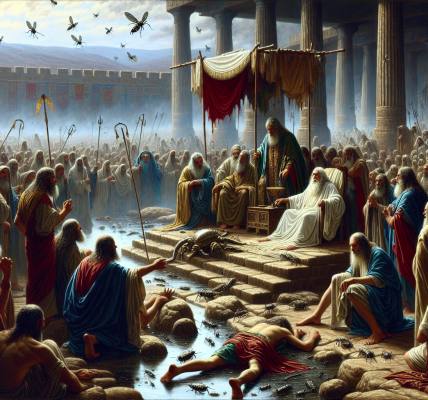
Bildad’s hand sketched the horrors in the air. “Hunger is his companion. Calamity is ready for his stumbling. It devours patches of his skin; the firstborn of Death devours his limbs.” He was speaking of disease now, a rotting from within, a pulling up from the land itself. “He is torn from the security of his tent, and you are marched to the king of terrors.”
The others were silent. Even the wind seemed to still. Bildad spoke of the roots beneath a withered plant turning to stone, of the branches above being cut off. His voice was not loud, but it was dense, final. “His memory perishes from the earth, and he has no name in the street. He is thrust from light into darkness, and driven out of the world. He has no offspring or descendant among his people, nor any survivor where he used to live.”
He paused, letting the desolate image hang—a lineage extinguished, a name erased, as if he had never been. He looked around at the barren landscape, then back to Job, a man sitting on an ash-heap, his children dead, his body breaking.
“They of the west are appalled at his day,” Bildad finished, his tone dropping to a grim whisper, “and horror seizes them of the east. Surely such are the dwellings of the unrighteous, such is the place of him who knows not God.”
There was no plea in it, no call to repentance. It was a cold, judicial listing. This is the mechanics of ruin. This is what happens.
Job did not look at him. He was staring at some point in the middle distance, beyond the friends, beyond the rim of his devastation. His chest rose and fell slowly. A fly settled on the crusted edge of a sore on his hand, and he did not brush it away.
Bildad sat back, his own breath coming quicker now, his point delivered. The truth, as he understood it, was now laid bare in the space between them: a sequence of cause and effect as natural and irreversible as the setting of the sun. He had offered no comfort, only the stark geometry of justice. In the heavy silence that followed, broken only by the faint, hot sigh of the wind, he waited. Not for an answer, but for the dawning recognition he was sure must come.