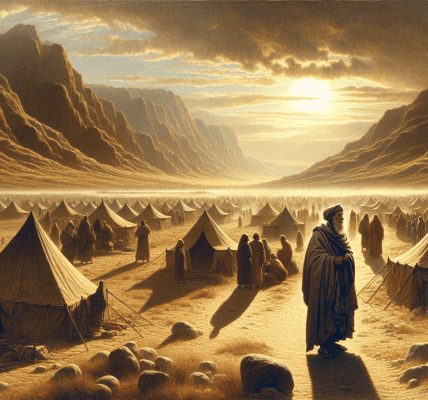

The air in the desert held a memory of heat, even now, three months to the day since they had stumbled out of Egypt. It was a dry, granular heat that settled in the folds of their robes and made the distant peaks of the range seem to shiver like a mirage. The plain before Mount Sinai was not sand, but a broad, stony waste, littered with shards of rock and tufts of bitter, grey-green brush. And upon it, a nation camped. Not an army, not yet a people, but a multitude—a great, restless sprawl of former slaves, their animals bleating, their children’s cries carried on the wind, the smoke of a thousand cooking fires rising in thin, straight lines toward a sky of relentless blue.
Moses felt the weight of them, a physical pressure against his back as he walked away from the camp, toward the mountain. The dust, churned by countless feet, still coated his sandals. Aaron was with the people, trying to maintain order, but the tension was a live thing. They had washed their garments as instructed, they had kept their distance from the base of the mountain, but fear had a scent, and it was thick in the camp. It was the fear of the unknown, a terror far deeper than the familiar lash of an Egyptian overseer. They had seen the water stand in heaps, had eaten bread from the sky, had drunk from split rock. They knew they were in the presence of something that could not be bargained with.
The mountain itself was a brooding presence. It was not the tallest he had seen, but there was a severity to its lines, a starkness that felt intentional. As he approached the boundary they had set with stones and warnings, the air changed. It grew still. The ever-present wind of the desert died away, leaving a silence so profound he could hear the rustle of a lizard scurrying under a rock ten paces away. Then, a sound began, not from the mountain, but within it—a low, deep thrumming, as if the earth itself were a great drumskin.
He climbed, his old bones protesting, his heart hammering against his ribs not from exertion, but from a dread that was also a longing. The summit was wreathed in a cloud, but it was unlike any cloud. It did not drift; it sat, dense and dark, shot through with a deep, amber light that pulsed in time with the thrumming. It was a cloud of presence. And the thrumming resolved into a voice. Not a sound heard by the ear alone, but a vibration felt in the teeth, in the hollow of the chest, a voice that spoke the fabric of reality into trembling attention.
It began not with a proclamation of power, though power radiated from every syllable, but with a statement of identity. A reminder of deliverance.
***“I am the Lord your God, who brought you out of the land of Egypt, out of the house of slavery.”***
The words were not in Egyptian, nor in the hurried slang of the brick yards. They were in his own tongue, but spoken with a clarity that burned away all confusion. This was the foundation. Everything that followed was built upon this: a relationship forged in rescue. He was *their* God. They were *His* people. Not by conquest, but by covenant.
Then the voice shaped the world anew around a single, central axis.
***“You shall have no other gods before me.”***
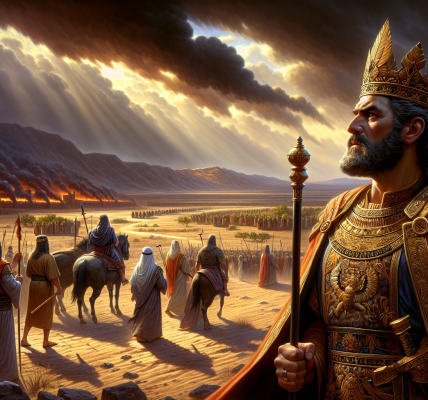
The command was absolute, leaving no room for the pantheons of Egypt, for the household idols some had smuggled in their bundles, for the tempting thought that power could be divided or shared. It was a demand for a singular loyalty, as total as the loyalty He had shown in breaking Pharaoh’s grip.
***“You shall not make for yourself a carved image…”***
The voice detailed the folly of it—bowing down to the work of one’s own hands, to a likeness of anything in creation. The God who spoke from consuming fire could not be contained in silver or gold, in the shape of a bull or a star. Worship was to be directed toward the unseen Reality, not a visible reduction. It was a guard against the human instinct to control the divine, to make God manageable.
His name came next.
***“You shall not take the name of the Lord your God in vain…”***
This was more than swearing. It was about the weight of association. To bear His name was to represent His character. To invoke it for petty curses, for empty oaths, for magical incantations—that was to treat the holy as common, to drag the currency of heaven through the mud of deceit. The voice held a warning here, a sober gravity. The Lord would not hold guiltless the one who played fast and loose with the essence of who He was.
Then, a pause in the relentless moral charge. A space carved into time itself.
***“Remember the Sabbath day, to keep it holy.”***
Six days for labor, for the sweat and struggle of building a life in this new, harsh land. But the seventh was different. It was a sanctuary in time, a holy echo of God’s own rest after creation. It was for everyone—master, servant, foreigner, beast. A weekly declaration that they were not merely economic units, but souls who belonged to a rhythm greater than production. It was a gift, a cessation, a breath.
The voice turned now to the heart of human society, beginning with its most fundamental bond.
***“Honor your father and your mother…”***
This was the first commandment with a promise attached. It was about more than obedience; it was about *honor*, a recognition of the fragile chain of being that transmitted life and culture. Stability in the family meant longevity in the land. It was the bedrock of a society that would not consume itself.
The prohibitions that followed came like hammer blows, each one drawing a boundary around sacred human dignity.
***“You shall not murder.”***
The absolute sanctity of life, the irrevocable line against the willful destruction of the divine image in another.
***“You shall not commit adultery.”***
The sanctity of covenant, the fire-wall around the one-flesh union that was the microcosm of God’s own faithful bond with His people.
***“You shall not steal.”***
The sanctity of stewardship, a rejection of the power-grab that says another’s provision is mine for the taking.
***“You shall not bear false witness against your neighbor.”***
The sanctity of truth, the glue that holds a community together. Lies in the public square were acid, eating away at the very possibility of justice.
And finally, the command that turned inward, to the hidden place where sin is conceived.
***“You shall not covet…”***
The list was intimate, comprehensive: house, spouse, servant, animal, *anything*. This was the radical surgery. It was not enough to keep your hands clean; you must guard your heart’s desires. It exposed the truth that the external acts of murder, adultery, and theft are born in the quiet, fevered workshop of envy and dissatisfied want.
The voice ceased.
The silence that followed was more terrifying than the sound. It was a silence that rang. The cloud on the mountain swirled, dark and impenetrable. Down on the plain, the people had heard it too—not the words, perhaps, but the sound of the voice, the thunder that seemed to form syllables, the blast of what might have been a shofar beyond all shofars. They had recoiled as one body. They moved back from the boundary, a wave of fear rippling through the camp. They came to Aaron, their faces the color of chalk. “You speak to us,” they begged, their voices trembling, “and we will listen. But do not let God speak to us, lest we die.”
Moses stood alone on the mountainside, the words etching themselves into the stone of his memory. This was the framework. This was the constitution for a people who had only known the law of the whip. It was not a list of suggestions for spiritual improvement. It was the architectural plan for a society built on reverence, justice, fidelity, and truth. It began with God’s character and ended with the human heart. It was terrifying in its scope. It was beautiful in its logic. And he knew, with a certainty that chilled him, that the hardest work was just beginning. For the thunder on the mountain was clear, but the quiet whisper of covetousness in a man’s tent in the dead of night—that would be the true battleground.
He turned and looked down at the sea of faces, tiny and afraid in the vastness of the desert. They wanted a mediator. They wanted distance. The Law had been given. Now, grace would have to teach them how to live it. He took a deep breath of the strange, charged air, and began his slow walk back down to them.