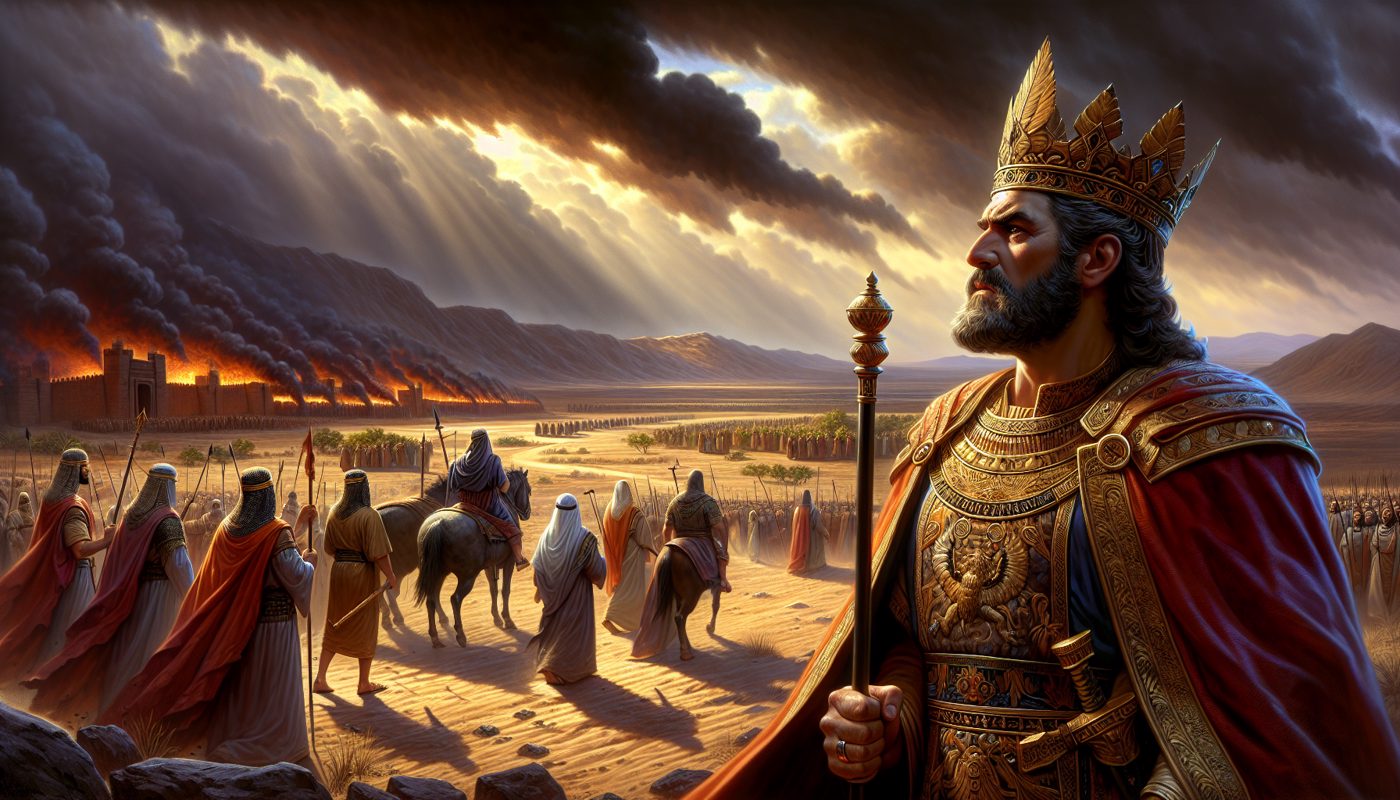
Joshua rose early, and the camp at Shittim broke ground. The people moved with him to the Jordan River and lodged there before crossing. For three days they waited, camped on the eastern bank, while the officers passed through the camp with instructions. The command was precise: when the people saw the ark of the covenant of the Lord their God carried by the Levitical priests, they were to set out from their positions and follow it. A space of two thousand cubits was to be kept between them and the ark. They were not to come near it. The reason given was practical—so that they would know the way to go, for they had not passed this way before.
Joshua then spoke directly to the people. He told them to sanctify themselves, because the next day the Lord would do wonders among them. This was not a vague promise. The wonder had a shape and a condition attached to it. Joshua then turned to the priests and commanded them to take up the ark of the covenant and pass over before the people. The priests obeyed. They lifted the ark and went ahead, moving toward the river that lay swollen at harvest time, overflowing all its banks.
That same day the Lord spoke to Joshua. The words were direct and carried a specific purpose. The Lord said that on that day He would begin to magnify Joshua in the sight of all Israel, so that they would know that as He had been with Moses, so He would be with Joshua. The authority Joshua carried was not self-made. It was being demonstrated through what was about to happen at the river. The Lord also gave Joshua a command for the priests: when they came to the brink of the waters of the Jordan, they were to stand still in the river.
Joshua then gathered the children of Israel and told them to come near and hear the words of the Lord their God. He spoke with the full weight of the moment. He said that by this they would know that the living God was among them, and that He would without fail drive out the Canaanite, the Hittite, the Hivite, the Perizzite, the Girgashite, the Amorite, and the Jebusite. The list of seven nations was named plainly. The ark of the covenant of the Lord of all the earth was about to pass over before them into the Jordan.
Joshua then instructed the people to choose twelve men, one from each tribe. The reason for this selection would become clear only after the crossing. For now, the instruction stood as a preparation. The people were to be ready to act when the moment came.
Joshua then gave the sign that would trigger the wonder. He told the people that when the soles of the feet of the priests bearing the ark of the Lord, the Lord of all the earth, rested in the waters of the Jordan, the waters coming down from above would be cut off and would stand in one heap. The condition was specific. The priests had to step into the water first. Nothing would happen until their feet touched the flood.
The people removed from their tents to pass over the Jordan, with the priests bearing the ark of the covenant going before them. When the priests reached the Jordan and dipped their feet in the brink of the water—the river was at full flood, overflowing all its banks during the harvest season—the waters that came down from above stopped. They rose up in one heap a great distance away, at Adam, the city beside Zarethan. The waters that flowed down toward the Sea of the Arabah, the Salt Sea, were completely cut off. The riverbed lay open.
The people passed over opposite Jericho. The priests who bore the ark of the covenant of the Lord stood firm on dry ground in the middle of the Jordan. They did not move. All Israel passed over on dry ground, and they continued until the entire nation had crossed clean over the Jordan. The crossing was not hurried or partial. It was complete.
The chapter does not record the people's reaction. It does not describe the mud or the dust or the order of the march. What it records is the mechanics of the event: the priests stood, the water stopped, the people crossed. The ark of the covenant of the Lord of all the earth went before them into the river, and the river obeyed. The Lord had begun to magnify Joshua in the sight of Israel, and the people saw that the living God was among them.
Comments
Comments 0
Read the discussion and add your voice.
Members only
Sign in to join the conversation
We keep comments tied to real accounts so the discussion stays clean and trustworthy.
No comments yet. Be the first to add one.