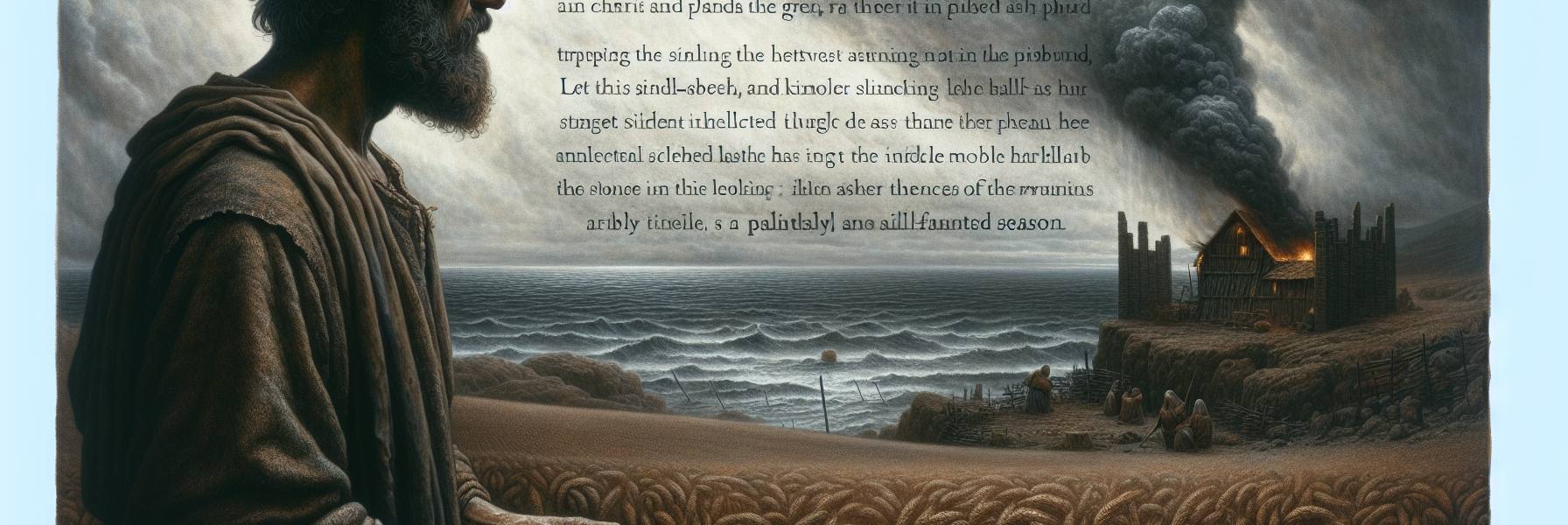

The sea was a hammered sheet of lead under a sky the colour of ashes. Elian wiped salt spray from his beard with a raw-knuckled hand, his eyes on the distant, churning line where water met cloud. The storm wasn’t here, not yet, but it was coming. He could taste its metallic promise on the wind. Behind him, in the single-room house of stone and timber, his wife Mara moved in the dimness, the soft clatter of a clay pot her only sound. The silence between them these past weeks had become a third presence, heavier than the impending gale.
The trouble had begun with the barley. A blight, subtle and swift, turning the green shoots on the rocky hillside a sickly bronze before they could head. A season’s hope, gone. Then the fever took their youngest, a burning, restless thing that for three nights made their small home echo with cries. The child lived, but was left wan and listless, a shadow of her robust self. And through it all, the silence from Mara, not of anger, but of a profound, bewildered hurt. “Why?” her eyes asked, whenever they met his. A question Elian had poured out on the stony ground during his vigils, a question the leaden sky threw back at him, unanswered.
He thought of the words of James, the brother of the Lord, that a traveling preacher had recited in the village square months before. Words that had seemed then like polished stones, beautiful but hard. *Consider it pure joy, my brothers and sisters, whenever you face trials of many kinds…* Joy? Elian stared at his blighted field. Joy felt like a mockery. The faith he had, a simple, inherited trust in the God of Abraham, felt like a dry well.
The first fat drops of rain began to fall, hitting the dusty earth with audible plops. He turned and went inside.
The storm broke with a fury that shook the very stones of the foundation. Wind screamed under the door, and the world outside became a roar of water and chaos. Elian secured the shutter, his movements economical, practiced. Mara sat on a low stool by the hearth, where a feeble fire fought the damp, mending a torn tunic by lamplight. Her face was all deep shadows and sharp planes in the flickering light.
“It will pass,” he said, the words hollow against the tumult.
“Will it?” she replied, not looking up. Her needle paused. “The barley will not return. The child’s strength is slow. And now this.” She gestured with her chin toward the howling dark. “Where is the goodness in this? Where is the God who provides?”
It was the question given voice. It hung in the smoky air, more palpable than the storm. Elian had no answer. He sank onto a bench, the weariness in his bones deeper than any physical toil. The preacher’s voice came back, another fragment. *If any of you lacks wisdom, you should ask God, who gives generously to all without finding fault…* He had asked. He had begged for wisdom—to understand the blight, to heal his daughter, to bridge the silence with his wife. All he felt was lack.
He watched the fire. The wind found a new pitch, a shriek that seemed to claw at the roof. And in that moment, a strange clarity came, not as a voice, but as a thought that felt both foreign and familiar. The wisdom he had been asking for was not a solution. It was not a secret technique to save the barley or a divine prescription for the fever. He had been asking for a way *out*. The wisdom from above, James had said, was first of all pure, then peaceable, gentle, open to reason…
His eyes moved from the frantic fire to Mara’s bent head, to the small pallet where his children slept, the littlest one breathing evenly now, thank God. The trial was not the blight, nor the fever, nor the storm. The trial was *him*. His faith, that quiet, untested thing, was being shown for what it was. It was being tested like gold in a furnace, not to destroy it, but to see if it was real. To see if it would hold when the harvest failed and the wind screamed. Could he consider *that* joy? Not the loss, but the proving? The thought was so unsettling it felt like a physical shift inside him.
He stood up. Mara glanced at him, wary. He did not go to her. Instead, he went to the large water jar in the corner, dipped a cup, and brought it to her. He held it out. “The noise is fierce,” he said, his voice rough. “But this house has stood through worse. We are dry. We are together.”
She looked at the cup, then at his face. Something in his eyes had changed. The desperate seeking was still there, but the bitterness around its edges had softened. She took the cup and drank. It was a small thing.
Later, as the storm’s wrath began to truly abate, fading to a steady, soaking rain, he spoke again into the quieter dark. “I have been a man of two minds,” he said, more to himself than to her. “Like a wave of the sea, blown and tossed. Asking, but not really trusting that any answer would come. Trusting that if God gave, it was good, but if He withheld… then it was not.” He ran a hand over his face. “The wisdom I needed was to simply stand in the storm. To not let it make me into something bitter.”
Mara set her mending aside. “And what are we to do now? When the rain stops and we see the damage?”
Another verse surfaced, this one with the force of a command. *Do not merely listen to the word, and so deceive yourselves. Do what it says.* His faith, if it was to be anything more than the sound of the wind, had to become action. Here. Now.
“Tomorrow,” he said, the plan forming as he spoke, “I will go to old Simon. His field on the south slope was spared. He will have surplus seed. I will work for him, a day for every measure of seed he can lend us for a late planting. It will be a hard thing, and the yield will be less. But it will be something.” He looked at her. “And you, with your skill… the merchant from Tyre praised your weaving. The belt you made. Could you make more? Not for us, but to sell when he returns?”
It was practical. Earthy. It was faith getting its hands dirty. A light, the first genuine one in weeks, touched Mara’s eyes. It was not a solution, but a direction. A path forward carved out of the trial itself.
The morning dawned clear and washed clean. The storm had littered the cove with driftwood and torn seaweed. The barley field was a sorry, sodden mess. But the air was fresh. Elian stood in the doorway, looking at the wreckage and the possibility. He remembered the end of the chapter. *Religion that God our Father accepts as pure and faultless is this: to look after orphans and widows in their distress and to keep oneself from being polluted by the world.*
The trial had shown him his own poverty of spirit. Now the doing would begin. Not with grand gestures, but with borrowed seed, a woven belt, a cup of water offered in a storm. His joy, he realized, was not in the blight, but in the fragile, stubborn shoot of a faith that, tested, had chosen to root deeper instead of withering away. It was a small, defiant green thing in a battered field. And for now, it was enough.