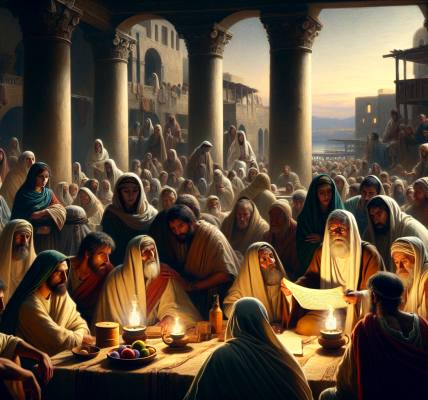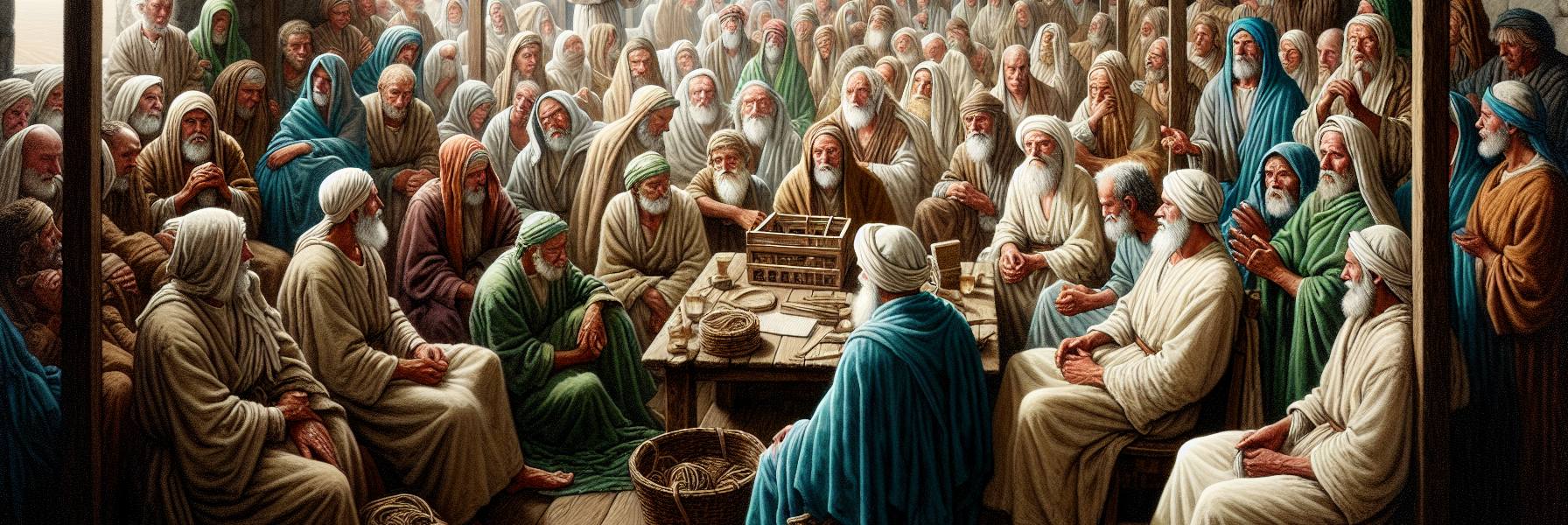

The air in the house of Jason still carried the morning chill, a sharp contrast to the warmth of the packed room. I sat on a worn rug, my back against the cool plaster wall, listening to the shuffling of sandals and the low murmur of greetings. We were a patchwork assembly—tentmakers like me, merchants with worry lines etched deep, freedwomen with keen eyes, and a handful of slaves who stood with a stillness that spoke volumes. The common thread was a fragile, desperate hope.
Clement, an old wool-carder with fingers perpetually stained blue, had just finished reading the letter. The papyrus sheet, creased from its long journey, trembled slightly in his hand. The words of Paul, Silvanus, and Timothy hung in the quiet. They were not ethereal pronouncements; they were practical, urgent, and they landed in the room like stones in a still pond.
“Finally, brothers and sisters,” the letter had said, “we ask and urge you in the Lord Jesus that, as you learned from us how you ought to live and to please God, you should do so more and more.”
*How you ought to live.* I glanced around. We knew how to live under Rome. We knew how to live in the marketplace, with its sharp deals and whispered rumors. But this… this was a different map. Aquila, who led our gathering, cleared his throat. His voice was gravelly from years of shouting in the dye-works.
“He speaks of sanctification,” Aquila said, not as a lecturer, but as a man puzzling it out with friends. “This ‘setting apart.’ It’s not about moving to a mountaintop. It’s about your hands.” He held up his own, palms calloused and nails cracked. “It’s about what these hands do when no one but God is watching. It’s about the body. That it is not a vessel for passion like the Gentiles who do not know God. It is a temple of the Holy Spirit. We must learn to control it.”
A young man named Marcus, a porter with shoulders like ox-yokes, shifted uncomfortably. The city’s temptations were not abstract; they were painted on the walls, offered in the taverns, a constant hum in the air. To hear that this struggle was part of the path, that holiness was a muscle to be trained in the grime of daily life, was both a burden and a strange relief.
Then the letter turned to *philadelphia*—brotherly love. “Concerning love of the brothers and sisters,” Aquila continued, “you have no need for anyone to write to you, for you yourselves are taught by God to love one another.”
Lydia, who sold purple cloth by the river gate, gave a soft, sad chuckle. “Taught by God, yes. But my teacher finds a slow student some days.” She looked at me. “Remember when Stephanas’s boy fell sick? We all brought what we could. But when Demas’s cart broke and he lost a week’s wages, did we rally the same?” She shook her head. “Paul says to do this ‘more and more.’ Not just when it’s easy. To aspire to live quietly, to mind our own affairs, to work with our hands. Why?”
“So that you may behave properly toward outsiders and be dependent on no one,” Clement quoted from memory, his eyes closed.
There it was. Our witness was not in grand speeches before the politarchs, but in the integrity of our work. In paying a fair price. In not gossiping at the well. In having enough to share with the sister whose husband had died, so she wasn’t at the mercy of a patron’s whims. This love was the quiet mortar holding our little city-within-a-city together.
But the room grew most still, the air most taut, when Aquila’s voice softened for the next part. It was the thing that gnawed at us in the dead of night, the open wound of our hope. Some of us had already died. Prisca, fever-stricken. Old Beniah, simply gone in his sleep. What of them? Had they missed the day?
“We do not want you to be uninformed, brothers and sisters, about those who have fallen asleep,” Aquila read, and every heart leaned in. “So that you may not grieve as others do who have no hope.”
The words were a balm and a revelation. We *could* grieve. Tears were not forbidden. But they were not the hopeless, scraping wails of the pagan processions. Our grief had a horizon.
Then the image, so vivid it was as if the roof of Jason’s house had peeled away: “For the Lord himself, with a cry of command, with the archangel’s call and with the sound of God’s trumpet, will descend from heaven, and the dead in Christ will rise first. Then we who are alive, who are left, will be caught up in the clouds together with them to meet the Lord in the air; and so we will be with the Lord forever.”
No one spoke. We were all seeing it. The shout—not a whisper, a command that would crack the sky. The trumpet, not a mournful bleat but a clarion call of triumph. And the order: *the dead first*. Prisca, Beniah, their frail, buried bodies suddenly alive, glorified, rising. *Then* us, the living, swept up, not away from the world, but into a welcoming committee in the very clouds. A reunion in the sky. To be with the Lord. Forever.
It wasn’t an escape plan. It was a coronation parade. My own fears, the daily anxieties about bread and taxes and Roman soldiers, they shrank back into a startlingly small corner. This hope was vast, solid, architectural. It changed the weight of everything.
Aquila let the silence settle. It was a comfortable, full silence. Finally, he rolled the scroll gently. “Therefore,” he said, almost in a whisper, echoing the letter’s conclusion, “encourage one another with these words.”
And we did. We didn’t launch into loud hymns. We just began to talk, as the pale Thessalonian sun strengthened and streamed through the high window. Marcus clasped the shoulder of the slave, Ariston, and asked about his master’s upcoming voyage. Lydia and another woman began planning how to rotate visits to a widow in the western quarter. The theology of the letter had finished; the living of it had begun. It was about hands, and love, and work, and a hope that refused to let death have the final word. We filed out later into the noisy, idol-cluttered street, but we carried a different city within us, one built on the echo of a future trumpet, and the present, persistent call to live a life that pleases God.