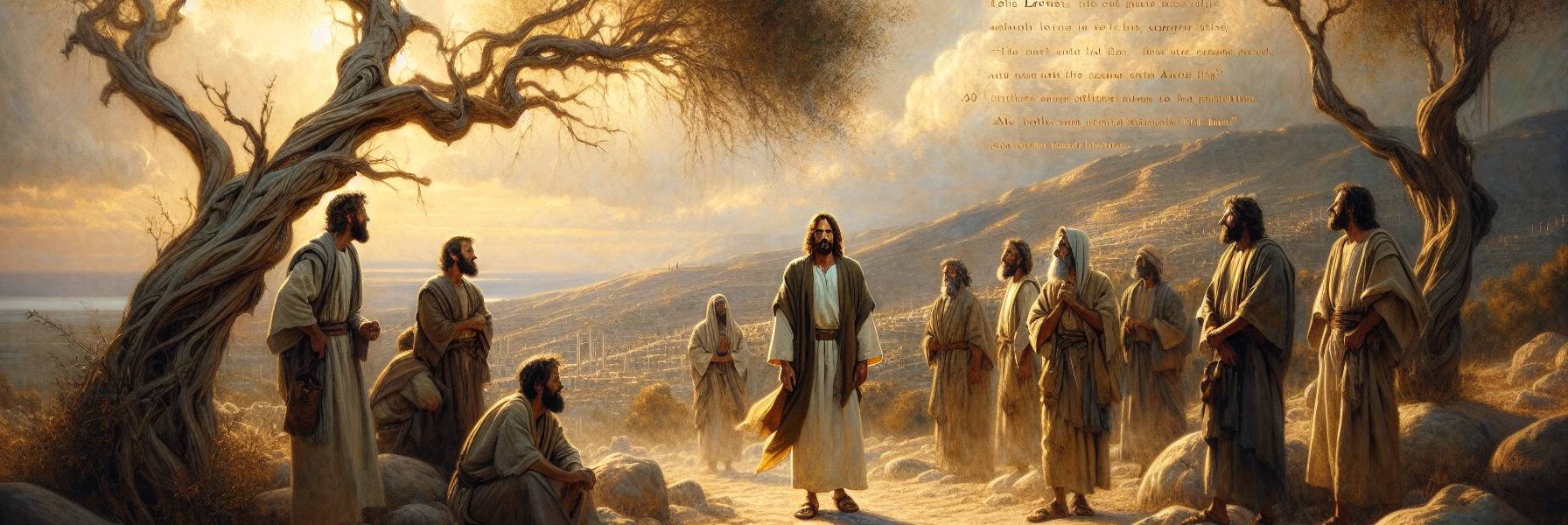

The air on the Mount of Olives held the last warmth of the day, a dusty gold settling on the leaves of the gnarled trees. For forty days, the world had felt upside down, and even now, standing with him again, the eleven couldn’t settle their minds. It was Thomas, his voice still bearing the rough edge of a grief not fully healed, who finally gave words to the hope tangled in all their chests.
“Lord,” he said, his eyes on the distant walls of Jerusalem, tinged pink in the fading light, “is this the time? Will you now restore the kingdom to Israel?”
A silence followed, broken only by the scuff of a sandal on stone. Jesus turned his gaze from the city to their faces, each one etched with expectation and fatigue. He didn’t smile the easy smile he’d used before the nightmare. This was quieter, more patient.
“It is not for you to know the times or seasons,” he said, the words measured, leaving no room for argument. “The Father has set those by his own authority.” He let that settle, watching their shoulders drop a fraction. The political dream, the immediate revolution—it was a seed he had to let fall, unpicked. Then he leaned into them, his tone shifting. “But you will receive power. Power when the Holy Spirit comes upon you. And you will be my witnesses. Here in Jerusalem. Then through all Judea. Then Samaria.” He paused, and his look stretched out, beyond the hills, beyond the sea they knew. “Then out to the very ends of the earth.”
The words hung there, vast and terrifying. *Ends of the earth.* Philip thought of the Roman roads, endless. Matthew, of incomprehensible languages. They had no map for this.
Then, as they watched, something changed. Not a sound, but a quality of light. He lifted his hands, not in farewell, but in blessing—an act so familiar, yet now final. And as he blessed them, he began to rise. Not like a bird, but like a man being drawn upward, gently, inevitably. His feet left the crushed grass of the hillside. The hem of his robe, still dusty from the road, lifted. Up he went, and their necks craned back, mouths agape, eyes straining.
Higher. A cloud, one of those soft, low clouds that often clung to the mount at evening, received him. Not violently, but like a veil, drawn slowly between him and their sight. One moment he was there, a figure against the vast sky, the next, the cloud’s grey folds had swallowed him whole.
They stood frozen, necks still bent back, staring at the empty cloud as it drifted lazily toward the west. Minutes passed. A donkey brayed somewhere in the Kidron Valley. The world had gone utterly, deafeningly normal.
Two men appeared. They weren’t there, and then they were, standing beside them as if they’d been part of the landscape all along. Their clothes were white, but a practical white, like linen in the sun, not blinding. Their faces were ordinary.
“Men of Galilee,” one said, and his voice was calm, almost mild, breaking the terrible spell of their upward gaze. “Why are you standing here, looking into the sky?” It wasn’t a reprimand. It was a nudge, a calling back to earth. “This Jesus, who has been taken from you into heaven, will come back in the same way you have seen him go.”
The words did what no miracle could have done in that moment. They grounded them. The promise of return was for later; the cloud was empty now. The work was here.
Without a word, as if by a single thought, they turned and began the walk back to the city. The path down the Mount of Olives was familiar, but everything was different. They didn’t speak much. Peter walked with a set jaw, his earlier bravado replaced by a deep, pondering weight. John kept glancing at the skyline, then at his own hands, as if seeing them for the first time.
They returned to the upstairs room where they were staying. It was the same room, smelling of old wood and lamp oil, the low table still bearing the remains of a meagre meal from that morning. But it was a different place. It was now a headquarters.
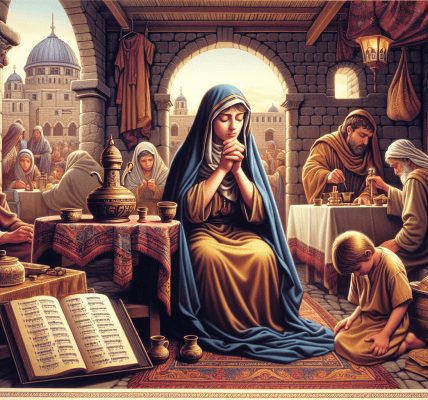
Over the next days, they were together constantly. Not just the eleven, but the women—Mary, his mother, her face a landscape of sorrow and serene strength—and his brothers, who now moved among them not as skeptics but as family. They prayed. That was the core of it. Not with elaborate words, but with a persistent, united urgency. They were waiting, but it was an active waiting, a gathering of souls.
And Peter, amid the prayers, found his voice again. He stood up one day, the scripture scrolls open before him. He spoke of the scripture that had to be fulfilled, about Judas. He didn’t spit the name; he said it with a heavy sadness, calling him “one of our number” who had shared their ministry. He recounted the field of blood, the grim justice of the man’s end. “For it is written in the Book of Psalms,” Peter said, his finger tracing the lines, “ ‘May his place be deserted; let there be no one to dwell in it,’ and, ‘May another take his place of leadership.’ ”
He looked around the room, at the faces watching him, trusting him to steer them. “So now, we must choose. A man who has been with us the whole time the Lord Jesus was living among us—from John’s baptism until the day he was taken up from us. Someone who can become with us a witness to his resurrection.”
They proposed two: Joseph called Barsabbas, also known as Justus, and Matthias. Both were known quantities, men who had walked the same roads, seen the same wonders, borne the same confusion. There was no campaign, no debate. They prayed simply, “Lord, you know every heart. Show us which of these two you have chosen to take over this apostolic ministry, which Judas left to go where he belongs.”
Then they cast lots. It was an ancient practice, a relinquishing of the final choice. The small, marked stones clattered on the table. The lot fell to Matthias.
And from that moment, he was counted with the eleven. Not as a replacement for what was lost, but as a new part of the whole. The number was restored, but the group was not the same. It was a body that had been wounded and had, in a mysterious way, begun to heal and regrow. They were no longer just disciples who had followed a teacher. They were apostles, ones who would be sent. They sat in that sunlit upper room, the sounds of Jerusalem filtering up through the shutter slats, waiting for the promise. Waiting for the wind to change.