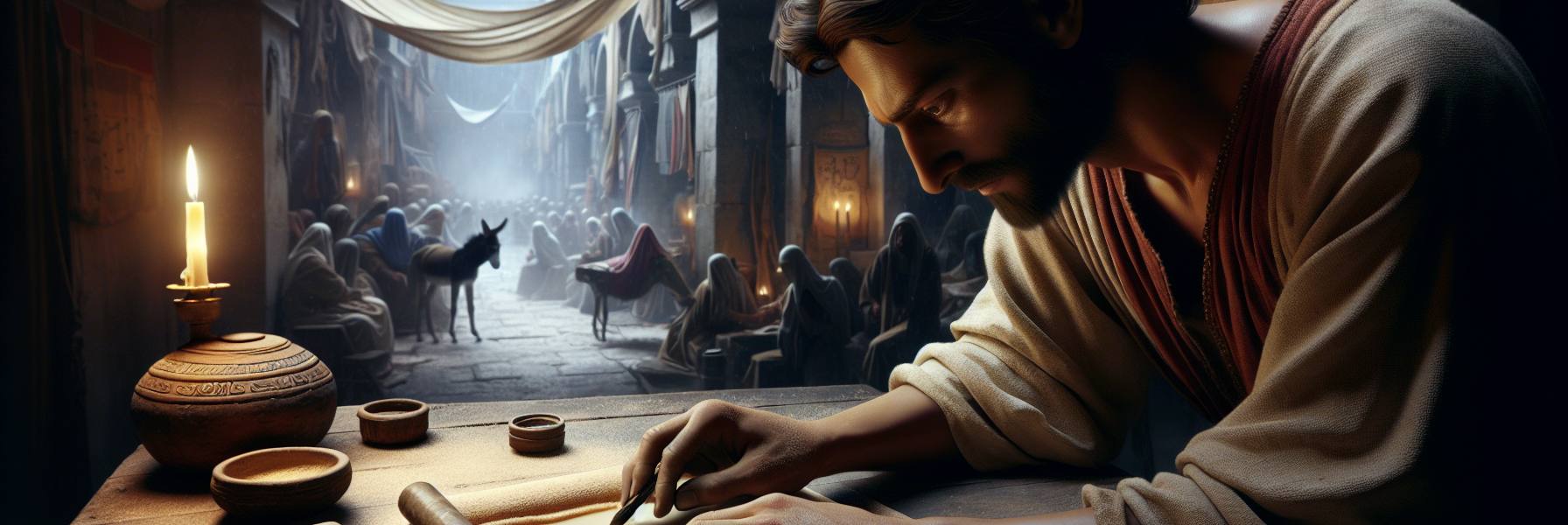

The room was quiet, save for the slow, grating scrape of a stylus on wax. Justus stared at the tablet, the words he’d copied hours ago now swimming in the dimming light. *Therefore, since we have been justified by faith, we have peace with God through our Lord Jesus Christ.* Peace. The word felt foreign, like a dialect he’d heard in childhood but could no longer speak.
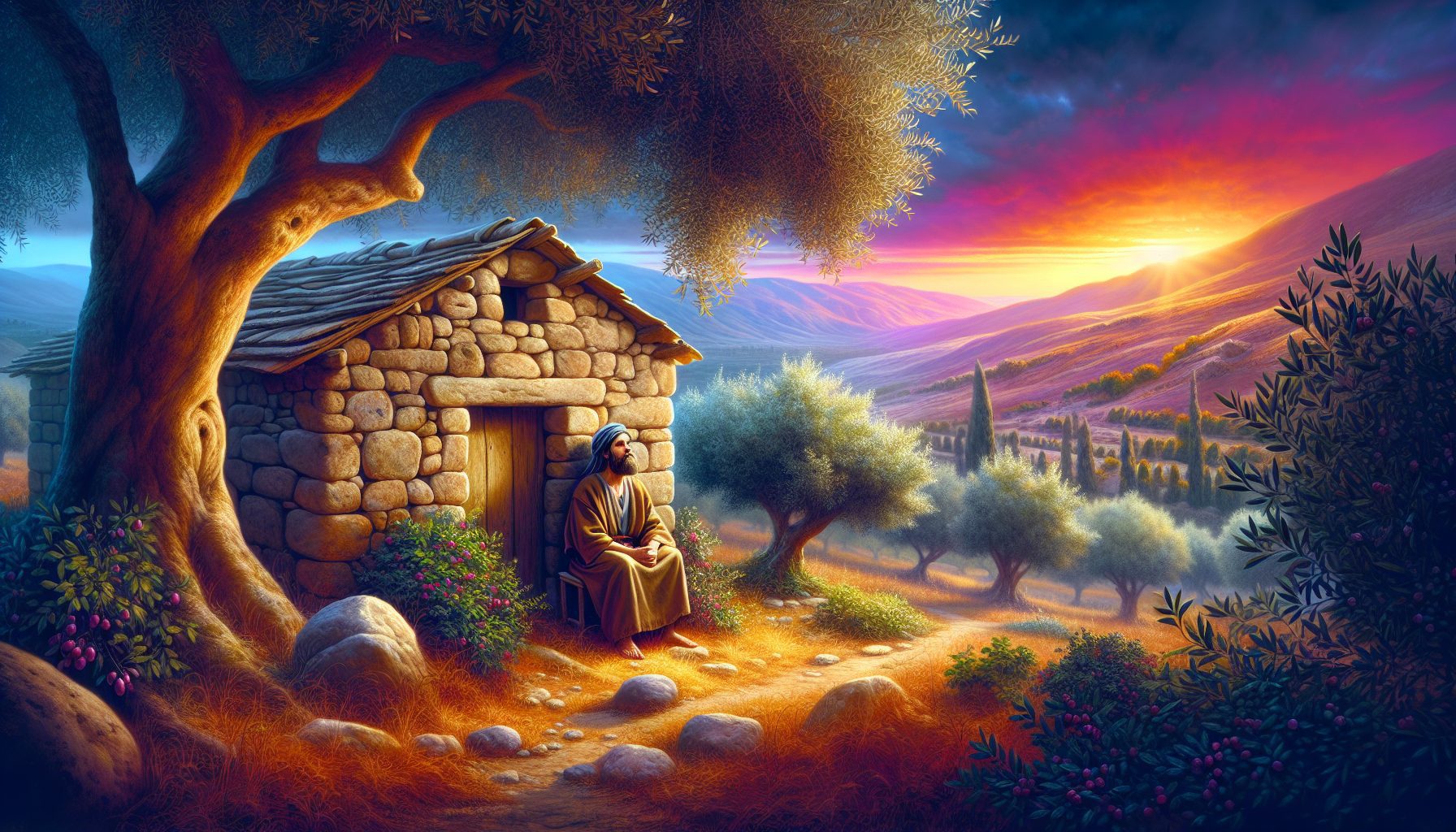
Outside, the sounds of Jerusalem filtered through the shuttered window—a donkey’s bray, a merchant’s final cry of the day, the distant notes of a prayer. He pushed the tablet away, the heel of his hand coming to rest in the soft dust on the table. Justification. A legal term, clean and decisive. But his own soul felt like the dust—shifting, unsettled. He thought of the Law, the relentless ledger of his life. Every inflection of anger, every glance of envy, every silent omission. He had kept track, a miserable accountant of his own failures. The balance was, and always would be, irrevocably in the red.
He stood, his joints protesting, and walked to the window, pushing the shutter open. The evening air was cool, carrying the scent of baking bread and myrrh. He remembered the Procurator’s courtyard, the clamor of the crowd, the terrible, weary resignation on the face of the man from Galilee. Justus had been there, not in the front, but at the edges, a spectator to the cosmic transaction he did not yet understand. That man had borne a weight. Not the physical beam of the cross, but something heavier. The collective debt of ledgers like his own.
And then, the thought arrived, not as a shout but as a slow, dawning warmth, like the first ray of sun on a cold stone floor. *God shows his love for us in that while we were still sinners, Christ died for us.* It wasn’t a transaction for the righteous. It was an invasion of grace into the territory of the lost. His own feeble faith, a sputtering candle in a vast darkness, hadn’t earned this. It had simply turned his face towards the source of the light.
A strange, almost disorienting shift occurred within him. The pressure to balance the ledger, to present a worthy self, began to dissolve. It was replaced by a profound, humbling recognition. The peace Paul wrote of wasn’t the absence of trouble in the streets below. It was the cessation of a war he’d been fighting against God Himself. The truce had been signed not with his own blood, but with Another’s. He was, in this very moment, at peace. Reconciled.
His mind drifted to the stories of the beginning, to Adam. He saw him not as a theological figure, but as a man—a first man—standing in a garden, his hand outstretched, the fruit’s juice still sticky on his fingers. One trespass. A single, catastrophic *no*. And the world had fractured, and the fracture had propagated down through every generation, like a flaw in precious pottery fired into its very essence. Sin entered, and death followed, a shadow that lengthened across all of human history, touching every cradle with the certainty of the grave. He saw it in his own body, in the grey at his temples, in the ache in his knees. He felt it in the separations, the misunderstandings, the quiet loneliness that visited even in a crowd. That was the reign. The kingdom of death.
But the apostle’s words turned the mirror around. *But the free gift is not like the trespass.* It was a different kind of mathematics altogether. If through one man’s failure the many were constituted sinners… his breath caught. Then how much more? The phrase echoed. *How much more.*
The trespass was a fall from a height. The gift was the lifting up from a depth no one could have imagined. Adam’s act was finite—a single bite. Christ’s act was infinite—a life given, an obedience unto death. The shadow of death had met a solid, irrefutable light. One man’s *yes* could, and did, overwhelm the legacy of a world’s *no*.
Justus looked at his hands, ordinary hands, marked with ink and dust. They were the hands of a man who would still lose his temper tomorrow, who would still fall short. But they were also the hands of a man now *in* Christ. The old, hopeless trajectory had been intercepted. He was no longer just in Adam, carrying that ancient flaw. He was in this new man. And what flowed from this head was not condemnation, but grace, righteousness, life.
He returned to the table, but did not take up the stylus. He simply sat in the gathering dark, a smile touching his lips, subtle and worn. The suffering of the present, the petty trials and the profound griefs—they hadn’t vanished. But their meaning had changed. They were no longer proofs of God’s displeasure or random arrows of fate. They were the forge where this hard-won peace was tested, where hope was purified, where the love of God, poured out, could be felt most acutely—not as a theory, but as a presence. A sustaining presence.
He had been an enemy, and was brought near. He stood now in grace. Not just visiting, but established, a citizen of a new country. And from this vantage point, he could look even at the coming glory not as a desperate wish, but as a logical, assured conclusion. If God had done the harder thing—reconciling rebels at the cost of His Son—then surely, *how much more* would He complete the work.
Justus closed the shutter. The room was fully dark now, but he did not rush to light the lamp. For a moment, he was content to sit in the darkness, not as one lost in it, but as one who carried an unquenchable light within. The peace was not a feeling. It was a fact. And for the first time in a long time, the fact was enough.