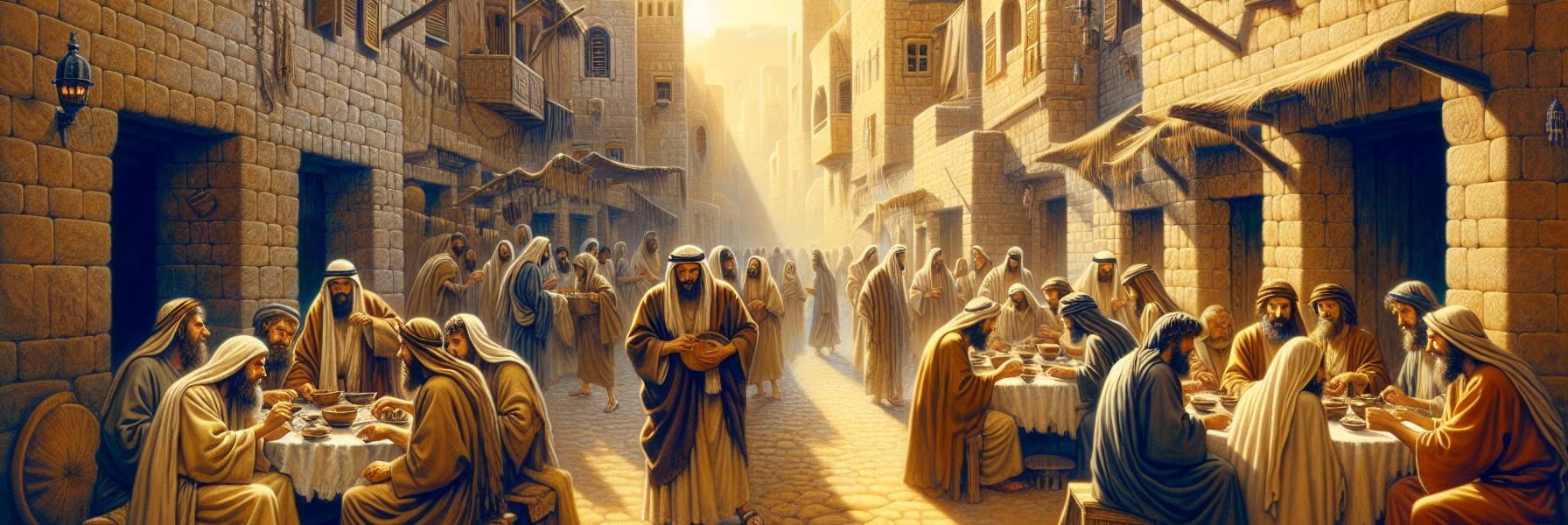

The heat of the day was beginning to soften, that long, dusty gold of a Judean afternoon settling over the streets. From the house of a certain leading Pharisee, whose name is lost to us but not his intention, came the low murmur of men’s voices and the smell of leavened bread and roasted lamb. It was the Sabbath, and he had invited Jesus to eat. It was not, as you might suppose, an act of hospitality. The room was thick with watching.
Jesus went in. His manner was quiet, but his presence, as always, changed the pressure in the air. The lawyers and Pharisees reclined at the table, postures carefully arranged, robes draped just so. And there, in a shadowed corner near the door, was a man. His suffering was a silent third guest. His body was swollen with a sickness that distorted him, a cruel inflation of flesh that made every breath a labour. The dropsy, they called it. He was a prop, placed there as a test. Would the teacher from Galilee break the Sabbath rules for healing?
Jesus turned, not first to the table, but to the learned men. His voice was calm, a stone dropped into their silent, watching pool. “Is it lawful to heal on the Sabbath, or not?”
They held their silence, a cold, stubborn thing. They knew the legal intricacies, the debates from Shammai to Hillel. A life in danger, yes, perhaps. But this? This chronic, ugly suffering? That could wait a day.
He looked at them, one by one, then turned and took the sick man’s hand. His touch was simple, direct. He healed him, and sent him away. The man left, his step new and bewildered, clutching his own normal-sized limbs.
Then Jesus faced them again. “Which of you, having a son or an ox that has fallen into a well on a Sabbath day, will not immediately pull him out?” The question hung, ugly and undeniable. They had no answer. Of course they would. Property had its privileges. A heart for a beast, but not for a man. Their silence this time was shame, hot and prickling.
He saw how they chose the places of honour, the subtle jostling for the best couch, the seat closest to the host. A quiet, weary sadness seemed to settle on him then. He began to speak, not as a lecturer, but as one offering a piece of shrewd, worldly advice that cut to the soul.
“When you are invited by someone to a wedding feast, do not sit down in the place of honour, lest someone more distinguished than you be invited by him, and he who invited you both will come and say to you, ‘Give your place to this person,’ and then you will begin with shame to take the lowest place. But when you are invited, go and sit in the lowest place, so that when your host comes he may say to you, ‘Friend, move up higher.’ Then you will be honoured in the presence of all who sit at table with you.”
It was more than etiquette. It was a picture of the kingdom. A dismantling of the instinct to build your own platform. True elevation, he implied, comes from an unforced humility, from releasing your claim.
Then he looked at the host, the Pharisee whose calculated invitation had begun this tense afternoon. “When you give a dinner or a banquet, do not invite your friends or your brothers or your relatives or rich neighbours, lest they also invite you in return and you be repaid. But when you give a feast, invite the poor, the crippled, the lame, the blind, and you will be blessed, because they cannot repay you. For you will be repaid at the resurrection of the just.”
The words hung in the room, among the half-eaten delicacies. A feast for the unrewarding. Charity without social currency. The economy of heaven, where the only return comes from God himself, in a time unseen.
Someone, perhaps eager to break the uncomfortable silence, blurted out a pious platitude. “Blessed is everyone who will eat bread in the kingdom of God!”
It was the right thing to say. A safe, theological sentiment. Jesus fixed him with a gaze that seemed to see the vast, empty space between the sentiment and the man’s own heart. And he told them a story.
“A man once gave a great banquet and invited many. At the time for the banquet he sent his servant to say to those who had been invited, ‘Come, for everything is now ready.’ But they all alike began to make excuses. The first said, ‘I have bought a field, and I must go out and see it. Please have me excused.’ Another said, ‘I have bought five yoke of oxen, and I go to examine them. Please have me excused.’ Another said, ‘I have married a wife, and therefore I cannot come.’”
The excuses were so reasonable, so daily. Property, business, family. Good things. But they were shields against the invitation. The master’s anger in the story was righteous, a hot wind. “Go out quickly to the streets and lanes of the city, and bring in the poor and crippled and blind and lame.” And when there was still room, the order went further, to the hedges and the highways, to compel people to come in. “For I tell you, none of those men who were invited shall taste my banquet.”
The message was thunderous. The original guests, the entitled, the religiously comfortable, were missing it. The feast of God was happening, and it was filling up with the very people in this room they’d consider unfit.
The crowds were following him now as he walked, great multitudes drawn by the power and the controversy. He turned on them, his words losing none of their severity. This was not a rally. It was a warning.
“If anyone comes to me and does not hate his own father and mother and wife and children and brothers and sisters, yes, and even his own life, he cannot be my disciple.” The word ‘hate’ was a shocking, deliberate wrench. It meant to love less, to relinquish ultimate claim. Family, the very foundation of their world, could not be the final loyalty.
“Whoever does not bear his own cross and come after me cannot be my disciple.” They knew what crosses were for. Rome used them by the roadsides. It was an image of utter, brutal finality. Not a burden to carry, but an instrument of death to carry to your own execution.
He gave them two parables of calculation. A man building a tower who must first count the cost, lest he lay the foundation and run out of resources, becoming a laughingstock. A king going to war, who must consider if his ten thousand can meet the enemy’s twenty. The application was plain, cold, and bracing: “So therefore, any one of you who does not renounce all that he has cannot be my disciple.”
It was not a call to impulsive enthusiasm, but to clear-eyed, costly surrender. Salt was his last image. “Salt is good, but if salt has lost its taste, how shall its saltiness be restored? It is of no use either for the soil or for the manure pile. It is thrown away.”
The afternoon had faded. The shadows were long. He finished speaking, and the silence that followed was different from the one in the Pharisee’s house. This was the silence of a choice laid bare, a feast offered, a cross presented. He walked on, and the crowd parted, some following, some turning back to their fields, their oxen, their lives, weighing the terrifying, glorious cost of it all.