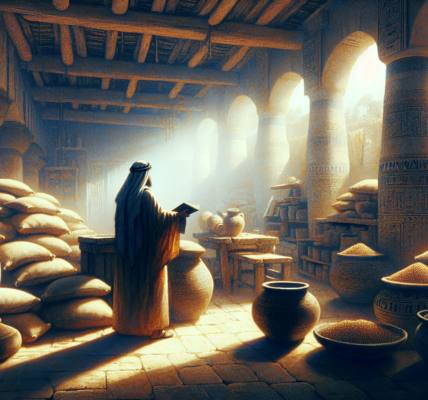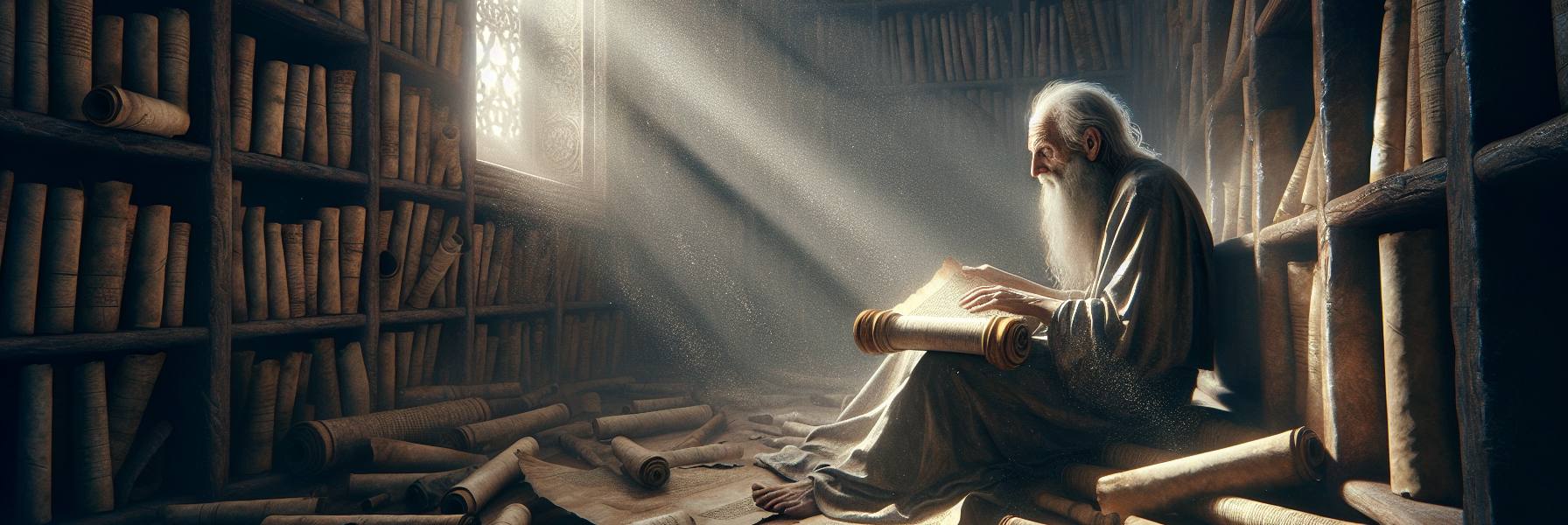

The air in the chamber was still, thick with the scent of aged parchment and the faint, metallic hint of distant rain. Dust motes swam in a single shaft of light falling from the high window, illuminating the scroll spread before Daniel. It was a copy of the words of Jeremiah the prophet, brought from Jerusalem decades ago, its edges softened by countless unrollings. His fingers, now showing the thin skin and prominent veins of his advanced years, traced the familiar lines. He was no longer the young exile, the promising administrator. He was an old man in the service of a foreign empire, and the words on the scroll were a haunting anchor to a world that had been swallowed by fire.
*“When seventy years are completed for Babylon, I will visit you…”*
Seventy years. He calculated the time in his head, not for the first time. The exile had begun with the first deportations, with King Jehoiakim. He had been a boy then. Now, the reign of the new Persian king, Darius, settled over the empire. The years stretched out, a ledger of divine patience and human failure. The seventy were nearly up. Babylon had fallen, just as Isaiah had foretold. Cyrus had issued his decree. And yet… Jerusalem remained a heap of stones. The temple mount was a desolation where jackals cried. The promise hung in the air, unfulfilled, and the silence from heaven felt heavier than any imperial decree.
A profound restlessness took hold of him. It was not the anxiety of court politics, which he knew well, but a deeper, soul-churning disquiet. The prophecy was a word spoken into time, and time, it seemed, was running out. But was the failure in God’s timing, or in his people’s heart? The question coiled in his gut. He pushed the scroll aside and stood, his joints protesting. He walked to the window, looking not at the orderly grandeur of Susa, with its gleaming canals and administrative bustle, but inward, toward the unseen city of his fathers.
He knew what he must do. It was not a matter of negotiating with God, but of aligning himself with the terrifying truth of their situation. He turned from the window, his mind resolved. He would seek the Lord. Not with a list of requests, but with a confession. A great, corporate owning of the catastrophe.
He sent for sackcloth and ashes. The rough fabric, abrasive against his skin, was a relief. The ashes, smeared on his forehead, were a language older than words. He did not make a public spectacle; this was between him and the God of the covenant. He withdrew to his chambers, fell to his knees not on a plush rug but on the bare, cool tiles, and faced toward Jerusalem. The posture itself was a ache, a physical turning toward the source of the wound.
And then he prayed. His voice, at first, was a dry whisper, cracking on the formal address: “O Lord, the great and awesome God, who keeps covenant and steadfast love with those who love him and keep his commandments…” The titles felt immense, threatening in their holiness. He pressed on, the words beginning to flow like a long-contained flood.
“We have sinned and done wrong and acted wickedly and rebelled, turning aside from your commandments and rules.” He did not say “they.” He said “we.” He, Daniel, who had kept himself pure, who had prayed three times a day toward that ruined city, included himself in the national guilt. It was the only honest way. He was of that people, bone of their bone, shame of their shame. He listed their failures: the kings, the princes, the fathers, the people of the land. All had ignored the prophets, those persistent, inconvenient voices sent with mercy to turn them back. Righteousness belonged to God; on them, and on him, was the open shame of rebellion.
He pictured the curses of Moses from Leviticus, marching out of the ancient texts and into brutal, historical reality. The siege, the famine, the scattering. “As it is written in the Law of Moses, all this calamity has come upon us; yet we have not entreated the favor of the Lord our God, turning from our iniquities and gaining insight by your truth.” The clarity was devastating. The prophecy of Jeremiah was not a detached puzzle; it was the direct consequence of a broken covenant. God had watched over his word to perform it—the word of judgment.
His prayer deepened, becoming less a recitation and more a plea from the depths. “O Lord, according to all your righteous acts, let your anger and your wrath turn away from your city Jerusalem… For we do not present our pleas before you because of our righteousness, but because of your great mercy.” He anchored his hope not in their repentance, which was too little and too late, but in God’s own character—in his mercy, and for the sake of his own name, which was mocked among the nations who asked, “Where is their God?”
The words spent themselves. A silence descended, thicker than before, but now it was a shared silence, a space hollowed out by confession. He remained on his knees, physically spent, the grit of ashes on his lips.
He did not know how long he had been there when the presence in the room changed. It was not a sound, but a pressure in the air, a charge that made the hairs on his neck rise. He lifted his head, still bowed low.
A figure stood before him, though he had heard no door open, no footfall. It was a man, yet not a man. His form was like polished bronze, his face like lightning, his eyes like flaming torches. It was Gabriel, the one he had seen by the Ulai Canal years before. A terror, both dreadful and wondrous, seized Daniel. He slumped forward, his face to the ground.
A hand, solid and real, touched him, pulling him up to his trembling knees. The voice that spoke was not loud, but it vibrated in the very marrow of his bones. “Daniel, I have now come out to give you insight and understanding. At the beginning of your pleas for mercy a word went out, and I have come to tell it to you, for you are greatly loved. Therefore consider the word and understand the vision.”
Daniel’s breath caught. *Greatly loved.* The words washed over the ashes, the sackcloth, the decades of exile. They did not erase the confession; they answered it from a place of unimaginable grace.
Then Gabriel began to speak of numbers, weaving a chronology that stretched the imagination far beyond the seventy years that had consumed Daniel’s thoughts. “Seventy weeks are decreed about your people and your holy city…” Weeks of years. A celestial calculus. Four hundred and ninety years. The purpose was staggering: to finish transgression, to put an end to sin, to atone for iniquity, to bring in everlasting righteousness, to seal both vision and prophet, to anoint a most holy place.
The explanation unfolded, a mixture of concrete events and veiled, prophetic mystery. There would be a decree to restore and rebuild Jerusalem. A coming prince. A period of rebuilding in troubled times. Then, an Anointed One, a prince, who would be cut off and have nothing. The people of a coming prince would destroy the city and the sanctuary. War and desolation were decreed until the end. And he, the coming prince, would make a strong covenant with many for one week, and in the middle of that week, he would put an end to sacrifice and offering…
Daniel listened, his mind reeling. The prayer about the past and the immediate future had been met with a revelation that tunneled through centuries. The seventy years for Babylon were a prelude. God was working on a canvas vaster than a single exile or restoration. The promise of an end to sin, of an atonement that would *seal up* vision and prophet—it pointed to a finality, a completion that the daily sacrifices could only ever mimic.
Gabriel finished. “And on the wing of abominations shall come one who makes desolate, until the decreed end is poured out on the desolator.”
As suddenly as he had come, the presence lifted. The room was just a room again—the scroll, the shaft of light, the cool tiles. But everything was different. Daniel slowly got to his feet, his body aching, his spirit weighed down with a majesty and a sorrow he could scarcely contain. He understood, and yet he understood nothing. He knew a timeline had been given, but its fulfillment was shrouded in a holy fog. The exile would end, yes. But a greater deliverance, and a fiercer tribulation, were woven into the fabric of the future.
He walked back to the window. The city of Susa went about its business, oblivious. The promise for Jerusalem stood. But it was no longer a simple promise of stones being stacked upon stones. It was a promise drenched in sacrifice, culminating in an Anointed One who would be cut off. The prayer of confession had been heard, and the answer was both a comfort and a cross-shaped mystery. The silence was now filled with a terrible, glorious purpose. He picked up the scroll of Jeremiah once more, its words now just the first sentence in a story whose final chapters God alone would write.