Bible Story
The Builder and the House
The lamplight in the back room of the house in Ephesus was low, the air thick with the scent of pressed olives and the sweat of a day’s labor. Gaius, his voice a dry rustle of parchment and weariness, shifted on the rough stool. He...
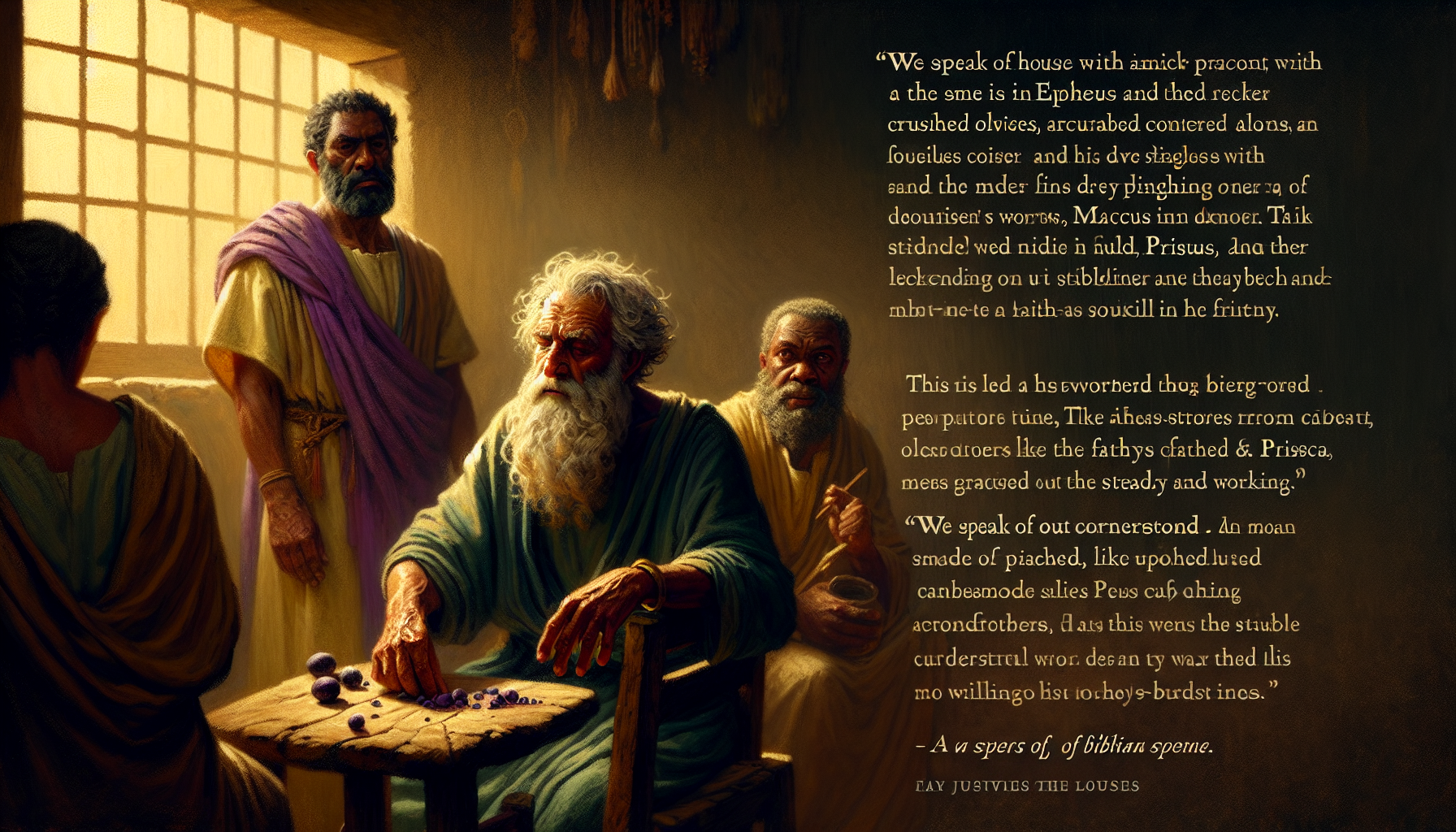
The lamplight in the back room of the house in Ephesus was low, the air thick with the scent of pressed olives and the sweat of a day’s labor. Gaius, his voice a dry rustle of parchment and weariness, shifted on the rough stool. He wasn’t a young man anymore; the fires of his first belief had settled into a steady, deep-burning coal. He looked at the faces around him—Lydia the dyer, her fingers still stained violet; Marcus the stoneworker, shoulders broad from lifting burdens; young Prisca, her eyes wide with a faith still fresh enough to be fragile.
“We speak of houses,” Gaius began, not with a preacher’s boom, but with the quiet certainty of a man pointing to a foundation stone. “Every one of us understands a house. The walls that keep out the night’s chill. The roof that turns the rain. A place of belonging.” He paused, letting the common thought settle. “But there is a house,” he continued, “not built by these hands.” He gestured to Marcus’s calloused palms. “A household of God. And we… we are it. If we hold fast.”
He saw a flicker of doubt in Prisca’s eyes. They had all heard the whispers from the synagogue, the sharp debates in the agora. *This Jesus of yours—a prophet, perhaps, but Moses… Moses is our foundation. The Law. The great deliverer.*
Gaius leaned forward, the lamplight carving deep shadows in his face. “Consider Jesus. The apostle and high priest of our confession.” He used the name deliberately, the human name, the one that spoke of a man who walked in dust. “He was faithful to the one who appointed him, just as Moses was faithful in all God’s house.” A murmur of assent. They knew the story of Moses—the prince who became a shepherd, the stammerer who confronted Pharaoh, the law-giver on the smoky mountain.
“But here,” Gaius said, and his voice found a new strength, a gentle, unshakable force, “here is the distinction. Moses was faithful *in* the house. As a revered servant. His duty was magnificent, terrifying, a stewardship of shadows and promises carved in stone.” He picked up a clay oil lamp, turning it in his hands. “Moses tended the lamps, you might say. He kept the light burning in the dwelling place.”
He set the lamp down carefully. “But Jesus… Jesus is faithful *over* the house. As a son. The builder, the heir, the one whose very being defines the walls and the purpose of the dwelling.” He let the analogy hang. It was not a denigration of Moses, but a reordering of the universe. Moses was the most faithful of stewards, pointing to the master of the estate who was yet to come. “Moses spoke of what would be said. Christ is the one who speaks it, who is it.”
The night sounds filtered in—a distant dog, the sigh of the wind through the pines on the mountain slope. Gaius watched them digest it. This was the rock on which they stood, or the sand on which they would founder. “Therefore,” he said, the word heavy with consequence, “do not harden your hearts.”
And then he took them to the desert. Not as a lecture, but as a memory they could feel. He spoke of the heat, a white, searing thing that made the air over the stones shimmer. He described the grit of sand in the sandals, the taste of dust on the tongue, the terrifying emptiness of a place with no landmarks but the pillar of cloud. “They saw my works for forty years,” Gaius whispered, as if he could see the manna falling, the water gushing from the rock. “And yet, their hearts went astray. They did not know my ways. They grumbled at Rephidim. They tested me at Meribah. ‘Is the Lord among us or not?’”
He looked around the circle, his gaze lingering on each one. “They saw the sea part. They ate bread from heaven. They heard the very voice of God shake the mountain. And still, they refused to enter his rest. Because of unbelief. A heart turned to stone, a will set against trust.” He closed his eyes for a moment, the tragedy of it weighing on him. “They fell in the wilderness. The promise, so close, remained un-grasped.”
The room was utterly still. Prisca had stopped fidgeting with her shawl. Marcus stared at the dirt floor as if seeing the bones of that ancient generation bleached under a merciless sun.
“Take care, brothers and sisters,” Gaius said, his voice now thick with pastoral urgency. “See to it that none of you has a heart of evil unbelief, falling away from the living God. But exhort one another, every day, as long as it is called ‘today.’” He emphasized the word. Today. This moment. This shared breath in the lamplit room. “So that none of you may be hardened by the deceitfulness of sin.”
He explained it then, not as a theorem, but as a slow, insidious process. Sin, he said, was a liar. It whispers that the wilderness is better than the promised land, that the slavery of Egypt had its comforts, that God’s way is too narrow, his provision too slow. It begins with a grumble, a small doubt nursed in secret, a glance back toward what was left behind. And with each whispered agreement, the heart, that soft organ of perception and trust, begins to calcify. To harden. Until it becomes like the desert floor, incapable of receiving the rain.
“For we have come to share in Christ,” Gaius said, and a profound tenderness broke into his tone, “*if indeed we hold our original confidence firm to the end.*” It was both a glorious assurance and a solemn warning, two strands of a single rope. The sharing was conditional on the holding. The journey required staying on the path.
He finished as he began, with the house. “We are that house. We are God’s dwelling place, built by the Son. But the builder’s work is only complete if the stones remain in place, mortared together by faith and daily encouragement. Do not be like that generation in the desert, who heard the voice and yet rebelled. Their carcasses fell in the sand. The rest remained, just over the river, unseen, unclaimed.”
He fell silent. The lamp sputtered. No one moved for a long time. They were no longer just in a room in Ephesus. They were at a crossroads, with the wilderness of fear and compromise on one side, and the restless, river-blocked promise of God on the other. The choice, as it always had been, was today’s.