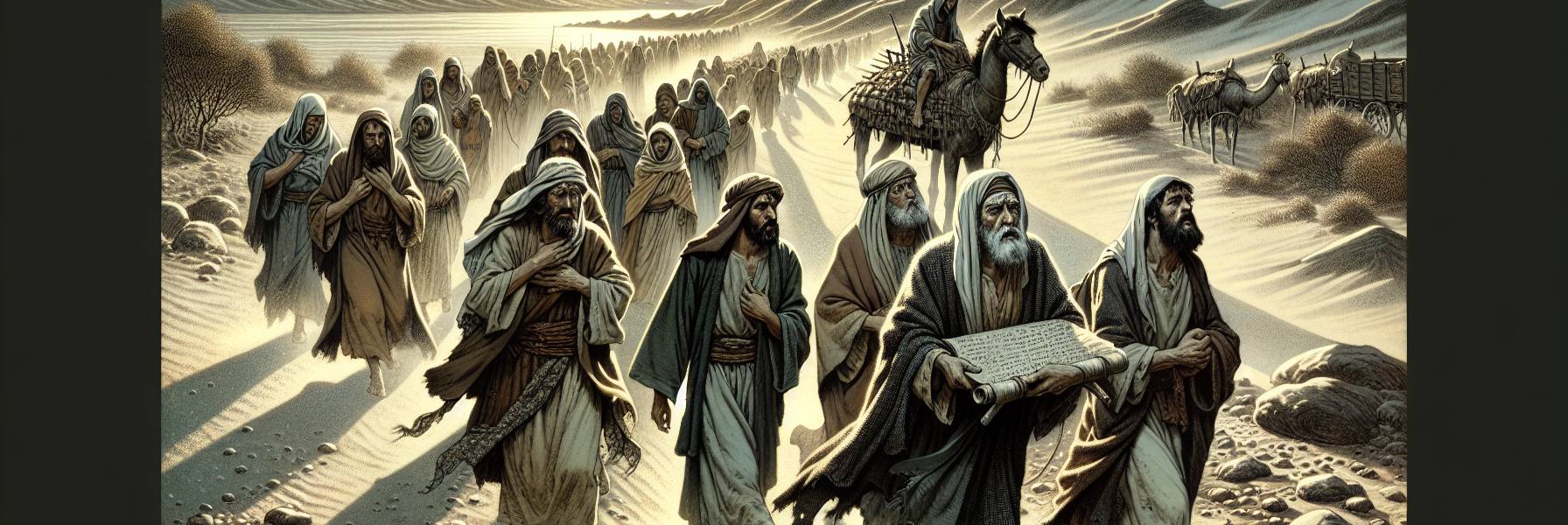

The road to Bethany was dust and desperation. It was a two-day journey from where they’d been, across the Jordan, and with every sluggish step, Thomas felt the knot in his stomach tighten. Jesus walked ahead, his pace infuriatingly deliberate. The message had found them four days ago, scratched onto a wax tablet by a wide-eyed boy from Martha: *Lord, the one you love is ill.*
They all knew who it meant. Lazarus. His laughter was a thing you felt in your chest. His home in Bethany was one of the few places that felt like respite, where Martha fussed with genuine affection and Mary would sit, listening, her quietness a cool stone in the heat of their constant movement. And now he was dying.
But Jesus had… stayed. He’d finished whatever he was saying, looked at the pale-faced messenger, and simply said, “This illness does not lead to death. It is for the glory of God.” And then he had remained where he was for two more days. Two days! The disciples exchanged confused, anxious glances. They’d seen him heal strangers. Why would he let his friend suffer?
Finally, on the morning of the third day, he’d stirred. “Let us go to Judea again.”
A collective dread had fallen over them. “Rabbi,” Philip had said, his voice thin, “the Jews there were just trying to stone you. And you want to go back?”
Jesus had looked at them, a tiredness in his eyes that went beyond physical fatigue. “Are there not twelve hours in the day? If anyone walks in the day, he does not stumble, because he sees the light of this world.” He paused, letting the metaphor hang. Then, more plainly, “Our friend Lazarus has fallen asleep, but I go to awaken him.”
Relief, clumsy and premature, washed through them. Sleep was good. Sleep meant recovery. “Lord, if he has fallen asleep, he will recover,” Peter said, a hopeful grin breaking.
Jesus stopped walking and turned to face them fully. The dust of the path settled around their feet. “Lazarus has died,” he said, the words flat and final. “And for your sake I am glad that I was not there, so that you may believe. But let us go to him.”
Thomas, grim, met the eyes of the others. He saw the same hollow understanding. It wasn’t sleep. It was a tomb. He shrugged, a gesture of utter resignation. “Let us also go,” he muttered, “that we may die with him.” It wasn’t loyalty speaking, but a bleak, prophetic certainty. Going back to Judea now felt like a death march.
***
They smelled Bethany before they saw it—the smoke of cooking fires, the scent of fig and olive, and beneath it, the faint, sour tang of mourning. The house was not hard to find; the crowd of neighbors clustered outside was a dark blot on the sunlit street. The sound of professional wailing, a high, ululating keen, cut through the murmur of conversation.
Martha heard of Jesus’ approach. She came out, pushing through the crowd, her face raw and swollen, her hair coming loose from its wrap. She didn’t run, but walked with a stiff, purposeful gait. When she reached him, she stopped, and her first words were an accusation soaked in grief. “Lord, if you had been here, my brother would not have died.”
There was no greeting, no title of respect. Just the blunt, painful truth of absence. Jesus looked at her, and his own face seemed to tighten with a shared pain. “Your brother will rise again.”
Martha, ever practical, even in despair, nodded. “I know that he will rise again in the resurrection on the last day.” It was the orthodox comfort, the doctrine learned at her mother’s knee. It was a hope for a distant horizon, not for the raw, gaping hole in her present.
Jesus took a step closer. The noise of the mourners seemed to fade. “I am the resurrection and the life,” he said, his voice low but carrying. “Whoever believes in me, though he die, yet shall he live, and everyone who lives and believes in me shall never die. Do you believe this?”
It wasn’t a theological proposition. It was a demand placed on her shattered heart. Martha looked into his eyes, and for a moment, the practical, managing part of her was utterly stilled. What she saw there wasn’t pity, but a kind of fierce, alive certainty. “Yes, Lord,” she whispered, the words scraped from the depths of her. “I believe that you are the Christ, the Son of God, who is coming into the world.” Having said it, she turned abruptly and went back into the house. They saw her lean close to her sister, Mary, and speak.
Mary stood up. Her movements were slower, weighted. The mourners, seeing her rise, assumed she was going to the tomb to weep and followed her, their wails rising again in a discordant chorus. She came to the place where Jesus still stood and fell at his feet, the dust coating her robes. Her words were the same as her sister’s, but where Martha’s had been a challenge, Mary’s were a desolate sigh. “Lord, if you had been here, my brother would not have died.”
She didn’t look up. Her shoulders shook with silent sobs. Jesus looked at her, then at the theatrical tears of the professional mourners, and a profound, visible disturbance came over him. The text says he was “deeply moved in his spirit and greatly troubled.” It was more than sadness; it was a kind of holy anger, a rage against the unnatural thief that was death, against the performative grief that surrounded real loss. “Where have you laid him?” he asked, his voice thick.
“Come and see, Lord,” they said.
And then, John records the shortest verse in Scripture, a moment of pure, unadorned humanity: “Jesus wept.”
The Jews saw it. Some were touched. “See how he loved him!” others whispered. But a few, their whispers edged with something harder, said, “Could not he who opened the eyes of the blind man also have kept this man from dying?”
They reached the tomb. It was a cave, cut into the limestone hillside, a common family sepulcher. A heavy stone, disc-shaped and fitted into a groove, lay against the entrance. The smell here was different—damp rock, dust, and something else, faint and sweetly foul. Four days in a Palestinian tomb.
“Take away the stone,” Jesus said.
Martha, the practical one, was instantly horrified. The grief was one thing; this was a violation of decency. “Lord, by this time there will be an odor, for he has been dead four days.”
Jesus looked at her. “Did I not tell you that if you believed you would see the glory of God?”
There was a long, tense pause. Then Martha gave a tiny, almost imperceptible nod. Some of the stronger men from the village, their faces set, stepped forward. They braced their shoulders against the heavy disc. With a grating rumble that echoed off the hillside, the stone rolled back along its groove. A darkness gaped. The crowd fell utterly silent. The wailing had stopped. All that could be heard was the dry rustle of olive leaves in the breeze.
Jesus lifted his eyes. He did not shout. He spoke, a prayer of such stark intimacy it was less a petition than a statement of fact. “Father, I thank you that you have heard me. I knew that you always hear me, but I said this on account of the people standing around, that they may believe that you sent me.”
Then, turning to the black mouth of the cave, he raised his voice. It was not a scream, but a command that seemed to vibrate in the very air. “Lazarus, come out.”
A beat of silence. Nothing. Thomas felt his heart hammer against his ribs. He saw the doubt on the faces of the mourners begin to harden into scorn.
And then, a sound. A shuffling, a slow, dragging scrape of cloth on stone from the depths of the darkness. A shape emerged, stumbling into the blinding daylight. It was Lazarus, but it was Lazarus bound in the grave clothes, the long linen strips wound tightly around him, arms pinned to his sides, his face wrapped in a separate cloth. He stood there, swaying slightly, a mummified figure steeped in the smell of myrrh and aloes and decay.
Jesus turned to the stunned, frozen crowd. His voice was quiet now, almost matter-of-fact. “Unbind him, and let him go.”
For a second, no one moved. Then Mary and Martha rushed forward, their fingers fumbling with the knots, the strips of linen falling away. The cloth came off his face. It was pale, waxy, but alive. His eyes blinked, squinting against the sun. He drew in a deep, shuddering breath—the first, it seemed, in four days. He did not speak. He simply looked at Jesus, and a confusion of profound wonder and terror passed between them.
The reaction in the crowd split like a cracked stone. Many believed, falling to their knees in the dust. Others backed away, their faces masks of fear, and hurried toward Jerusalem, to tell the Pharisees what they had seen. The miracle was not a neat resolution. It was a seismic event that created both faith and fury, that brought a man back from corruption and set in motion the machinery that would lead to the cross. Lazarus was alive, walking, breathing. But he walked now in a world forever altered, trailing behind him the cold, silent scent of the tomb.