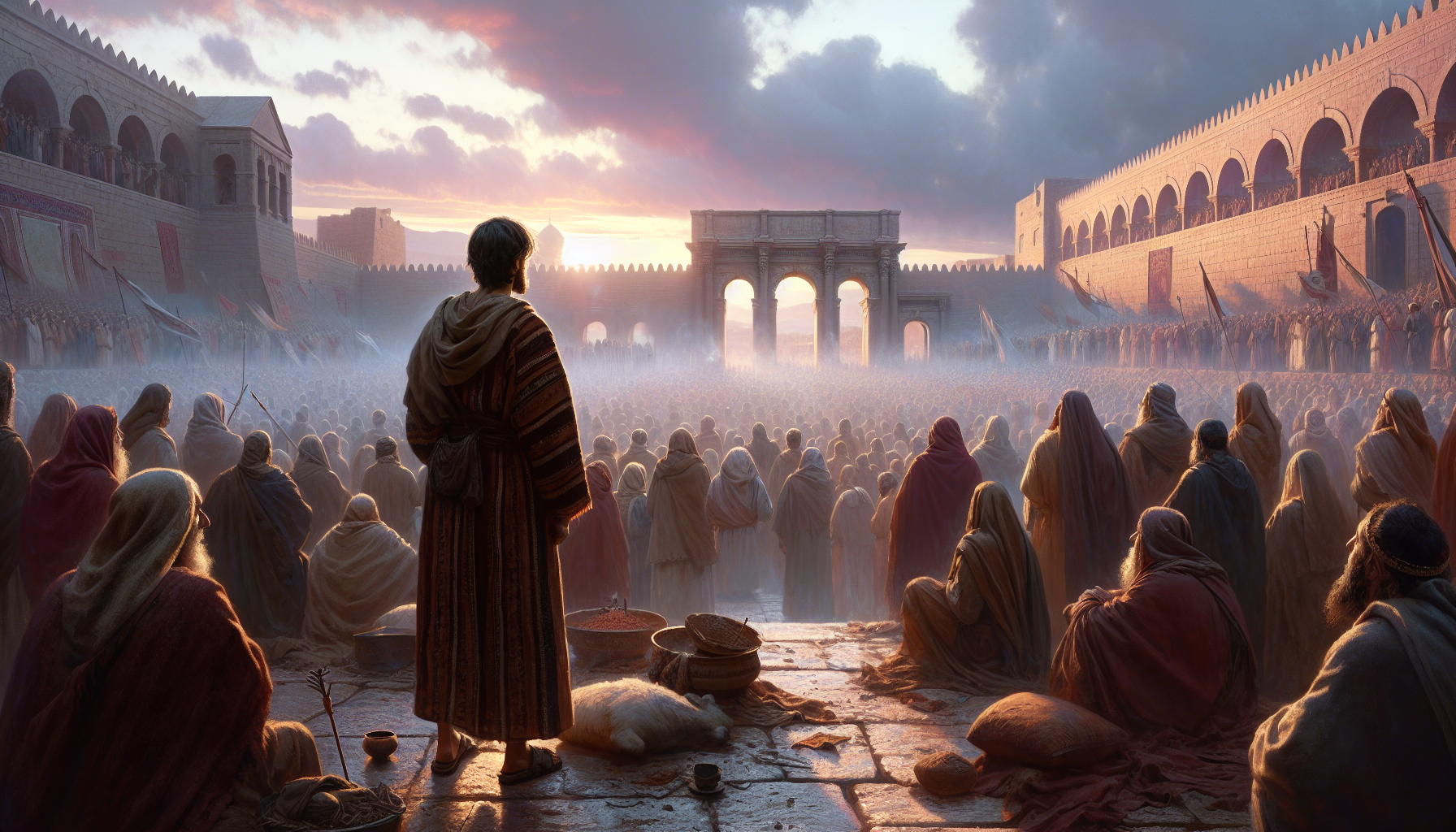
The eastern gate of the inner court stood shut on six working days. The Lord’s instruction through Ezekiel was precise: only on the sabbath and on the day of the new moon would that gate be opened. This was not a ceremonial convenience. It was a boundary that marked time itself, separating ordinary labor from the holy rhythm of worship.
The prince entered by the porch of the gate from outside. He did not stride into the inner court. He stood by the post of the gate while the priests prepared his burnt offering and his peace offerings. He worshipped at the threshold—not inside, not as a priest, but as a man who could approach only so far. Then he went out again, and the gate remained open until evening.
The people of the land worshipped at the door of that same gate before the Lord on sabbaths and new moons. They did not enter the inner court. Their place was at the entrance, visible to the prince and to the priests, but separated by the same gate that defined the prince’s own limit. The architecture of worship kept everyone in their proper station.
On the sabbath, the prince’s offering was six lambs without blemish and a ram without blemish. The meal offering was an ephah for the ram, and for the lambs as he was able to give, with a hin of oil to an ephah. On the day of the new moon, the offering was a young bullock without blemish, six lambs, and a ram, all without blemish, with meal offerings scaled to each animal. The prince’s ability to give was acknowledged, but the standard of without blemish was not relaxed.
When the prince entered, he went in by the porch of the gate and went out the same way. But when the people came before the Lord at the appointed feasts, they entered by the north gate and went out by the south gate, or entered by the south and went out by the north. No one turned back the way they came. The movement was forward, through the court, and out the opposite side. The prince went in and out in the midst of them, not ahead or behind, but together with the people.
If the prince prepared a freewill offering—a burnt offering or peace offerings as a freewill offering to the Lord—the eastern gate was opened for him. He prepared his offering as on the sabbath, then went out, and after his going out the gate was shut. The gate opened only for him, and only for his voluntary worship. It was not a privilege he could demand; it was a provision for his devotion.
Every morning, a lamb a year old without blemish was prepared for a burnt offering. With it came a meal offering of a sixth part of an ephah and a third part of a hin of oil to moisten the fine flour. This was a perpetual ordinance, morning by morning, a continual burnt offering that did not depend on the prince’s presence or the people’s gathering. The daily sacrifice held the temple in a steady rhythm of atonement.
The Lord also gave instruction about the prince’s inheritance. If he gave a gift to his sons, it became their inheritance permanently. If he gave a gift to a servant, it remained with the servant only until the year of liberty, then returned to the prince. The prince could not take from the people’s inheritance to thrust them out of their possession. He was to give inheritance to his sons out of his own possession, so that the people would not be scattered from their land. The prince’s generosity was bounded by justice; his sons came first, and the people’s holdings were protected.
Ezekiel was then brought through the entry at the side of the gate into the holy chambers for the priests, which looked toward the north. There was a place on the hinder part westward. The Lord said, “This is the place where the priests shall boil the trespass offering and the sin offering, and where they shall bake the meal offering, that they bring them not forth into the outer court, to sanctify the people.” The holy food was to be kept separate, consumed in the holy chambers, not carried out where the people might be sanctified unintentionally by contact with it.
Then Ezekiel was brought into the outer court and caused to pass by the four corners of the court. In every corner there was a court, enclosed, forty cubits long and thirty broad, all of one measure. Around each court was a wall, and under the walls round about were boiling places. The Lord said, “These are the boiling houses, where the ministers of the house shall boil the sacrifice of the people.” The entire temple complex was arranged so that worship, sacrifice, and the preparation of holy food happened in designated spaces, each with its own boundary, each with its own purpose. Nothing was left to improvisation.