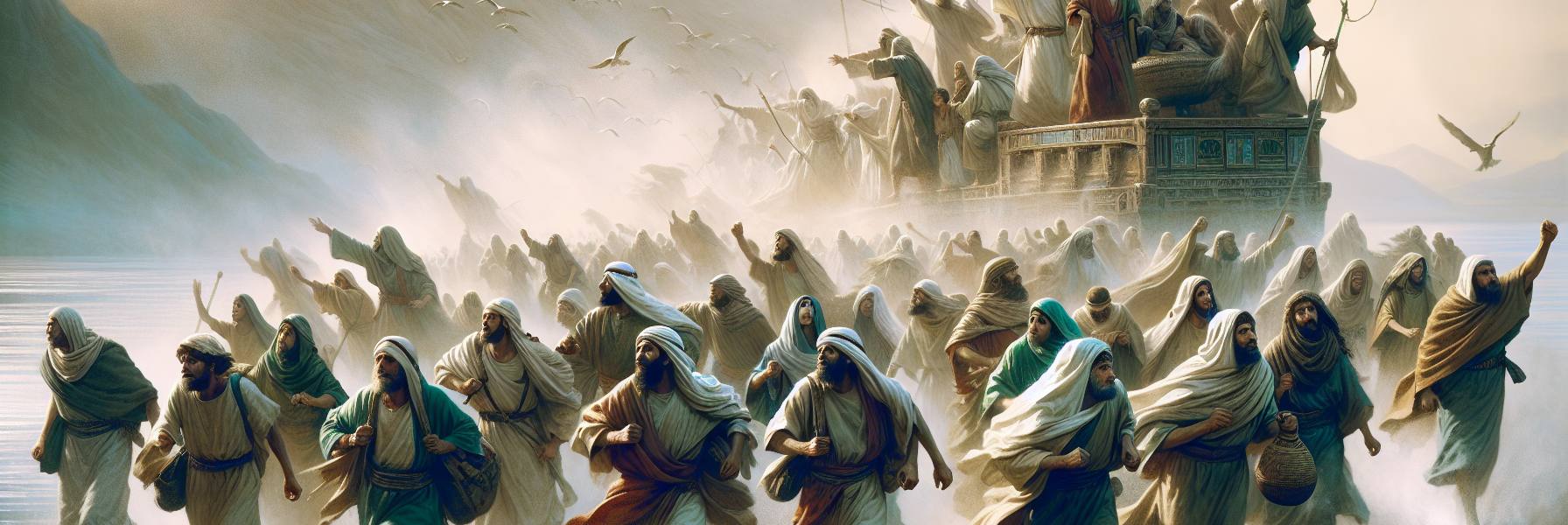

We never spoke of it afterward. Not in the forty years that followed, not around the fires at night, not even in whispers when our children asked. Some memories are too heavy for words; they live in the shudder of a shoulder, in the way an old man might pause and stare at a running stream, his eyes far away.
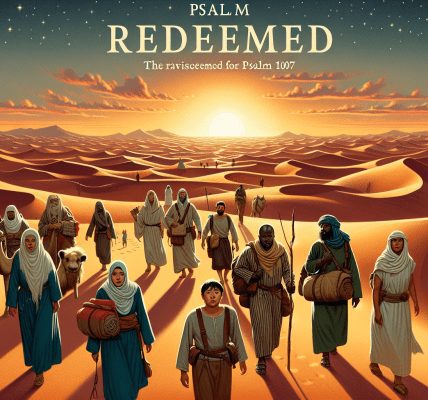
But I remember the leaving. Not the plagues—those were horrors, yes, signs and wonders that broke the world we knew. I mean the actual leaving, the first few days when the dust of Egypt still clung to our sandals and the taste of unleavened bread was sharp in our mouths. We were a chaos of noise and livestock and fear, a wound of a people slowly being pulled from the flesh of Egypt.
Then we came to the sea.
And the sea… saw. That’s the only word for it. It wasn’t a wind, not at first. It was a presence. The great green-grey mass of it, which had been churning with its own deep, salt-thick life, grew still. Not calm, but watchful. The roar of the surf died to a hiss, then to silence. The gulls fell mute in the air. My cousin’s toddler, who had been wailing for hours, suddenly sucked in a breath and was quiet, his wide eyes fixed on the water.
Then it parted. Not with a crash, but with a terrible, gentle sigh, as if the depths were drawing back a curtain. Walls of water stood, glistening, trembling, held up by nothing but a will that was not ours. We walked through on mud that was strangely dry, ridged and ancient, smelling of secrets and old shells. We walked in a silence so profound I could hear the heartbeat of the man next to me. And the water watched us pass. I felt its gaze on the back of my neck, a pressure like the weight of a mountain made liquid.
We thought that was the miracle. We were fools.
Days later, footsore and quarrelsome, we came to the river Jordan. A brown, sluggish thing it was, clogged with reeds, nothing like the mighty Nile of our bondage. Our leaders went ahead, carrying that sacred chest they were always so careful with. And as the feet of the priests touched the water’s edge, the river… stopped.
It didn’t part like the sea. It simply ceased to be a river. Upstream, the water piled upon itself in a clear, glassy heap, as if it had hit an invisible wall. Downstream, it drained away towards the Salt Sea, leaving a wide, stony bed gaping like a dry throat. The Jordan was afraid. It fled from the presence of the God who carried us. I saw a fish flop in the sudden mud, absurd and desperate, and I understood its confusion. The order of the world was coming undone.
But the mountains. The mountains were the worst.
We made camp in the wilderness of Sinai, a place of terrible beauty, all jagged rock and aching sky. And there, in the fireless dark of the third night, the trembling began. Not an earthquake—not something that came from below. This came from above. The great black shoulders of the peaks against the stars began to quiver. Horeb, the massive, ancient king of that place, seemed to shiver like a frightened lamb. Pebbles clattered down its flanks. The very air vibrated with a deep, sub-audible hum, a sound felt in the teeth and the hollow of the chest.
It was not destruction. It was recognition. The oldest things in creation, the un-moving movers, the foundations of the world, were shuddering in the presence of their Maker. The God of Jacob was not just leading us; He was walking before us, and the earth itself could not bear the weight of His passing. The mountains skipped. Not a dance of joy, but the frantic, involuntary jerk of a startled beast. Rams’ horns, they call them, those peaks. That night, they were rams caught in a thicket of their own awe.
Why? That was the question that burned in me afterward, hotter than the sun on desert stone. Why should the sea flee? Why should the Jordan turn back? Why should the granite bones of the world twist like warm wax?
And the answer, when it came to me years later as I watched my own sheep drink from a still pool, was terrible in its simplicity.
It was because He was coming home.
The waters saw their Master, who walked on the face of the deep before time was. The river saw its Owner, from whom all life springs. The mountains saw the Architect, who laid their foundations. They were not obeying a command. They were reacting to the essence of His presence, as iron filings leap to a magnet. They were contorting in the unbearable nearness of the source of their being.
We, His people, merely walked through it. We were the reason for the procession, the fledgling nation in the wake of a returning King. The whole earth recoiled and rippled in a wave before Him, a cosmic bowing of the head.
We never spoke of it. But sometimes, when the rain falls hard and long, I think of the wall of water standing. When I see a stream change its course after a storm, I remember the Jordan’s flight. And when the wind moans through the high places, I hear the echo of ancient stone, shuddering. It reminds me that we follow a God who makes the world itself gasp, and that we, dust that we are, are called His people.