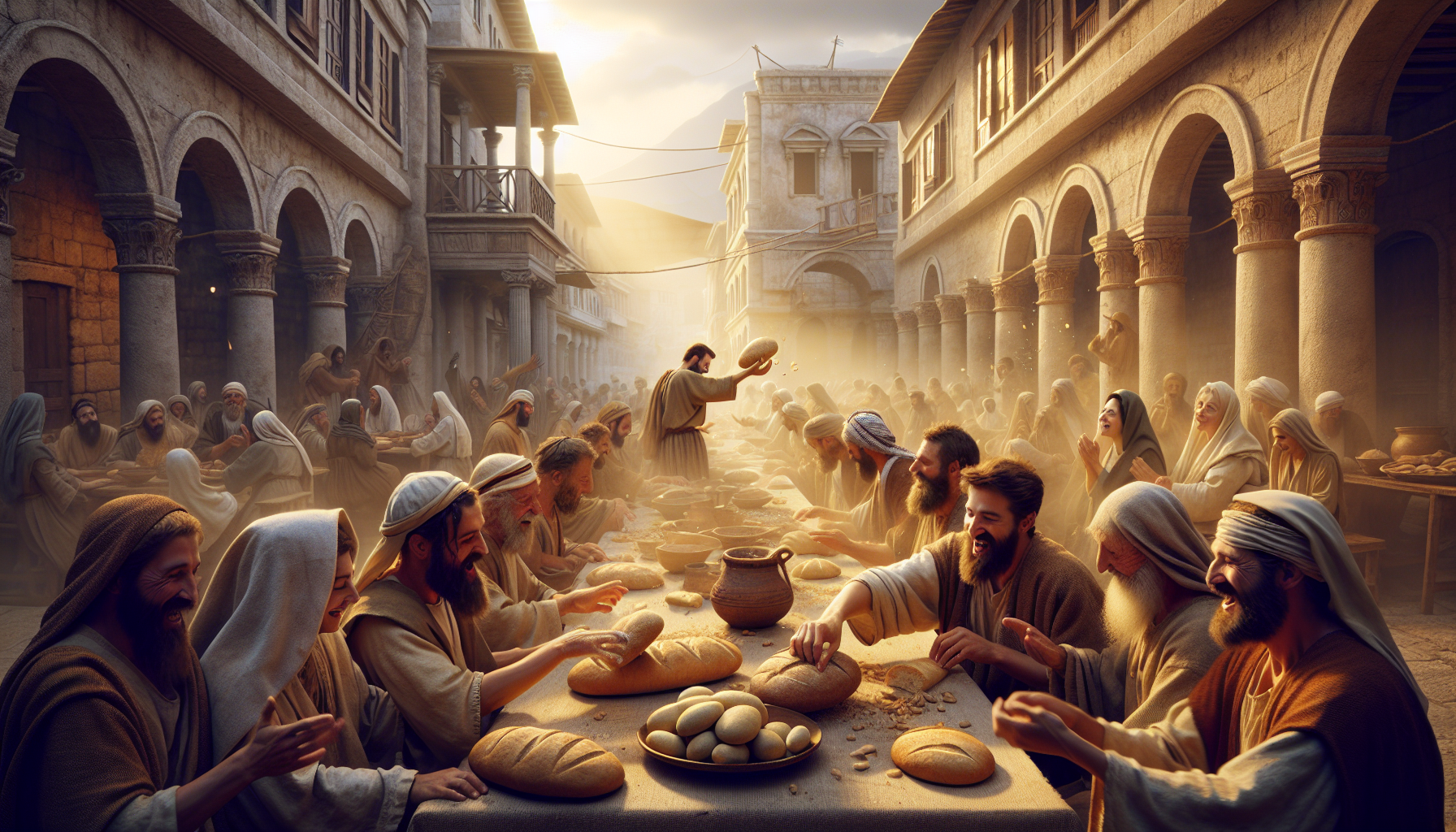
When Cephas came to Antioch, the table was already set. Jews and Gentiles were eating together, and Peter himself had been sitting with them, tearing bread with men whose hands had never touched the law the way his had. It was not a small thing. It was the gospel made visible—the wall broken, the old boundary erased. But then certain men arrived from James, and Peter pulled back.
The word Paul uses is stark: he separated himself. Not a gentle drift, but a deliberate withdrawal. He stopped eating with the Gentiles. He drew a line in the dust with his own feet. And the rest of the Jewish believers followed him. Even Barnabas, Paul's own companion, the man who had vouched for him in Jerusalem, was carried away by the current.
Paul saw it for what it was: hypocrisy. Not ignorance, not confusion, but a calculated retreat from the truth of the gospel. Peter knew better. He had already lived as a Gentile at that table—eating what they ate, sharing the same cup. Now he was acting as if those meals had never happened, as if the grace that had brought them together was something to hide when the Jerusalem crowd showed up.
So Paul confronted him. Not in a letter, not through a messenger, but face to face, before everyone. He did not wait for a private moment. He spoke where the hypocrisy was visible, because the damage was public. Peter's withdrawal was not a private scruple; it was a signal that sent the whole church stumbling.
Paul's question cut to the bone: If you, a Jew, live like a Gentile when it suits you—when no one from Jerusalem is watching—how can you now compel Gentiles to live like Jews? The contradiction was not theological abstraction. It was a man who had tasted freedom and then slammed the door behind him.
Paul had not come to Antioch to build a new set of walls. He had come with the gospel that said a man is not justified by the works of the law, but through faith in Jesus Christ. He and Peter and the rest of them—Jews by birth, not sinners from the Gentile world—had all believed that. They had staked their lives on it. And now Peter was acting as if that faith meant nothing, as if the old boundary markers still mattered more than the table they had shared.
The issue was not food. It was the truth of the gospel itself. If righteousness could come through the law, Paul said, then Christ died for nothing. That was the stakes. Peter's retreat was not a tactical error; it was a theological collapse. By separating himself, he was rebuilding what the cross had destroyed.
Paul did not let him do it quietly. He called it what it was: dissimulation. Play-acting. A performance of piety that denied the reality of grace. And he did it not to humiliate Peter, but to hold the gospel in place. The right hands of fellowship that James, Cephas, and John had given Paul in Jerusalem—the agreement that Paul would go to the Gentiles and they to the circumcision—that handshake was now being undone by Peter's own fear.
Paul's own life was not a negotiation. He had been crucified with Christ. He no longer lived; Christ lived in him. The life he now lived in the flesh, he lived by faith in the Son of God who loved him and gave himself for him. That was not rhetoric. That was the only ground on which he could stand, and the only ground on which the church in Antioch could stand.
The table in Antioch was not a symbol. It was the place where the gospel either held or broke. And when Peter withdrew, Paul did not let the fracture go unnoticed. He spoke, and the words still carry the weight of that confrontation: the truth of the gospel does not bend to the fear of men.