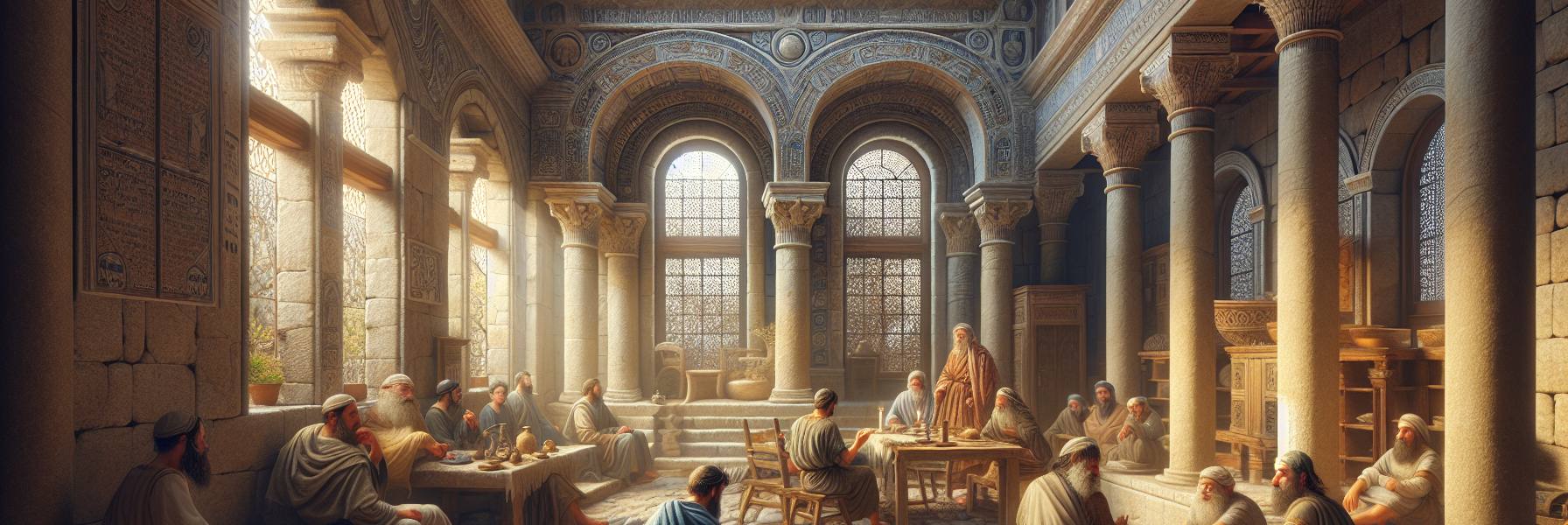

The air in Prisca’s house was thick with the smell of baking bread and old stone. It was a familiar scent to Marcus, one that usually brought him comfort. But today, it felt heavy, oppressive. He sat in the corner of the main room, his back to the wall, his gaze fixed on the uneven floor tiles. The murmur of voices was a constant hum, a river of Aramaic and Greek and Latin that he felt he was drowning in.
He was a Gentile, a Greek from Corinth, and though he’d been meeting with this peculiar Jewish sect for months, he still felt like a visitor in a foreign land. His faith was real, a burning coal in his chest, but the customs, the arguments over food, the endless references to a law he’d never known—it all felt like a wall he could never scale.
Across the room, an older Jewish man named Jacob was speaking, his voice rising with passion. He was talking about the feasts, the purity required. Marcus saw a few of the other Gentile believers shift uncomfortably. A woman named Lydia, a seller of purple cloth from Thyatira, caught Marcus’s eye and gave a small, weary shrug.
Later, as the meeting broke up and people began to share a simple meal, the tension became tangible. Jacob and a few others had brought their own food, carefully wrapped, adhering to the strict dietary laws. The rest, including Marcus and Lydia, partook of the common bread and fish Prisca had provided.
Jacob’s friend, a young, zealous man named Eleazar, looked at the piece of bread in Marcus’s hand with barely concealed disdain. “How can you be sure that wasn’t offered to an idol before it came to this table?” he asked, his tone not quite hostile, but sharp enough to draw blood.
Marcus felt his face grow hot. “I trust Prisca and Aquila,” he said, his voice tighter than he intended. “Must every meal be a trial?”
“It is a matter of conscience,” Eleazar retorted. “Of strength. The weak in faith eat only vegetables, as the Scripture implies, to avoid any defilement. We who are strong must bear with their failings.”
The phrase “the weak” hung in the air like a blow. Marcus felt the label sear into him. Was that all he was? Weak? His faith felt like the strongest thing about him, yet here he was, being judged for a piece of bread.
He left quickly, the taste of the meal ash in his mouth. For days, he avoided the gatherings. He prayed alone in his small rented room, the confusion a knot in his stomach. He believed in Christ, in the Messiah who had torn down the dividing wall. So why did it feel so high, so insurmountable here, among his own brothers and sisters?
It was Aquila who found him a week later, sitting by the Tiber, watching the muddy water churn. The big tentmaker sat down beside him without a word, the scent of leather and sun on his clothes. For a long time, they just sat in silence.
Finally, Aquila spoke, his voice a low rumble. “You’ve been missed, Marcus.”
Marcus scoffed, kicking a pebble into the river. “I doubt Jacob and Eleazar have noticed.”
Aquila sighed, a heavy, weary sound. “They are good men. Their faith is a fire, but sometimes it burns those who stand too close.” He paused, picking up a flat stone and skimming it across the water. “Paul, our brother, wrote to us. A letter arrived yesterday. He speaks of this very thing.”
Marcus looked at him, his interest piqued despite himself.
“He does not tell the ‘strong’ to lord it over the ‘weak’,” Aquila said, his eyes on the river. “He turns it all upside down. He says we who are strong have an obligation—not to please ourselves, but to bear the failings of the weak. Each of us should please our neighbor for his good, to build him up.”
The words landed on Marcus not as a reprimand, but as a revelation. It wasn’t about who was right about the food. It was about something else entirely.
“For even Christ did not please himself,” Aquila continued, his voice gaining a reverent softness. “Think of it, Marcus. The Scriptures say, ‘The insults of those who insult you have fallen on me.’ He absorbed it all. He took on the weight of our divisions, our pride, our petty judgments, and he carried it to the cross. He became a servant, to both the circumcised and the uncircumcised, to confirm the promises made to the patriarchs, so that we Gentiles might glorify God for his mercy.”
Aquila turned to face him, his eyes earnest. “This isn’t a competition, Marcus. It’s a symphony. Paul writes that we are to welcome one another, just as Christ welcomed us. So that with one mind and one voice we may glorify the God and Father of our Lord Jesus Christ.”
The knot in Marcus’s stomach began to loosen. It wasn’t about his strength or his weakness. It was about Christ’s strength, made perfect in their shared weakness. It was about a welcome so profound it could encompass a Greek from Corinth and a zealot from Jerusalem.
The following gathering, Marcus went back. He saw Jacob and Eleazar, and instead of the usual defensive pride, he felt a strange, new compassion. These were men trying to be faithful to the God they had known their whole lives. When the meal was served, he saw Eleazar hesitate before the common plate. This time, Marcus didn’t feel judged. He saw a brother, struggling.
Later, as Paul’s letter was read aloud, the words filled the room with a tangible power. The apostle spoke of a hope, a God of endurance and encouragement, a oneness that came not from uniformity, but from a shared focus on the Messiah who had welcomed them all.
When the reading was done, Marcus found himself standing next to Jacob. The older man was quiet, his eyes thoughtful.
“That was a powerful word,” Marcus offered, his voice gentle.
Jacob nodded slowly. “It is… a challenging word.” He looked at Marcus, and for the first time, Marcus saw not judgment in his eyes, but a flicker of shared burden. “To bear with one another. It is harder than keeping any law.”
“It is,” Marcus agreed. “But he bore us first.”
A slow smile touched Jacob’s lips, a rare and beautiful thing. “Yes. He did.”
There was no grand reconciliation, no single moment that solved everything. But a space had been cleared in that room, a space of grace. Marcus knew there would still be disagreements, still be days of friction. But the foundation had shifted. They were no longer weak and strong, Jew and Gentile, in opposition. They were, as Paul wrote, living in harmony, so that together, with one voice, they might tell a story older than the law and wider than the temple—the story of a Messiah who came as a servant to the world, so that the world might finally come home.